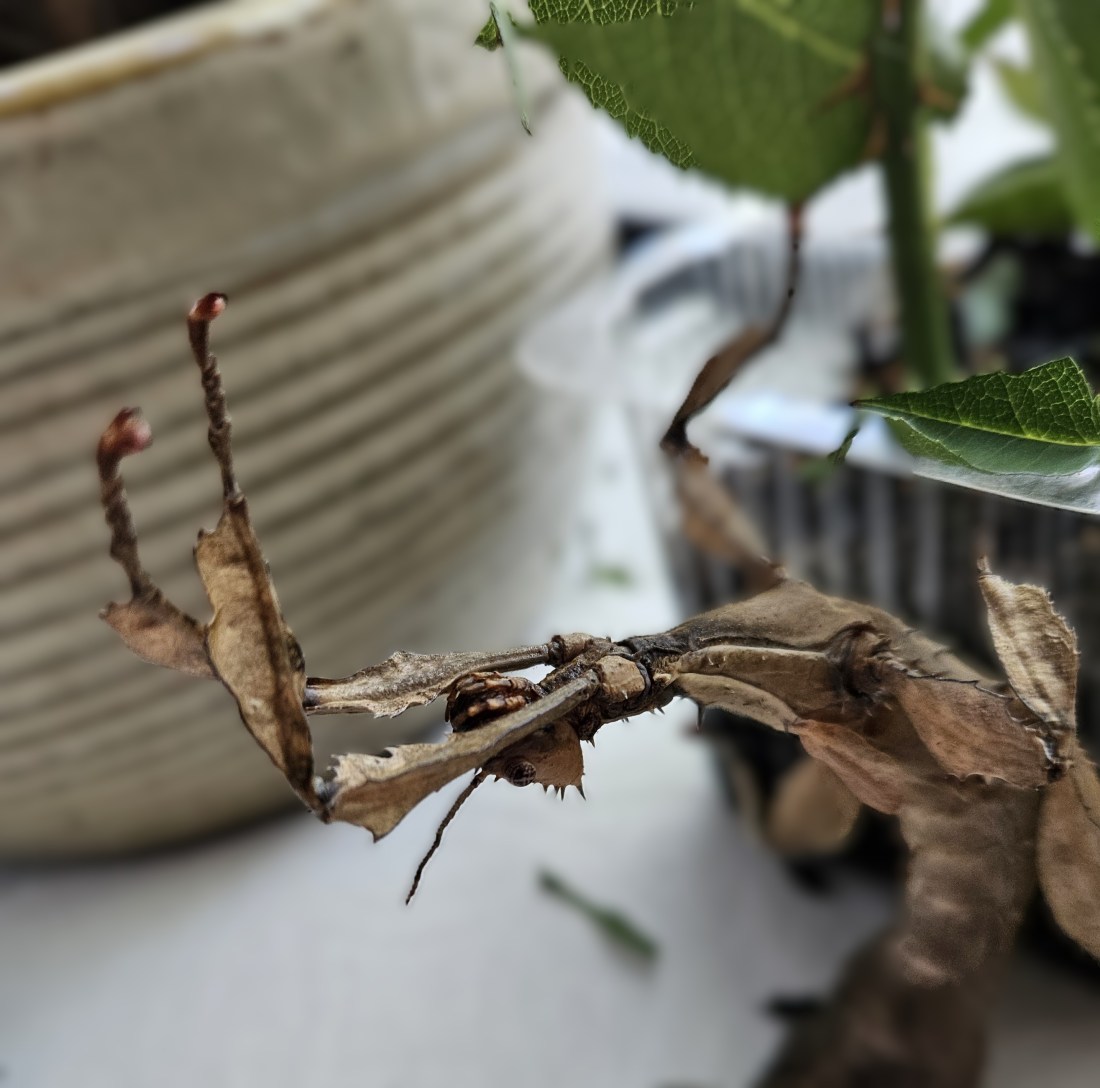
Usually, Sticky Willie, my dear Giant Australian Prickly Stick insect, recoils from my presence, especially if I open her door. She curls, rolls her tail over her back like a scorpion, and rocks frantically, trying to make it known – spikes here – be afraid.
What a poser.
One day, August 6, 2025, to be exact, magic happened: I opened her door. She looked up. Slowly, carefully, one leg at a time, she began creeping toward me. It was as if she were asking, “Who are you?”
Every few steps, she would stop and reach up with one arm as if to explore what was in front of her.
The third time she did this, she was close. Her little face seemed focused on mine. She reached out.
Gently, I touched her tiny claw with the tip of my forefinger.
She patted me.
I stayed there for her, letting her little claw explore my touch.
A sweet moment passed between us, a single moment of joy, shared by two beings of Earth, one homo sapien and one extatosoma tiaratum.
My heart dances each time I return to that exquisite, wondrous moment.
I can’t help but think how joyful this world would be if we as humans were patient with every living thing, waiting for their energy to come to us rather than us bullying our way into their lives’ plan. What would happen if all of us stopped to learn what trees have to say, what birds are really singing about, what the lady bugs at our feet are doing?
Sticky Willie has her agenda. Her agenda does not alter mine, except with the things she cannot do for herself because I have placed her in an artificial situation. She can’t keep her cage clean, nor can she leave her cage to hunt for her own rose leaves. She cannot squirt herself with water to simulate rain. She may no longer be in her native habitat, but she chose to come here, to trust that I will take care of those things she cannot do for herself.
I am rewarded with the chance to learn more about my world by watching her. And every once in a while we have a moment. It’s worth slowing down to wait for that one single moment of joy.
I am left with the question, what should I annihilate: my desire to destroy the strangling grasses that cling to my roses, or the plants themselves. These unwanted neighbors take nutrients and sunlight from my precious plants. They resist all attempts to eradicate them year after year after year. Where did these insidious creepers come from? What is the reason for their existence? Why can’t they go back where they came from?
As a tree lover, there are only small patches of land in which to grow sun loving plants. As a reluctant gardener, I am tired of fighting. Do I have resources for both?
Bermuda grass is a sought-after perennial that is lush to walk upon and stays green all season. Intolerant of shade, it is drought tolerant, preferring at least seven hours of sun daily, which is why it is growing where my roses love to be. Bermuda belongs to the family Poaceae. Its official name is Cynodon dactylon. The name sounds like a creature from a monster movie and perhaps it is. Native to the Mediterranean, not Bermuda as its name suggests, people most likely brought it to this continent during the slave trade where it hid in contaminated hay used as bedding. Later, during the 1930’s it was used as a turf grass for golf courses, and in California’s early agriculture days, especially in the Central Valley, it thrived even when irrigated with salinated water. It is tough enough to withstand the trampling of grazing cattle with tenacious root systems. The roots I dig up are bright orange, and can dive as deep as six feet underground. Needless to say, at age seventy, I am not digging holes deep enough to eradicate it.
There is a close look-alike to Bermuda that also plagues my roses.
Crabgrass.
Native to Eurasia, it was accepted by the U.S. in 1849, an oddly specific date. The Patent Office named it a “potential forage crop.” Now it is EVERYWHERE. I have even found it growing up the walls of my basement. The most common species in Central California is Digitalis ischaemum. It spreads by scattering seeds, which unfortunately I have facilitated by ripping out the whorls it makes from the ground. Considered a tiller grass, new shoots develop on the crown of a parent plant and while they send down seminal root systems, they still depend upon the parent. And finding that parent can be a scavenger hunt. The good news: Crabgrass actually happily crowds out Bermuda. The bad news….
While researching I discovered there is another invasive pest in my yard that I have actually encouraged and now grows at the base of my roses…Quackgrass.
Elymus repens, i.e. Quackgrass arrived on this continent sometime during the 16th century. My own ancestors were probably responsible for carrying what is now considered an invasive species over the Atlantic when they escaped…uhh…immigrated, from persecution in Europe. This plant from Eurasia and North Africa, commonly known as Common Couch or Creeping Wild Rye, spreads really fast. Sometimes the rhizomes grow an inch per day. The offspring can be found as far as ten feet from the parent plant. Unwittingly, I find the seed heads to be quite beautiful. It is one of the few grasses I don’t physically react to so naturally, I invited it to stay.
A quick dive through the internet taught me that Quackgrass, of the three of them, probably has a place in this yard as it is nutritious as forage, and good for humans. In early spring, the young shoots are tasty in salads. As well as providing healthy fiber, they are sweet and crunchy. Rhizomes can be dried, ground, and used as flour or as a coffee substitute. Even the sweet, fibrous roots can be eaten. Unfortunately, this plant is allelopathic, which means it uses chemical warfare to repel other plants. My poor roses.
I probably introduced it into my yard in the bales of straw used to feed and bed my children’s 4-H rabbit projects. However, after learning about this plant, I may take it off my pest list, providing I can move the roses out of its reach.
I have come to the conclusion that it may be easier to learn to live with these plants than try to fight them. This plant war has been fought on one of the steepest grades in my yard. It would be a thousand times easier to deal with the grasses without the roses getting in the way. The only way to save the roses is to move them to the other side of the house. That’s doable. There’s enough room for everyone here.
Citations
Kaffka, Stephen (2009) – “Can feedstock production for biofuels be sustainable in California?” Original printed in California Agriculture 63 (4): 202-207, 2013
Kaffka, Grattan, Corwi, Alonso, Brown Jr. “Bermuda Grass Yield and Quality in Response to Salinity and N, Se, Mo, and B Rates in West San Joaquin Valley.” UC Center for Water Resources, September 27, 2015.
All ten toes tightly grip the precipice of youthful choice. Across a career chasm, a queue of breasty blondes vie for a chance to become the next Marilyn.
“You could have that and more, Miss Singer. You have one of those rare faces that can be either very young…virginal really, or old and wise. You have what it takes.”
I nod. All the high school and college experiences are worth something after all. The queue telescopes closer.
He lifts my resume and waves it. “The resume is impressive. You’ve answered all my questions. Do you have any?”
Is it too soon to say, “When do I start?” Instead, I shake my head no.
He says, “I just need one more thing. Pictures.”
Pictures. The last step before my place in that queue.
“Please remove your clothes.”
What? Do I hear that correctly?
“Ahh. There’s no need to remove your panties, at least not yet.”
Details of the queue, hidden by distance, suddenly crystallize: bruised and tear-stained faces, slipped bra straps hanging from bare shoulders, torn blouses, snagged nylons on too much leg flashing beneath dish towel-length skirts. Eyes filled with hunger, desperation, regret….
Is this what it takes? I lift one foot and –
– step back. “No sir. I will not be doing that.”
“I misunderstood. I thought you were hungry. Everyone who is anyone has gone through this.” Disappointment in my choice taints his words, colors his features.
I bow my thanks and back up to the door. Shaking, I grab the doorknob. It turns easily. I escape into the dank hallway.
Funny.
I didn’t notice the squalor upon entering.
I fly from the building and slam into sunshine. San Francisco is warm today.
“Did-I-do-the-right-thing?” quickly dissipates in the golden light.
The prompt for May 6th of this year was based on a reading from a book titled The Beauty of Everyday Things by Soetsu Yanagi. In it he discusses mingei, literally a word that means crafts of the masses. He talks about how art, a visual appreciation driven by aristocratic tastes, opposes everyday use, but he asks the question, why? Why should everyday use be merely functional and not also beautiful?
Then he makes the argument that beauty is not just visual, beauty is also defined by function.
Everyday Things – AV Singer 5/6/2024
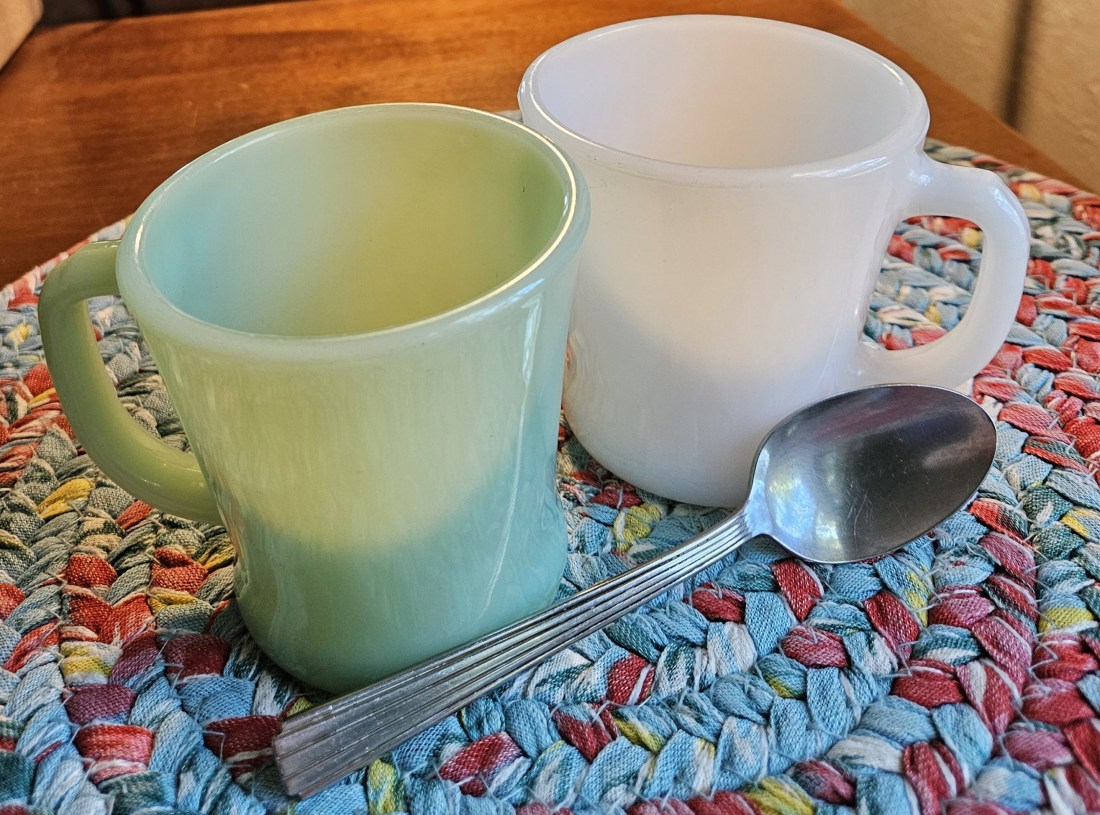
I wonder if concepts of beauty are universal or if economic status plays a central role in how relationships with everyday things develop. Yes, I have fine china, gorgeous crystal, beautiful linens, but I don’t use them much. I use the hand-me-downs: family objects that have endured time, that are easy to store, easy to wash. I hunt thrift shops for balanced, well-crafted beauty. If a spoon is balanced and well-bowled, I am inclined to use it everyday with appreciation though it is mass-produced from simple stainless steel. I prefer stainless steel to silver. Stainless does not contribute an extra taste to the food the way sterling does and it’s easier to clean, and easier to store. Although I have both, I use the mundane everytime, but I chose it with the eye of someone who appreciates beauty.
I have nice mugs, but the ones I use everyday are green-stamp cups from the 1950’s: one green, one white molded translucent glass. The heft is comfortable even when filled with liquid. The handle is balanced perfectly on the vessel, and because it’s mass produced, both are exactly alike except for color. They are easily cleaned. My finger joints don’t hurt after nursing a cup of coffee.
Utility.
They are like friends. The favorite spoon, the favorite mugs, ones I have lost in the past – mourned like family members. I hunt for new pieces to fill the empty space. I learn to love another chosen piece, cherishing time spent together. This is beauty to me. The fine china, the crystal, and the silver sit in my cupboard, occasionally used for special occasions. I no longer have the linen, which was so hard to care for.
I reach for my shimmering, translucent cup of coffee, take a sip, appreciate the warmth and the comfort of a treasured object. I wonder if my grandmother felt the same about it when she used it. What does that say about me?
My writing sisters understood his words with their own experiences. For the first time I was asked, “Will you share this on your blog?” lI felt so honored.
Betsy Rich Gilon – Clay Bowl
I have a bowl, a simple bowl
Its clay body textured
With undulations of the fingers
That caressed bowl into life.
I hold a bowl between my hands
Bowl beckons for me to touch
As it pleases my heart, bowl lies cupped.
I have a bowl, a simple bowl
Beauty awakens
Shari Anderson – Appreciating Beauty
Appreciating the beauty of everyday things requires time. It requires allowing a spacious
moment in which to notice the weight of a cup in your hand, its shape and texture.
Time – to feel the heat radiating from the luscious Chai within, the steam caressing your chin
and cheek. Time – to smell the cloves, the cinnamon, and sigh with pleasure.
True enjoyment is just that, bringing joy to the moment. With attention, involvement, and
gratitude, our physical, emotional and ethereal senses take in what each moment offers us.
We then experience the blessing.
Dianne Chapman McCleery – The throw away society that we live in.
When did possessions take the place of safety and security? You can buy t-shirts at big box stores for $2.95. How long do they last? Not long, I imagine. I’ve never been a fan of the latest fashions. If I buy something, and it takes on the value of “I really like this” after I wear it several times, I wear it until it falls apart.
A problem would often pop up when I would buy new clothes from stores. After washing, often their shape would change (or mine would). When my kids were little and money was tight, I discovered resale stores. Shirts for $2, pants for $3. And they were already washed and often worn into comfortableness. The major downside was that oh-so-comfortable pair of jeans would wear out sooner than a new pair would, but that was the price I was willing to pay. After all, there were always more at the resale shop.
Lynnea Paxton-Honn – Seeing (experiencing) beauty is not the same as being attached to that which is being seen as beautiful.
I have built my nest slowly through the years, learning what gives me comfort, what fulfills my idea of beauty. In the process of my nest building I have found beauty in the creating. Seeing the beauty in work that others perform with materials: smelting, molding, painting, weaving, the growing of the basics from which the materials are birthed. Scores of farmers, harvesters and craftspeople go into the creating of my home. Because of thrift stores and yard sales I can gather a quality that gives aesthetic comfort. I have my mother’s silverware. It is not super high-end but sweet and special. My house is old, well used, just the right size and shape.
“Just the right size and shape.” We end with Lynnea’s words about aesthetic comfort. Those items we use everyday mean something to us, and therein lies the reason to find those things to use everyday that give us not only pleasure when we use them, but also a sense of beauty, a sense that using them makes our lives richer.
I can’t remember the exact date I joined the writer’s group I belong to, but I am very grateful to belong to this collective. For those of you readers serious about writing, it is infinitely more fun to find support among like minded people who encourage, lovingly critique, and celebrate each others’ writing efforts. Because we meet weekly, I had binders full of not only ideas, some of which have bloomed into full stories, and even novels which I have published, but there were many that seemed complete just as they were. So many of my blog ideas come from these writings. I lost insight of that with the past crowding me. Now that it has been dealt with, I hope to share some of those overlooked pieces.
This bloomed a couple of years ago on 9/19/2022. For those of you who like numbers, 919 seen often can signify a change coming. Hopefully, the change for me is being able to write more often.
Meditation Writing – Playful
What is it like to be in the center of a creative moment? Is it a swirling tornado careening across a plain, or a capricious dust dervish hopping over the sands of a desert?
Is it a roller coaster with screaming kids or a quiet walk in the forest? Did it toss you off a cliff, pound you under the surf, or did you float in a deep lake, sparkling with pricks of sunlight?
What is it like, the center of a creative moment?
Does time stop?
Does the world…disappear?
Does darkness creep around the perimeter of your head wondering,”What’s going on in there?”
Do you connect with More Than Self, or do you find connection with Self? Does it fill you with bubbling laughter, or crushing pathos? What is it? What is that center, the very center of a creative moment?
Does self bow to not-self as some mysterious impulse takes over to write itself?
What is it like…what IS it like…to be…in the center…of a creative…moment?
The second prompt of that night was “Lost in Passing Seasons.” Sometimes, the first few minutes are spent uselessly, as in this first attempt:
“Pass the seasons, please.”
“What? You don’t like the weather?”
“Huh? What’s that got to do with anything?”
“You just said, ‘Pass the seasons.’”
“Yes. Please.”
The best course of action is to scratch it out, or if you are typing into a computerized program, hit delete. Fortunately for us today, I always write by hand at these meetings, even when they are online. It gave me a chance to reject what I consider…c^@p!
In and out of the garbage pail worked better that night:
Passing seasons.
Pass the seasoning.
Did you season the sauce?
She’s a seasoned warrior.
‘Tis the season to be jolly,
Have a holly, jolly Christmas
Pass the Christmas cheer
Pass on Christmas.
Happy New Year!
Finally:
A lion and a bear pass seasons differently.
It’s amazing what can be written in ten minutes, even if it never sees any life beyond the notebook you put it into. If you want to be a writer, just write. The more the merrier. Mary had a little lamb. Lamb chops, chopsticks, stick in the mud, or in your eye, or better yet: Stick to it. Just write.
The clock ticks with relentless accuracy while I wait for a shiver of connection. In the trunk of this tree of self, I realize it’s on me now. I am my own advisor. If I were to actually act in that capacity, what would I tell myself? “RIght now there is nothing.
“Nothing about which to worry, nothing about which to rejoice, no aches, nor pains, no elation, nor disheartening ennui.”
There is only a moment of quiet – the tick, tick, tick of a clock, counting the seconds of this empty moment of peace.
I wonder if this is the normal truth of most lives, or am I alone here? Is this why we are driven toward busy-ness? Would life seem to last forever if this moment lasted the length of it?
Tick, tick, tick.
This was the kind of thing running through my mind while waiting for the voice of inspiration during the ten minutes of writing time on August 8, 2022 after the opening meditation. For that ten minutes, the voice of inspiration never came. I had no words to address the meditative prompt, no words to tell a story. Just emptiness…so, that’s what I wrote about. I kept this, because even when the muse is absent, one can still write something. For me, these moments occur.
All.
The.
Time.
Later that night, for our last prompt, the muse brought me an acrostic. The prompt was Beyond the Beyond:
Beautiful dreamers create
Everything they see.
Your life is
One like this
Never empty, always budding
Day after Day.

This is
How we
Endure.

Beginning with one thought
Each trmbling into the next
Yearning for substance
Otherworld to ours.
Now is the time.
Dream.
As an intuitive I get a lot of information from a lot of places, and it’s presented multiple ways. The knowledge doesn’t just blossom, it bursts into my awareness like a supernova. Sometimes I can make sense of it: an ah-ha that feels so right that chinks that had heretofore been missing, suddenly click into place. Other times I wonder, “What the heck just happened?”
This year my guides nudged me to practice. Intuition isn’t something that just happens, although it used to seem that way. Over time I have learned it is something that can be practiced, like music. While meditating upon this notion I heard: Practice psychometry. Learn to read objects.
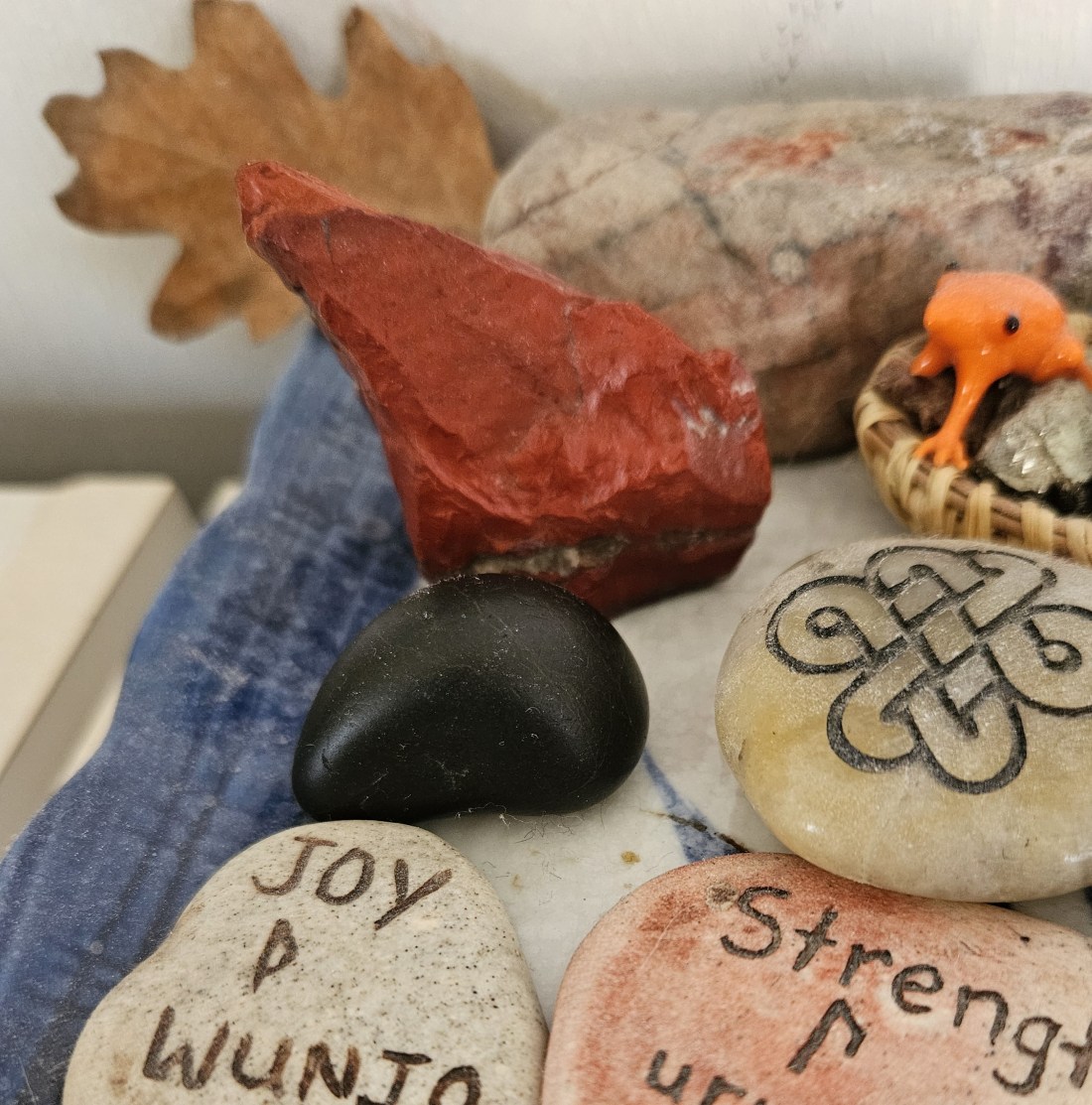
Objects? Where should I start? I look around my house. I know the history and value of almost everything, but then my eyes settle on a basket of rocks. Why not?
I have always been a rock collector, picking up specimens, not only as keepsakes from my travels, but also from my yard. Somehow, they become coveted objects. I had never thought much about them, I just collected them, took them home, and put them into baskets.
One day, after nightfall, while walking in my garden, the scant light of a half-moon shone upon a small, kidney-shaped rock. It was smooth, soft to the touch, and as black as the velvet of the sky.
A comfort rock.
I slipped it into my pocket and rubbed it as I walked about. When I went inside, I placed it upon my altar. From time to time, I picked it up to rub its silkiness, then I put it back among the other treasures that remind me of who I am. It’s been there for several years.
For this new practice, my perfect little comfort stone was not my first choice. Another altar stone caught my attention, a chunk of red jasper from Patagonia, Arizona.
I held it in my hands, cradled between my palms. First, the stone felt cold, then colder still. Odd. The more I held it, the colder it got.
“Follow the cold,” I told myself. “Follow the cold.”
In my mind’s eye a migration of people passes, wind howls. Darkness, ice, snow blow against them. They shuffle on, heads down, dressed in fur.
Profound cold. Ice-aged people in an ice-aged world.
Excited, I practiced for several days. I was learning to let go of preconceived notions. It was an important lesson because often intuition is skewed by personal ideas or desires.
On the fourth day, feeling as if I was learning how to read these rocks, and to let go of what I expected to learn about them, I picked up my comfort stone.
The lesson of preconceived notions didn’t stop my monkey mind forming them. “It is most likely black basalt, washed and tumbled smooth from a creek bed. Where did it come from? Somewhere atop the Sierra Nevada.”
I nestled it between my palms. Immediately I saw a tumbling washing machine.
“Well, that can’t be right.”
I focused on the feel of the rock as I had been doing, expecting this one, as had all the others, to be cold and either remain cold or get colder.
Not so.
There is heat. And the more I held it the hotter it became. It became so hot I was compelled to let go, and when I picked it up, I placed it against my cheek. It was as if a tiny furnace burned inside it.
I followed the heat.
Suddenly, there was the washer again.
What?
Ahh! Then it came to me. This tiny rock was tumbled in an industrial rock polisher! It was sold as gravel, “polished” to resemble river rock and used as a blanket to line decorative waterways or patios. In my yard, it lined a drainage ditch. Before that, it knew only pressurized heat, not volcanic, pressurized. Pressurized heat seemed very important to this reading.
I pressed the lingering warmth against my cheek, cherishing it, and then set the tiny, black rock onto my altar.
How surprising.
As I left my bedroom, a notion hit me. Is it possible that some of the major psychic events I experience come from the very rocks I stand upon? How much do rocks know?
My neighbor worried that my fig tree was giving up. There were several reasons: I cut her back so she doesn’t have to work so hard while Californians ration water. She lost the shade to which she was accustomed when the large companion tree that sheltered her was trimmed. As a reluctant gardener, my plants fend for themselves. I am not heartless, instead I am desperate to help conserve our water supply, so I wait and watch wondering what grows here naturally, and hoping some of it will be good to eat.
Who will survive the new, harsher conditions?
My Black Mission fig leafed earliest. The first inflorescences began to bud late this Spring.
What makes her so successful?
Figs have fed hominids and others throughout history. Uniquely adapted for harsh conditions, it grows where other plants fail. Technically, that which we call a fruit is actually an enclosed collection of flowers. Stem growth forms a bulb within which this cluster of flowers develops. Each blossom is destined to become a single, tiny drupelet. Encased within a protective womb, they do not need to fight heat or dry conditions. Some species, forming both male and female flowers, do not need assisted pollination. Others invite a miniscule female wasp into their chambers to spread pollen while she lays her eggs. These flowers then grow into a cluster of drupes, all encased within their pristine environment. (No worries, the babies escape before we eat the figs.)
This year, a few flowers ripened early, oh so sweet. I await the others. My fig thrives in this hot, dry climate and can live a century. Planted during my lifetime, she will be my companion as long as I am here.
On Monday July 17th, Shari, one of the members of the writing group to which I belong, threw us this prompt: fig leaf. A short ten minutes later, we had the following offerings. I am thrilled to present my writing sisters and their responses to her prompt.
Fig Leaf – Shari Anderson
When I was a young child, my father planted a grapevine and a fig tree in our backyard. It was
biblical
“Every man under his vine and his fig tree”
inspired.
I don’t remember the grapes –
maybe they never fruited, but the figs were juicy and delicious. The leaves of that tree were
wonderful,
unusually shaped with lots of rounded edges, sensual, with female curves.
Why a man, under his fig tree? Why not a woman? Why not just the fig tree itself, shapely,
verdant, simply divine?!
But, my favorite backyard plant was a wild cherry bush, which we used as a hideout, gorging ourselves with fruit while fighting off attacking pirates.
Fig Leaf – Dianne McCleery
The other day, I had to duck under fig leaves to reach Valarie’s front door. And I loved it. I love the hugeness of fig leaves. I love their shape. And, of course, I love to eat figs, especially since they are really flowers, not fruit. I’ve always appreciated adding pansies or nasturtiums to salads, but their tastes are “eh,” not like the deep deliciousness of figs. Yes, I am a fan.
Fig Leaf – Joyce Campbell
The fig leaf reminds me of an outstretched hand
Welcoming and offering a space to land.
Winged beings pause there, some large and some small,
And those with vibrations I can’t see at all.
Hidden below in the cool of the shade
Sprout tiny green nuggets, a prize for their fame.
Soon to be wrinkled and golden with age,
Dried to perfection a treat with no shame.
Fig Leaf – Anne Jeffries
As far as I’m concerned,
Eve’s “transgression” freed humanity
From an unconscious tunnel of an existence.
Imagine Utopia:
Yours different than mine, I suppose
But however that flowered garden is laid out before you
Without the snake
Slithering it’s SINewy offerings
There is no Will
No humanness at all:
Our choices and failings, our triumphs and joys, our sufferings and lessons.
Eve took us, perhaps out of our pure animal nature.
She gave way for the fig leaf of shame
To eventually free us from innocence
Fig Leaf – Amel Tafsout
Covered with a gentle morning frost.
Stretching your fingers to many directions
The lines of your open palm
Go back to the beginning of creation.
Your soft green color soothes the sight
Attached to the blessed tree.
You share shade generously.
You hold your sweet biblical fruit with care.
Then leave with the wind.
Blowing to a new world
Moving with lightness
Dancing your way freely
Ending on Adam’s private part
Covering up Humankind
Living in the complexity of reality.
Afternoon Delight – Barbara S Thompson
Do you remember the scene from
A Woman In Love
When the meal slowly unfolds
at the garden table
like luscious lovemaking?
As guests
caress and stroke
kiss and swallow plump red grapes,
black olives and
cheeses, soft and hard.
In slow, sultry nibbles.
Alan Bates leans back in his chair
with heavy lidded eyes
preparing to explain
the proper way to eat a fig,
It is an English garden after all.
When Eleanor Bron selects a smallish fig
piercing it’s base with one long, elegant finger
splitting it open to reveal the pale purple fruit within
Heavy with seed and fragrance
Slowly she opens her mouth
biting into the flesh
her soft moan echoing around the table.
Fig Tales – Betsy Rich Gilon
Ancient one, your leaves flutter,
The desert wind murmurs,
Camels leave footprints.
Would I have felt
The stories you tell,
Had I bitten into your flesh
Fig Leaf – Symbol of Shame? – AV Singer
Protection from sun
Invitation to hunt
hidden treasures,
Oh, fig leaf,
Why you?
∞
Fingers of mercy
on palm so large,
how long
must you
hide me?
∞
Figs ripen
hidden behind
green curtain.
Why is this
forbidden?
Please connect in the comments, or by clicking on the Like button. For more information about figs, follow these sources:
I am very grateful for my sisters of Women Writers of the Well. If you are an aspiring writer reading this, I recommend the idea of joining or creating a group of like-minded people who meet with the intent to support each other’s writing efforts. The magic of connection is everything. It’s a miracle. Without the support of these women, it would have taken much longer to find my way out of the dark, uninspired hole into which my creativity fell. They shone a light into that darkness and helped me crawl out step by step. I am still climbing, but I can see the way ahead.
In an effort to get me working on this blog again, I asked my writing sisters to share work with me any time they wanted it published. Anne B. Jeffries shared my last blog. This blog I share with Shari Anderson. She sees the Light everywhere and shines it brightly for her students, her musical sisters and brothers, her family, and her friends of which I am so blessed to be considered. Shari combines musicality within her prose and poetry. She isn’t afraid of experimentation. She publishes songs and chants, and is a beloved performer in this lovely area of California. She is one of those people that prefers to see the positive even when others can’t see it. Here is the sample of her writing she has sent to share with you:
Meditation Writing
Her voice –
warm and compassionate
Magically weaving wisdom and breath
Loving head to knowing heart
In, through and around
A creative dance from impulse Divine
traveling as words into our minds
Shari Anderson
2/6/23
Family Dynamics
Why does the word, dynamics, when paired with family, feel so very different than the same word applied to music?
“Family Dynamics” feels complicated, determined by emotional responses and past triggers, but talked about with rational, linear vocabulary completely insufficient to the task.
Dynamics in music evokes: expressiveness, freedom, flow, creativity, give and take, communication.
Maybe the key to better family dynamics is a musical approach, an excitement, a curiosity, an impulse to dive in so we can soar.
Shari Anderson
2/6/23
“So, we can soar.”
I agree with this wholeheartedly, having come up with a different viewpoint from the prompt “Family Dynamics” using words such as: responsibility, expectations of generations, fear tactics, grief dynamics, frustration with education, anger and growth – family – it is what it is: life shared.
The fact is, we all come out of families with a better understanding of who we are, and how to love.
That is cause for celebration. That’s enough to make us all take flight.
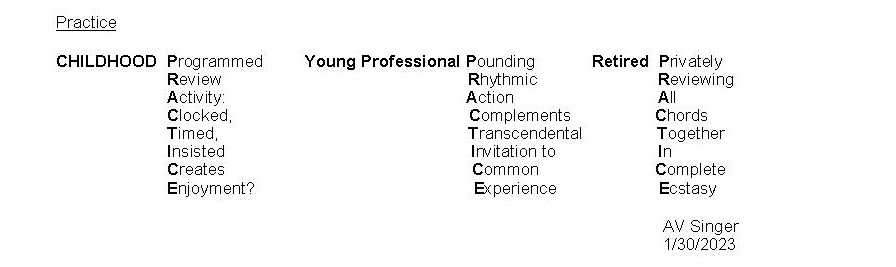
Shari is the one that pointed out that my attempts at creating acrostics with the word ‘practice,’ amounted to a journey through a lifetime study of music. My words take flight here because she found the value in them. I didn’t read these in this order because I didn’t write them in this order, but she saw it this way and now I do too:
Thank you Shari.
Thank you Readers. May you take flight until next time you land on my blog space.
Author’s Notes: Writer’s block. Everyone has heard about it, jokes made, condolences offered. It’s a real thing, a time most Creatives face. The well of ideas runs dry, the lake of inspiration empties and a desert of despair stretches farther than one can see. I had it bad, wandering that desert for at least six months.
One of my writing sisters sympathized, stating her creativity had recently become dormant. We discussed the idea. She was taking a course by David Whyte who offered a solution.
She shared it with me. “Ask yourself, what do you want to say that you are not saying?”
It is a question any creative person can mold to unblock many avenues of stagnation. For an artist, “What do I need to see that I won’t look at?” For musicians, dancers, actors, “What do I need to feel that I haven’t allowed?”
When Lynnea Paxton-Honn shared this with me, my re-awakening began. “What do I want to say that I am not saying?”
In California, where we live, January roared into our state with a deluge capable of filling dry lakes and ponds, and creating new ones, seemingly overnight. It ferociously filled rivers, washing away many things. Tides surged, waves plundered. From Earth’s perspective the rain was needed even though it was so destructive. From a spiritual viewpoint, it was a physical expression of the need to wash away all that no longer serves, a process that caused great grief, but also opened new solutions and opened hearts. It awakened memories, and filled our creative lakes and wells with words for both of us…I am thrilled to present Lynnea’s poem Memories Sleeping.




 Connection