Remembrance of a Gravestone

With the publication of this short personal essay, Alton Parker, a dear friend of mine, and talented writer presents “Remembrance of a Gravestone,” about a monument he saw while on the road from Flagstaff, Arizona to Los Angeles, California. 

Thank you, Alton, for considering publishing, for the first time, on my blog. I love this story.

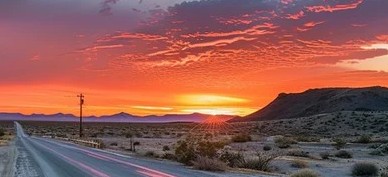
The setting sun gave the distant mountains a glow of flaming amber. Heading to their far off vista was a straight asphalt highway, cracked and pitted with age. On either side of the highway, a plain of gamboge prairie grass stood. It did not complain about being split by the road; it simply was. Utilitarian power lines were strung alongside the highway, periodically interspersed with poles stretching up into the twilight. Upon one of these, a speckled falcon perched, scanning the ground intently for its next unfortunate meal. Vultures circled the violet sky. 

An unusual monument stood at a point between destination and beginning: a gravestone. Long ago, eons for all I knew, a car accident had killed two people here. Artificial flowers had been collected. The roses must have been a striking crimson at some point, but they had long since been sun bleached into a dull depressing grey. 

No one stops to pay their respects. No one cares about the gravestone beside the asphalt highway. The names of those deaths have been lost, the files rotting away in the archives of some forgotten local newspaper. 

I wonder what their names are. 

I feel a burning need to know who they were and  who they left behind. Does anyone remember them? Does anyone care anymore? I continue my journey towards the amber mountains, now disappearing into ink black night. I remember the gravestone beside the asphalt highway. 

I remember.

December 12, 2025

One Single Moment of Joy

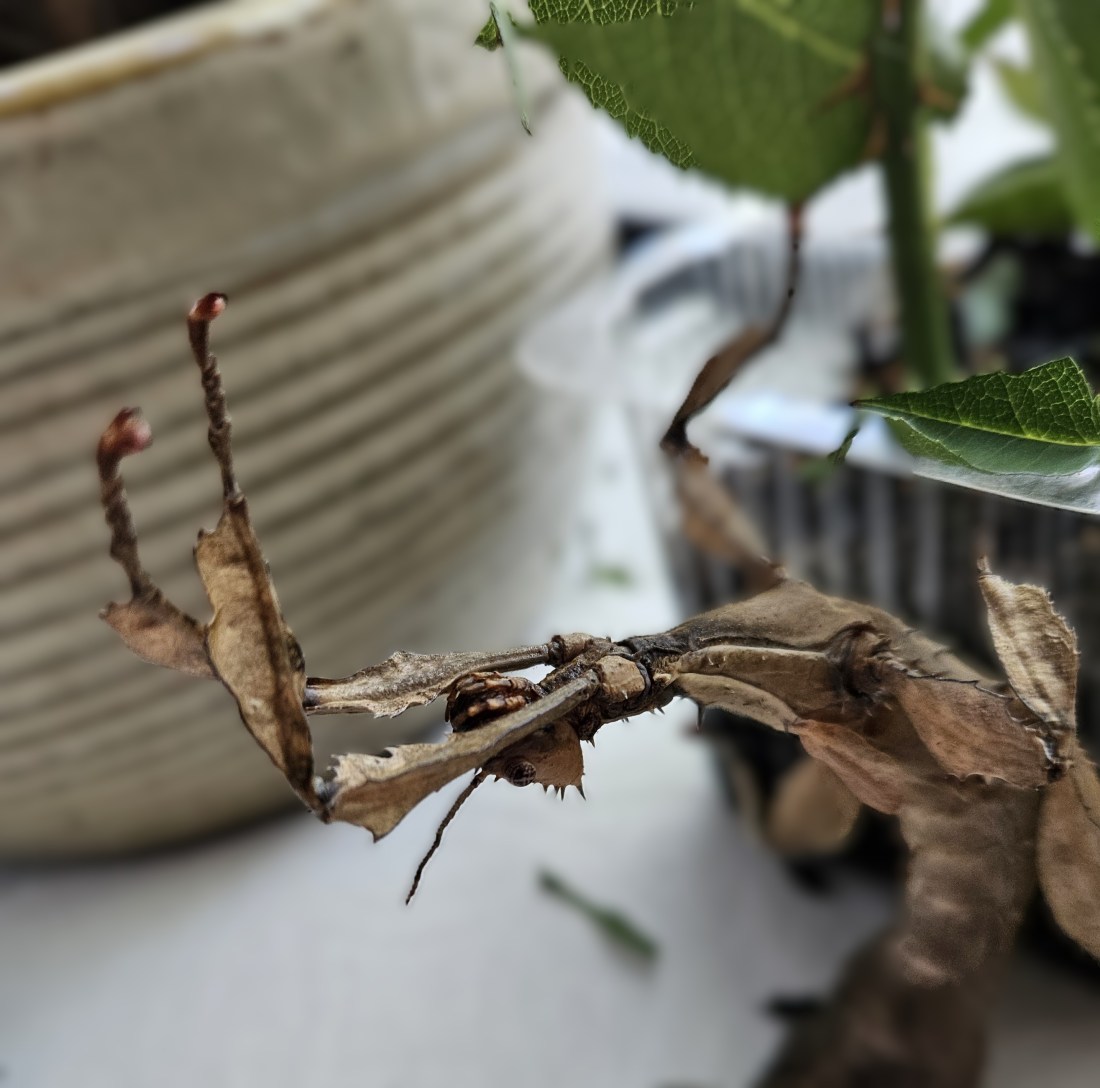
Usually, Sticky Willie, my dear Giant Australian Prickly Stick insect, recoils from my presence, especially if I open her door. She curls, rolls her tail over her back like a scorpion, and rocks frantically, trying to make it known – spikes here – be afraid.

What a poser.

One day, August 6, 2025, to be exact, magic happened: I opened her door. She looked up. Slowly, carefully, one leg at a time, she began creeping toward me. It was as if she were asking, “Who are you?”

Every few steps, she would stop and reach up with one arm as if to explore what was in front of her.

The third time she did this, she was close. Her little face seemed focused on mine. She reached out.

Gently, I touched her tiny claw with the tip of my forefinger.

She patted me.

I stayed there for her, letting her little claw explore my touch.

A sweet moment passed between us, a single moment of joy, shared by two beings of Earth, one homo sapien and one extatosoma tiaratum. 

My heart dances each time I return to that exquisite, wondrous moment.

I can’t help but think how joyful this world would be if we as humans were patient with every living thing, waiting for their energy to come to us rather than us bullying our way into their lives’ plan. What would happen if all of us stopped to learn what trees have to say, what birds are really singing about, what the lady bugs at our feet are doing?

Sticky Willie has her agenda. Her agenda does not alter mine, except with the things she cannot do for herself because I have placed her in an artificial situation. She can’t keep her cage clean, nor can she leave her cage to hunt for her own rose leaves. She cannot squirt herself with water to simulate rain. She may no longer be in her native habitat, but she chose to come here, to trust that I will take care of those things she cannot do for herself. 

I am rewarded with the chance to learn more about my world by watching her. And every once in a while we have a moment. It’s worth slowing down to wait for that one single moment of joy.

Reluctant Gardener – Tale of Two Species

As a gardener, even a reluctant one, there are some unwanted visitors that show up from time to time. Those are usually the species that attract the most attention from us because they seem to disrupt the equilibrium of the garden. But what if that is not the story? What if I don’t need to spend an inordinate amount of time trying to eradicate them?

Galium aparine, known around here as Sticky Willy, or the Hitchhiker plant has many names: Cleavers, Goosegrass, Catch-weed, or Velcro Plant. Leaves, stems, flower petals and seed pods are covered with tiny, hook-like hairs that cling to plants, animals, clothing, and human skin…literally everything.

A self-pollinating annual, I never look forward to early spring as its admittedly beautifully fanned leaf whorls begin to rise through the oxalis, prairie grasses, and three-cornered leeks. I can’t walk my sidewalks without this hitchhiker grabbing my pant legs. And of course when it does, it hangs on for dear life. In doing so, its stem breaks. Such a weakling. However, the roots stay embedded and the little suckers come right back up. 

Until this year, I was successful removing them in a timely manner. I never had a chance to see their display of delicate and beautiful light green and white flowers. I did not witness the seed pods, their means of propagation, so I don’t know how they proliferated throughout my property, but here they are. 

Here is the magic of this plant. It prefers to grow in shade, dappled shade or full sun…truth. It likes clay, sand, or loam. It grows in coastal areas, mountainous terrain or on the plains. It tolerates everything and grows EVERYWHERE. Though botanists think it is indigenous to North America, it is found in many other countries. It probably hitchhiked there. (Perhaps in some unwitting person’s pocket).

It’s useful. Seriously. According to my research it has a purpose. In fact it has many uses. Flowers curdle milk for cheese making. It’s used for stuffing mattresses. It’s edible.

“Wait. It is edible? What?”  

That’s right. People can eat Sticky Willy. The stems and leaves can be cooked with other greens. They are used for tea. The fruit can be dried and used as a coffee substitute. It actually has caffeine. 

(Why am I trying to get rid of this????)

It’s an herbal medicine. An infusion can help reduce swelling, treat infections, or boost energy. There are topical uses as well: ease psoriasis, eczema, and acne. It supports the immune system, and can help support the liver when detoxifying the body. It isn’t reactive with other herbal treatments nor does it affect medications. Sticky Willy is more effective used fresh and not dried, but it grows throughout the spring and summer here. 

(Note: always test a plant on your skin before you try to eat it. Then try a tiny amount, to see how your tongue reacts. Spit out if your body reacts negatively to it.) 

My body did not react negatively to this plant. I might have to create zones for this plant because I think I am going to have to learn to love this plant and look forward to its appearance every year instead of dreading it. 

This leads me to my next tale, also about Sticky Will(ie). On April 12th, 2025 family and friends gathered for my son’s birthday. It’s important to remember that my son seems to be coexisting just fine with the plant called Sticky Will(y). I sat on a bench at his party to admire a flower bed, and there it grew galium aparine, with sparkling fans shining in the string of lights lit for the party.

Go figure. 

The love of his life, his wife, invited a ‘bug lady’ to come to the party to share exotic and interesting insects. My son is a biologist with a love of all things that have multiple legs and sometimes wings. 

The first insect she shared with all the party goers was a monstrous looking thing called extatosoma tiaratum, otherwise known as Giant Prickly Stick Insect. 

I have held stick insects and at the party held another species that looked exactly how you would imagine an insect that imitates a stick should look. Extatosoma tiaratum like its name is GIANT and covered with spiky armor that reminded me of rose thorns. When alarmed, which they all were, they looked like ferocious scorpions of some kind. I did not want to hold this one and didn’t even pet it. It was interesting to “look at.” 

 I was glad when they all went back into their travel carrier.

She loved them though and told us all about it. Native to Australia, they live in trees, usually eucalyptus trees. Herbivorous, they eat the leaves. The insect isn’t harmful, but it does kick when it is angry or scared. 

Then, she gleefully showed us the poop as compared to the eggs that were dropped on the paper towel substrate she was using to transport them. The poop was long and rectangular, the eggs were round. This particular colony was parthenogenetic. 

My listening became more focused. Parthenogenesis, all female colonies – not needing males to breed: I have written about other insects that have this trait. 

She explained that the eggs are dropped to the ground, because the insects don’t come out of the trees willingly. The eggs are coated with a sugary substance that attracts ants. The ants gather them to take them home to feast upon. After eating the sugary shell, they cannot eat through the hard layer underneath so they discard them in their compost piles. (I am interested enough to do some research on ant composting practices in a later blog post.) The babies incubate in the heat of the compost, then hatch, resembling baby ants with black bodies and red heads. 

(Okay, at this point, you have to understand, I was maternally and intellectually interested. The fact that they were born as redheads intrigued me, since my own children are genetically redheads, and my daughter had vivid red hair when she was born.) 

From egg to hatchling takes nine months to 400 days. Wow. That’s a long time. By six molts they look like tiny versions of their mothers. They are quite literally clones of her, since this is a parthenogenetic colony, but there are colonies with both male and female insects. They tend to live longer, and the reproduction cycle may be faster. Each female that is born of a parthenogenetic colony is capable of producing approximately 800 eggs per year, but they only live about eighteen months.  

She continued for at least an hour and a half, perhaps two, sharing many different species with the party crowd which was as intellectually curious as I was. We held and played with many other insects, amphibians, snakes, and even an Amblypygi, the arachnid of Harry Potter fame. I spent a lot of time with a lovely creature that I fell in love with, a small Crested Gecko. 

As she packed up, all of us went to eat food, use the facilities, sit in the living room or around the outside firepit to talk. My daughter and I stayed for about another hour, later than we usually do because this was the best party ever. 

When we got into the car, we fastened our seatbelts for the thirty minute drive to her house. I planned to tank up on coffee for the next leg of my own journey, another forty minutes to my front door. I used the facilities again, made some coffee, and sat down in a chair to review the party. I got up to clean my coffee cup, and pulled a handkerchief from my pocket, which I had done repeatedly during the party to wipe my nose, because it was irritated by the fire pit smoke and my clothes reeked of it.

I felt something prickly in my pocket. Sticky Willy. I didn’t realize I had sat next to some of it, while playing with the animals. Ugh. The tiny green hitchhiker was stuck in my pocket. 

I pulled out the prickliness. It felt like velcro, just like it always did. I felt a pang of disgust because I had not yet come to terms with this plant. (This was pre-research.) 

Instead, I pulled out something brown that clung to my fingers for dear life. I held it up to my daughter. She slowly backed down the hallway away from my outstretched hand, shaking her head. I said, “This isn’t what I think it is, is it?”

She nodded her head, “Yes.” 

A Giant Prickly Stick Insect had hitch hiked home with me. What are the chances that a native tree dweller from Australia, in a yard full of people and TREES would choose my pocket to hide in? 

WHAT ARE THE CHANCES????

My daughter quickly found a jar. We called her brother, and said, “Happy Birthday. You have a new insect,” to which he replied, “No. I am leaving for Ireland tomorrow. You have a new insect.” 

My daughter shook her head, vehemently. “I don’t a don’t have a new insect,” she informed me.

I got home around midnight. I sat in my car, staring at the pint canning jar I had nestled in my cup holder. I sighed, picked it up and trudged into the house. 

My cat greeted me, and I fed her again. I stared at the pint jar on my dining table. “What am I going to do with you?” The tiaratum stayed hidden under the leaves we’d thrown at her from my daughter’s backyard. 

Finally, I threw my hands up into the air and said to the powers of the universe, “Well, I guess I am going to learn how to love an insect.”  

As I write this, she is in a two gallon canning jar, with a makeshift screen lid made for screening I’d bought to repair a door. She is happily munching on oak and rose leaves, while laying eggs. 

Oh goody for me. 

She has huge but peaceful energy, and I am starting to like her. I bought some supplies to make her a better house. I hope she lives the whole eighteen months so I can get to know her better. 

It’s amazing what one can learn and who one can find common ground with when one decides to love, whether that new love is a plant, an animal or another human. 

Works Cited

  1. https://plants.ces.ncsu.edu/plants/galium-aparine/#:~:text=Phonetic%20Spelling%20GAL%2Dee%2Dum,flowering%20and%20seed%20production%20commences
  2. https://www.verywellhealth.com/cleavers-health-benefits-5084341 
  3. https://www.inaturalist.org/taxa/141860-Extatosoma-tiaratum 
Neighbors

Strength wanes

long tenticles of grasses strangle

roses 

bridges between total death

and life

simplicity in purpose

if not grace

grasses

cover earth

otherwise scorched

by relentless sun.       

I am left with the question, what should I annihilate: my desire to destroy the strangling grasses that cling to my roses, or the plants themselves. These unwanted neighbors take nutrients and sunlight from my precious plants. They resist all attempts to eradicate them year after year after year. Where did these insidious creepers come from? What is the reason for their existence? Why can’t they go back where they came from?

As a tree lover, there are only small patches of land in which to grow sun loving plants. As a reluctant gardener, I am tired of fighting. Do I have resources for both?  

Bermuda grass is a sought-after perennial that is lush to walk upon and stays green all season. Intolerant of shade, it is drought tolerant, preferring at least seven hours of sun daily, which is why it is growing where my roses love to be. Bermuda belongs to the family Poaceae. Its official name is Cynodon dactylon. The name sounds like a creature from a monster movie and perhaps it is. Native to the Mediterranean, not Bermuda as its name suggests, people most likely brought it to this continent during the slave trade where it hid in contaminated hay used as bedding. Later, during the 1930’s it was used as a turf grass for golf courses, and in California’s early agriculture days, especially in the Central Valley, it thrived even when irrigated with salinated water. It is tough enough to withstand the trampling of grazing cattle with tenacious root systems. The roots I dig up are bright orange, and can dive as deep as six feet underground. Needless to say, at age seventy, I am not digging holes deep enough to eradicate it.

There is a close look-alike to Bermuda that also plagues my roses. 

Crabgrass. 

Native to Eurasia, it was accepted by the U.S. in 1849, an oddly specific date. The Patent Office named it a “potential forage crop.” Now it is EVERYWHERE. I have even found it growing up the walls of my basement. The most common species in Central California is Digitalis ischaemum. It spreads by scattering seeds, which unfortunately I have facilitated by ripping out the whorls it makes from the ground. Considered a tiller grass, new shoots develop on the crown of a parent plant and while they send down seminal root systems, they still depend upon the parent. And finding that parent can be a scavenger hunt. The good news: Crabgrass actually happily crowds out Bermuda. The bad news….

While researching I discovered there is another invasive pest in my yard that I have actually encouraged and now grows at the base of my roses…Quackgrass. 

Elymus repens, i.e. Quackgrass arrived on this continent sometime during the 16th century. My own ancestors were probably responsible for carrying what is now considered an invasive species over the Atlantic when they escaped…uhh…immigrated, from persecution in Europe. This plant from Eurasia and North Africa, commonly known as Common Couch or Creeping Wild Rye, spreads really fast. Sometimes the rhizomes grow an inch per day. The offspring can be found as far as ten feet from the parent plant. Unwittingly, I find the seed heads to be quite beautiful. It is one of the few grasses I don’t physically react to so naturally, I invited it to stay.

A quick dive through the internet taught me that Quackgrass, of the three of them, probably has a place in this yard as it is nutritious as forage, and good for humans. In early spring, the young shoots are tasty in salads. As well as providing healthy fiber, they are sweet and crunchy. Rhizomes can be dried, ground, and used as flour or as a coffee substitute. Even the sweet, fibrous roots can be eaten. Unfortunately, this plant is allelopathic, which means it uses chemical warfare to repel other plants. My poor roses. 

I probably introduced it into my yard in the bales of straw used to feed and bed my children’s 4-H rabbit projects. However, after learning about this plant, I may take it off my pest list, providing I can move the roses out of its reach. 

I have come to the conclusion that it may be easier to learn to live with these plants than try to fight them. This plant war has been fought on one of the steepest grades in my yard. It would be a thousand times easier to deal with the grasses without the roses getting in the way. The only way to save the roses is to move them to the other side of the house. That’s doable. There’s enough room for everyone here.

Citations

Kaffka, Stephen (2009) – “Can feedstock production for biofuels be sustainable in California?” Original printed in California Agriculture 63 (4): 202-207, 2013

Kaffka, Grattan, Corwi, Alonso, Brown Jr. “Bermuda Grass Yield and Quality in Response to Salinity and N, Se, Mo, and B Rates in West San Joaquin Valley.” UC Center for Water Resources, September 27, 2015.

https://ag.umass.edu/turf/fact-sheets/biology-management-of-crabgrass

https://forages.oregonstate.edu/regrowth/how-does-grass-grow/developmental-phases/vegetative-phase/tillering

https://www.canr.msu.edu/news/pain-in-the-grass-bermudagrass

https://thenatureofhome.com/bermuda-grass-vs-crabgrass/

https://www.thespruce.com/all-about-bermuda-grass-7151762

https://turf.arizona.edu/tips103.htm

Reality Check

San Francisco – 1978

All ten toes tightly grip the precipice of youthful choice. Across a career chasm, a queue of breasty blondes vie for a chance to become the next Marilyn.

“You could have that and more, Miss Singer. You have one of those rare faces that can be either very young…virginal really, or old and wise. You have what it takes.” 

I nod. All the high school and college experiences are worth something after all. The queue telescopes closer.

He lifts my resume and waves it. “The resume is impressive. You’ve answered all my questions. Do you have any?”

Is it too soon to say, “When do I start?” Instead, I shake my head no. 

He says, “I just need one more thing. Pictures.”

Pictures. The last step before my place in that queue.

“Please remove your clothes.”

What? Do I hear that correctly?

“Ahh. There’s no need to remove your panties, at least not yet.”

Details of the queue, hidden by distance, suddenly crystallize: bruised and tear-stained faces, slipped bra straps hanging from bare shoulders, torn blouses, snagged nylons on too much leg flashing beneath dish towel-length skirts. Eyes filled with hunger, desperation, regret….

Is this what it takes? I lift one foot and –

– step back. “No sir. I will not be doing that.”

“I misunderstood. I thought you were hungry. Everyone who is anyone has gone through this.” Disappointment in my choice taints his words, colors his features. 

I bow my thanks and back up to the door. Shaking, I grab the doorknob. It turns easily. I escape into the dank hallway. 

Funny. 

I didn’t notice the squalor upon entering.

I fly from the building and slam into sunshine. San Francisco is warm today. 

“Did-I-do-the-right-thing?” quickly dissipates in the golden light. 

Tick-tick-tick

Tick, tick, tick.

The clock ticks with relentless accuracy while I wait for a shiver of connection. In the trunk of this tree of self, I realize it’s on me now. I am my own advisor. If I were to actually act in that capacity, what would I tell myself? “RIght now there is nothing.

“Nothing about which to worry, nothing about which to rejoice, no aches, nor pains, no elation, nor disheartening ennui.”

There is only a moment of quiet – the tick, tick, tick of a clock, counting the seconds of this empty moment of peace.

I wonder if this is the normal truth of most lives, or am I alone here? Is this why we are driven toward busy-ness? Would life seem to last forever if this moment lasted the length of it? 

Tick, tick, tick.

This was the kind of thing running through my mind while waiting for the voice of inspiration during the ten minutes of writing time on August 8, 2022 after the opening meditation. For that ten minutes, the voice of inspiration never came. I had no words to address the meditative prompt, no words to tell a story. Just emptiness…so, that’s what I wrote about. I kept this, because even when the muse is absent, one can still write something. For me, these moments occur. 

All. 

The. 

Time.

Later that night, for our last prompt, the muse brought me an acrostic. The prompt was Beyond the Beyond: 

Beautiful dreamers create
Everything they see.
Your life is
One like this
Never empty, always budding
Day after Day.

This is
How we
Endure.

Beginning with one thought
Each trmbling into the next
Yearning for substance
Otherworld to ours.
Now is the time.
Dream.

What Do Rocks Know?

As an intuitive I get a lot of information from a lot of places, and it’s presented multiple ways. The knowledge doesn’t just blossom, it bursts into my awareness like a supernova. Sometimes I can make sense of it: an ah-ha that feels so right that chinks that had heretofore been missing, suddenly click into place. Other times I wonder, “What the heck just happened?”

This year my guides nudged me to practice. Intuition isn’t something that just happens, although it used to seem that way. Over time I have learned it is something that can be practiced, like music. While meditating upon this notion I heard: Practice psychometry. Learn to read objects.

Objects? Where should I start? I look around my house. I know the history and value of almost everything, but then my eyes settle on a basket of rocks. Why not?

I have always been a rock collector, picking up specimens, not only as keepsakes from my travels, but also from my yard. Somehow, they become coveted objects. I had never thought much about them, I just collected them, took them home, and put them into baskets.

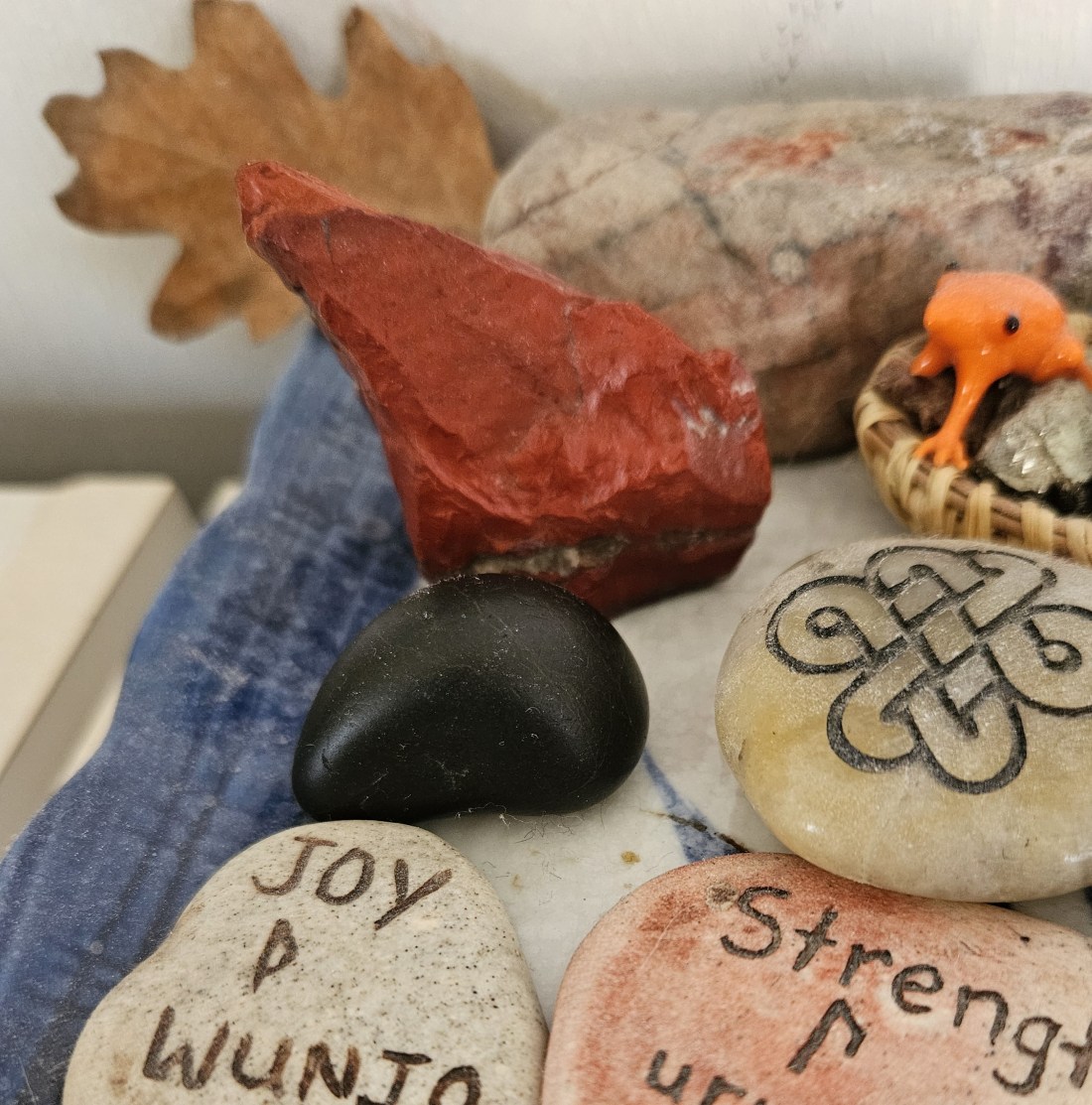
One day, after nightfall, while walking in my garden, the scant light of a half-moon shone upon a small, kidney-shaped rock. It was smooth, soft to the touch, and as black as the velvet of the sky.

A comfort rock.

I slipped it into my pocket and rubbed it as I walked about. When I went inside, I placed it upon my altar. From time to time, I picked it up to rub its silkiness, then I put it back among the other treasures that remind me of who I am. It’s been there for several years.

For this new practice, my perfect little comfort stone was not my first choice. Another altar stone caught my attention, a chunk of red jasper from Patagonia, Arizona. 

I held it in my hands, cradled between my palms. First, the stone felt cold, then colder still. Odd. The more I held it, the colder it got.

“Follow the cold,” I told myself. “Follow the cold.”

In my mind’s eye a migration of people passes, wind howls. Darkness, ice, snow blow against them. They shuffle on, heads down, dressed in fur. 

Profound cold. Ice-aged people in an ice-aged world.

Excited, I practiced for several days. I was learning to let go of preconceived notions. It was an important lesson because often intuition is skewed by personal ideas or desires. 

On the fourth day, feeling as if I was learning how to read these rocks, and to let go of what I expected to learn about them, I picked up my comfort stone.

The lesson of preconceived notions didn’t stop my monkey mind forming them. “It is most likely black basalt, washed and tumbled smooth from a creek bed. Where did it come from? Somewhere atop the Sierra Nevada.”

I nestled it between my palms. Immediately I saw a tumbling washing machine. 

“Well, that can’t be right.”

I focused on the feel of the rock as I had been doing, expecting this one, as had all the others, to be cold and either remain cold or get colder. 

Not so. 

There is heat. And the more I held it the hotter it became. It became so hot I was compelled to let go, and when I picked it up, I placed it against my cheek. It was as if a tiny furnace burned inside it.

I followed the heat. 

Suddenly, there was the washer again. 

What?

Ahh! Then it came to me. This tiny rock was tumbled in an industrial rock polisher! It was sold as gravel, “polished” to resemble river rock and used as a blanket to line decorative waterways or patios. In my yard, it lined a drainage ditch. Before that, it knew only pressurized heat, not volcanic, pressurized. Pressurized heat seemed very important to this reading.

I pressed the lingering warmth against my cheek, cherishing it, and then set the tiny, black rock onto my altar. 

How surprising. 

As I left my bedroom, a notion hit me. Is it possible that some of the major psychic events I experience come from the very rocks I stand upon? How much do rocks know?

Stuck in a Box

From a very young age, we look at the reflection of ourselves in others’ eyes. If someone takes the time to see who we really are, we know ourselves. We learn to trust and love our core being. Instead, I fear, most of us see how others measure us against cultural standards, especially women in my generation, the first generation to deal with contrived image saturation in visual media. 

Recently, I went with friends and family to see Barbie, a movie about a doll designed to perfectly depict a contrived image of beauty that saturates television, magazines, book covers, and advertisements. We all expected fantasy, a perfect woman in a perfect world gone awry. What I didn’t expect was a profound statement about the way each of us as women see ourselves. We need to sit up and take a look at this.

As the movie progressed, Weird Barbie was introduced. Just the mention of her made me sit up. When I saw her I thought, “My God. This is the first time I have seen myself depicted in the media.” I can’t say it’s the equivalent of the reaction that women or men of color have, but it certainly was a reaction that I couldn’t ignore. 

I saw myself. 

Weird Barbie. 

Huh. 

This set off a chain reaction. I started to remember and notice things I never had before.

As a young prepubescent woman, I didn’t hear sex ed in school, nor did I hear it from my mother. She never spoke of such things. I believe my father worried about me because my self-esteem was poor. He taught me how to be a woman with his Playboy magazines as examples. 

He loved me, but that was not the right approach for a little tomboy that developed quickly into a BIG girl at age ten.  

To say I wasn’t ready is a gross understatement. I loved climbing trees, riding horses, playing imaginary games of hunt, shoot, and capture, playing the saxophone in marching band, swimming, tennis, jumping (I loved to jump off roofs and balconies). You name it, my blossoming got in the way of all I loved to do. Big breasts were the bane of my existence.

Later, when I was old enough to have crushes, I learned from magazines that men liked big-bosomed women. 

Why didn’t they like mine?

What turned them off? My legs? My teeth? My hair? My eyes, hands, feet, intellect (I was a smart girl.) Was it because I didn’t do girly things? I didn’t play with dolls or other girly toys. I felt uncomfortable in dresses.I found lizards and brought them home. I had a pet crawdad. Once, I had a pet fly. I continued to ride horses, to play tennis, to swim with a team, and chuck hay bales out of a barn. I talked to frogs.

I was weird. 

I wanted to fit in. I wanted to be the stereotypical girl that boys sought. I had breasts, dammit. 

As a teenager I felt comforted by The Velveteen Rabbit. It wasn’t  because I loved soft, worn things. Rather, it was because I felt pitted against my culture’s vision of ‘ideal woman’ and didn’t believe I fit it. I thought if I could allow myself to be loved, to get shabby with attending to others’ needs, it would prove I was worthy. 

It turns out, life doesn’t work that way. 

I practiced yoga to keep perfect proportions. As I aged, I found it was more meditative for me. Recently, I learned a new way for me to practice meditation. I found it in a book called, belonging here: A Guide for the Spiritually Sensitive Person, by Dr. Judith Blackstone. In it, she teaches a technique to fully inhabit one’s body. During it, one focuses breath in the feet. I couldn’t do it. 

I didn’t acknowledge my feet. 

I really only noticed them when they hurt. 

As I moved my breath into my ankles, it was easier to focus, though I worried I didn’t have the delicate ankles I was supposed to have.

Then I moved breath into my legs. 

With devastating clarity, I realized I saw my legs as objects – not part of self – objects! 

Did I classify other parts of self as objects? My hair? My hands, my eyes, my breasts, hips, belly? OMG! My neck, my chin, my nose? Is there anything about my person that wasn’t an object to be presented and judged as worthy, or in my case, not?

Then it occurred to me. If I have this problem, do other women my age suffer this way? How about men? Do men suffer this way? 

I suddenly resented Mattel for not giving us Weird Barbie before this, because now I am old and can never become stereotypical again. 

My daughter asks, “Why would you want to be?” 

That’s an excellent question. I can only answer that I have spent a lifetime worrying about it. Am I good enough? Am I thin enough? Am I desirable? Are my breasts big enough? Are they too big?(Yes, dammit.) Do I meet the code that others impose upon me?

Why, indeed, should I worry about this?

I fear I am not the only one with such self-conscious judgment. What can be done?

For me, seeing Weird Barbie has been a god-send. 

While I resent Mattel for not presenting her earlier, I am also grateful she has finally made her appearance. After meeting her, I am beginning to see my own body as the finely tuned instrument it is. Without it, I could not produce the tone I have when I sing. Without it, I could not have birthed my babies. Without it, I could not have fed them for as long as they needed. Without it, I could not have jumped off roofs, or out of trees and felt that exquisite moment of flight. Without it I wouldn’t feel the pain of a stubbed toe, or the caress of ocean waves. Without it, the cool evening breezes wouldn’t thrill me as they have. Without it, I wouldn’t remember what it is like to touch another human, or pet my favorite cat, or feel the earth beneath my bare feet. Without it, I couldn’t smell the deliciousness of Spring or see the vibrating color of a bright orange rose.

When I asked my daughter if she remembered her Barbies, she said, “No. I didn’t have Barbies.”

Trust me. She did. I know. I spent hours making clothing for them. 

As we talked more, she did mention she had dolls that rode her Breyer horses. I looked it up. The Barbies in her day had knees that bent. 

She had Barbies. How Barbie looked did not define my daughter’s self-image. If anything about Barbie defined something for my daughter it was what she did. 

Barbie rode her horses. Nothing more. 

Nothing less.

Looking back, I don’t think boys turned away from me. I am fairly certain I turned away from them because I didn’t believe I was stereotypical enough. Physically, I may have been, (I have breasts, dammit) but, psychologically, I am Weird Barbie. I don’t claim that proudly, I just am. I always have been. The image I see in a mirror does not define me. 

The Barbie movie says it best. If you get a chance, watch it. I’d be interested to hear about any awakening you might have had after the experience. Now, wouldn’t it be wonderful if someone were to design an Old Weird Barbie with saggy bits? And a Ken to adore her?

Big Heart

In June of 2020 I ‘graduated’ from teaching. Teaching requires mindfulness and extreme focus, a one-hundred percent investment of love during time spent one-on-one with a child or with a group in the classroom. It requires setting aside self to see and hear others instead.

One of my sister writers, author of “Cross Roads,” Anne B. Jeffries, agreed to post on my blog this week. She had just finished a full day of commitment at school but she came to write with us.  She is adept at pouring Heart. When she attends our Wise Women Writing group, she feeds our souls. In a mere ten minutes, she addresses each prompt with profound honesty. Her act is an inspiration for the rest of us. She demands authenticity for herself, while maintaining curiosity, joy, love, and compassion for the rest of us.

Dear Readers, I don’t know what some of you do, but I do know that if you are reading my blog you have a sincere desire to connect with heart. Anne’s heart makes a big connection.

Anne, thank you. I feel honored that you have  given me your words to give to my readers. Fellow teacher, fighter for children, fighter for people, Anne, I love your heart. You pour out all it carries every day and I know your students feel your intent. Your writing takes away my breath and reminds me that teaching is something I still love to do. 

Memories Sleeping

It’s not just my memories sleeping,

It’s all of it.

A honey drip slowness.

I can catch up tomorrow.

Just want to sink down in sleep.

Rest.

Like a frenetic fall.

What is the charge?

Is it my nervous system that signals the experience to fizzle,

Lose its edges?

Then, sink away in categories and compartments,

With no present security access?

Where is my agency?

Who is filing these memories and who granted permission for this protocol?

Or, maybe, it’s all chaos and no “thing” has access.

My consciousness just sifts above it all like a metal detector pulling up old coins.

What about the pieces made of wood and plastic?

What loosens those?

Eternal Minutes

He said it’s like wearing a lie on his face.

I feel that way all the time.

In class- with him- with them.

Like I’m a puppet driven by a motor I did not program, or know how to run.

Today, 

For hours,

I peered out from below the lip where I stuffed myself down into a pouring cup,

Until all the drops of the eternal minutes,

Ran out against the automaticity

Of that forced time.

Family Dynamics

There is something about the inability to walk away.

A fabric woven together?

Fabric doesn’t work

because it’s made of thread that can be woven into something else.

My sentiment is too deep to separate out –

Like color in the sky?

Nope

Color is only light.

What holds us together?

Is it, in fact,

A choice?

Check it out

If you would like to read more of Anne’s work, check it out here:

Anne B. Jeffries, Author

Memories Sleeping

Author’s Notes: Writer’s block. Everyone has heard about it, jokes made, condolences offered. It’s a real thing, a time most Creatives face. The well of ideas runs dry, the lake of inspiration empties and a desert of despair stretches farther than one can see. I had it bad, wandering that desert for at least six months.

One of my writing sisters sympathized, stating her creativity had recently become dormant. We discussed the idea. She was taking a course by David Whyte who offered a solution.  

She shared it with me. “Ask yourself,  what do you want to say that you are not saying?” 

It is a question any creative person can mold to unblock many avenues of stagnation. For an artist, “What do I need to see that I won’t look at?” For musicians, dancers, actors, “What do I need to feel that I haven’t allowed?”  

When Lynnea Paxton-Honn shared this with me, my re-awakening began. “What do I want to say that I am not saying?” 

In California, where we live, January roared into our state with a deluge capable of filling dry lakes and ponds, and creating new ones, seemingly overnight. It ferociously filled rivers, washing away many things. Tides surged, waves plundered. From Earth’s perspective the rain was needed even though it was so destructive. From a spiritual viewpoint, it was a physical expression of the need to wash away all that no longer serves, a process that caused great grief, but also opened new solutions and opened hearts. It awakened memories, and filled our creative lakes and wells with words for both of us…I am thrilled to present Lynnea’s poem Memories Sleeping

Water–Life Giving

drips, drips, drips

through layers of rock

and sediment,

leaks out through fissures

into the outer air,

trickling from mountain aquifers,

runoff gullies down

spilling over rocks,

around root tangles,

debris caught and bundled

catching all the matter

torn from banks

barricading the streaming water,

damming the flow,

holding the power

of the stream no longer streaming,

but pooling, pooling as it pushes

against the barricade, blocked

until it’s not

and tiny tear trickles

begin to slide through the micro

cracks in the barricade.

The things I do not want to say come forth.

Lynnea Paxton-Honn  January 2023

To read more from Lynnea, you can visit her blog site: heartofahorsewoman.blog

Or her author page at: Author Central – Amazon