Caretaker

Caring For Others – May 31, 2021 Women Writers of the Well

The week prior to May 31st was rough for most of us in the writers group. I was in the middle of a course called Healing the Mother Wound, an exploration of shadows held within me, some created by myself, some by my own mother in our dance together, some passed down to the two of us from the women who came before us. I was in a fragile spot. A tiny shimmer of compassion for all involved slowly blossomed and I wanted to care for it.

Another woman had an awakening encounter with a homeless man, and realized her first reaction was fear, fear of him simply because he was a man and then because he lived wild, and looked it. It was the learned behavior of a woman growing up in the United States of America, most probably the reaction of any woman meeting a man in an unpredictable situation anywhere in the world. In the end, this one experience was positive, opening a door for both of them, but it left her in a fragile space wondering how, as women, we had come to fear men so.

A third woman in our group was caring for a devastatingly ill family member. She was inexorably disappearing as the ‘caretaker’ role took over. Alone with the task and afraid of losing herself, she was extremely fragile. Because many of us in the group have grappled with the same situation, her story, along with the meditative prompt, sent us over an emotional edge, which became public to each other when we read our pieces aloud.

This was mine:

“As a woman, caring for others is easier than caring for self. Caring for self requires looking too closely at who we are, what we are, how we define ourselves. Healing ancestral mother wounds has opened my eyes to how much my personal definition has been shaped by patriarchal conditioning handed down, not by the men in our lives, but the women.”

While reading, I looked up at the screen. Heads were nodding, eyes filled with tears. I thought, Oh dear, how will I read the rest of this to them?

I took a breath, and continued, “All of us define our worth according to how we care for others, whether on the job, in the home or within our communities. We ignore Self because we are valued only as Helper. We keep the machinery of life running.

“As I breathe in, I realize how much I don’t know about the “who” of me. I know what I am, I know what I do, I know about the people I tend. As I breathe out, do I freely let go, giving to others, or is there a part that I zealously hold onto, knowing there is not enough, not enough – not enough. Who am I? How do I define myself? What information could I give so that you could decide whether or not we would trust each other? If I don’t have full Self on board, I don’t have full Self to give and right now, in today’s world, it is paramount we offer full Self.”

Some of the comments to this piece were:

We are sic not whole if not perfect.

You can murder a woman without taking her life.

We are always whole, but it’s hard to see it if we tired, distracted, or sick.

How do we fill empty moments, spaces of silence?

How do we choose to fill them? Who are we in those empty moments not spent tending others? Recently, my Guides advised me to sit at the base of one of my trees to ground myself. It was less a suggestion and more an imperative. I was to sit and let the tree do the work. This is not easy for me, to sit and let others do…even trees. The Guides advised me that if I wanted to continue journaling, I should do it grounded at the base of a tree. After these past three weeks of doing so, I finally started asking, Who am I? – not my placement in the world as daughter, wife, mother, ex-wife, teacher, retiree – not that which I do to fill the empty moments and spaces of silence: writer, artist, singer, gardener, housekeeper, reader, student, dreamer, (well, maybe dreamer).

Who.

Am.

I?

What snippet of information could I come up with to give you a hint of who I am? What bits do you need to decide whether or not we will enjoy each other’s company, work well as a team, or just simply “be” together. What do you need to know to decide a friend stands before you?

Who am I?

I calculate risks before I take them,

Then jump in with my whole, tenacious heart.

Extreme imagination

Informs me of past, present, and future

I dream in color

A seamless wave

Of knowledge.

I see the path before me

Before I take a single step.

I fly on wings of music.

Therefore, sound distracts me because

Music is EVERYWHERE.

Profound quiet

Creates a space to regroup

But then,

I want to fly again,

Let the beats of a song

Erase my stasis.

I am an empath.

Your pain,

Your joy,

Your fear, your sorrow

I feel it; I feel you.

Sometimes I cannot tell

The difference between us.

Oh yeah.

You wear that separate meat suit.

Intuition guides me

To recognize and honor authenticity

But, I have no time for masks

Or deceit.

Once I see your true self

Shining from your eyes

I will love and honor you

And steadfastly

Hold space for you.

I soften with sensuality

Drawn by sound, texture,

Color, smell and taste.

I lose myself

With a single touch.

In the trappings of sensation

I have to work to stay present.

Therefore,

I am grateful for trees.

 …so very grateful for trees. I am learning a lot from them. I plan to make sitting under trees a regular part of my meditation practice. For the first time, I am beginning to feel as if I belong, as if I am a part of Earth, as if I am an amazing contribution to all there is. I am re-establishing who I am.

Who are you?

I would love to know you. Are you a risk taker? Are you someone who will reach out, leave a comment? Have I given you enough information to make such a decision?

Thank you, Dear Reader, for waiting these last three weeks for another post. I appreciate your interest and the time you are willing to spend with me. May you find Peace and a sense of Self as you go about your days.

AV
Music – Soundtrack to Life

Do songs or melodies stick in your head? Like me, and my good friend Danae, do you find comfort or inspiration in them? Danae C. Little, author of Grant Us Mercy, an inspirational tale about survival after an apocalypse, shares my blog space this week. An amazing, empathetic person she is always willing to give any help she can. In our group, Women Writers of the Well, she leads the rest of us towards becoming published authors. As a teacher, she leads softly, but determined that we have success.

She has had several bestseller titles. You can see her collection of work on her Amazon author’s page:

https://www.amazon.com/Danae-C-Little

She wrote this piece during our group meeting last Monday and when I asked her to share it, she agreed. I am elated to share her words with you.

Music – Soundtrack to Life, by Danae C. Little

Music is our soundtrack to life. Oftentimes I wake with a song in my head. The melody strumming forth, the words repeating like a stuck needle. In those moments between sleep and wake, I swear I actually hear the song as if I’m being serenaded until the notes fade out as I open my eyes.

I find that these mornings when I wake with my own soundtrack, my life follows the tune, my perception shifts towards the song’s meaning. 

Music has always been an important part of my life, drawing on emotion, deepening moments, and pushing back depressing thoughts. I used to sing my way through the day as a child, much to my brother’s dismay, who would repeatedly ask my mom to make the tone deaf girl stop. 

I was tone deaf. I’ve had three surgeries on my ears, two of them major leaving me mostly deaf on one side. It never stopped me from enjoying music though.

I spent my childhood, before the self-conscious years of adolescence, performing in church musicals. Then came my years of silence, years of only freeing my voice when I was alone.

When I became a mom, something shifted and released, freeing my voice once more. It started with softly sung lullabies to soothe my infant, turning into silly songs to make my toddler laugh, and now we sing popular songs together while smiling at each other.

I had missed singing, but I’m back, and maybe not even as tone deaf. At least, my son never complains about me being off key. Now, if I’m feeling down, I’ll find my favorite artist on YouTube and belt out the lyrics. It always lifts my spirits.

So, I’ve decided to choose my own soundtrack for life. What will yours be?

Fumble – Part Three

(Author’s Note: I want to start this last installment with the words of two writers I admire. Their words speak to me.). 

David Roddy co-writes the podcast “Worker’s Cauldron” with Mercedas Castillo. He advocates for the marginalized and homeless. The “Worker’s Cauldron” originally called “Sh!t Gets Weird” focuses on “the cultural politics of the paranormal.” Each program is a lesson about history you probably did not learn in school, at least not here in the United States. You can catch the podcast at: https://podcasts.apple.com/gb/podcast/the-workers-cauldron

David states: 

The most dangerous person is one who never questions the efficacy of his or her hard work to overcome adversity, who doesn’t take into account circumstance, outside help, or sheer luck. It is dangerous to disconnect racial disadvantages, disadvantages that are especially hard for those who are single mothers. A person is doomed to callousness and a heartless inconsideration of others as long as they idealize that hard work is the sole cause of success. 

The other is poet Lyla Osmundsen, a member of the Women Writers of the Well. At our Monday evening meeting, she responded to the prompt: “Have I invented the world I see?” Vibrant with emotion, shining Love with the heart of an angel, Lyla wrote from the core of her being, which she does – always. She completed the first two lines during our meeting and read them to us. I was so touched I asked if she could complete it to add to this blog entry. Thankfully, she agreed. Her book is available at: Wa(o)ndering to Poetry (9781717396556): Osmundsen, Lyla Fain: Books 

Have I Invented the World I See? – Lyla Osmundsen, 3/10/21

Does my anger vibrate in unison

with the anger of others,

causing volcanic eruptions of

daily gun violence?

Does my careless waste

of food

constitute a crime

against a starving individual?

Does stuffing my house

with thoughtless trifle

transform into the tragedy

of a child with no home?

Lyla asked the hard questions of herself. Those of us that hear her words, in turn ask them of ourselves. What are the ramifications of our emotions, our patterns, our wants and desires? We all need to ask, “What world have I created?” Is it the one we want to see?

To live, a human needs water, food, and shelter. These are not privileges. These are necessities. According to most articles that I read, the top four reasons for homelessness are: lack of affordable housing, unemployment, poverty, and low wages. Contrary to popular belief, more than one third of people who are homeless are not jobless. They work long hours, sometimes more than one job, even more than two or three jobs at a time. Housing is too expensive and there aren’t enough developments to house all the people that need housing. Even if there were, the average wages for the average worker cannot cover mortgages, or even skyrocketing rental costs.  

The housing problem compounded in California when yearly firestorms became the norm, forcing people to leave established living accommodations. As a teacher, I worked with families displaced by fire. Some lived out of their cars, more fortunate ones found safety with family or friends. Others, unable to find work in California, left the state, abandoning their old lives entirely. These were the lucky people.

The rest careened into homelessness and took to the streets, or the edges of parks, or under overpasses of highways. People of small towns and rural areas, areas with limited job availability especially develop an attitude of looking down on the displaced citizens that hover in their areas. The typical response I heard was that the hardworking taxpayer shouldn’t have to subsidize lazy vagrants.   

Then Covid-19 hit. Stimulus packages were not enough and came too late. Workplaces were shut down, people lost their businesses, mortgage holders weren’t compassionate enough because their own livelihood was compromised. Homelessness was no longer an issue of “you just have to work hard.” I wonder, do those angry people bemoaning their taxes still feel the same? Are some of them now living on the edges of society, possibly still working hard, still paying taxes, living under makeshift tents on the edges of town?

Covid-19 gave most of us time to realize our good fortune is largely due to luck. Having or not having is often a matter of who you know. It’s almost always a matter of what color am I?

As early as the 1970’s Federal investment in housing was threatened. In the 1980’s there was already an unwarranted number of families with children considered homeless. In 2008, financial crises created foreclosures forcing people to give up their homes and take rentals instead. Unfortunately, affordable and safe rental construction could not meet the demand of displaced homeowners. Rents rose, but working class wages did not. By the time Covid-19 was a pandemic, rents were too high for most people working full time year round as minimum wage workers. According to the U.S. Bureau of Labor Statistics in a survey completed in 2019, 82.3 million workers 16 years and older, represent well over half (58.1 percent) of all wage and salary workers in the United States. These are people struggling to maintain shelter. Six percent of white households are extremely low-income renters. (2,3,4)

For people of color, the statistics are bleak. “Twenty percent of Black households, 17 percent of American Indian or Alaska Native households, 15 percent of Hispanic households, and 10 percent of Asian households (compared to the white households), are extremely low-income renters and are often locked out of affordable housing due to systemic and structural racism and decades of racist policies.” (1)

I think about other single mothers like myself. What are those statistics?  Over 85% of homeless families are headed by women, specifically, by single women with children, and domestic violence is a principal cause of homelessness among single mother families. (5) 

Reading a statistic such as this raises the ugly face of my own fear. My fear was real. I was afraid of homelessness, however, that fear was as irrational then as it is now. I always had people who cared for me. I had places I could go. I am white. Job opportunities, even in this rural area, were presented to me, largely because of who my family knew. There was no way I would find myself on the street.

Even now, as a retired person living on barely adequate retirement wages, when the fear stops me in my tracks, the truth is – I remember that money is adequate. I have shelter. I have water. I have food.  

I will never know who that huddled person in front of Starbucks was. I didn’t stop to ask their story. Where was that person’s luck? Did my callousness leak some of it away? Were they as terrified of me, as I was of them? Were they huddled under the mound of clothing in defense and shame? Could I have alleviated part of that shame for one transitory moment if I had stopped to smile, at the very least? Could that one moment have made all the difference in the world for that one person?

December 31, 2019 was a lost opportunity. Today, as I rewrite this article, terror washes over me again as I remember being a single mother of two very young children. My heart crumbles as I remember the person I left behind at Starbucks. Before my fingers touched the keyboard, I sat on my bed sobbing. I lived on the brink of disaster, that person lives the disaster.

I have to own that terror and let it go. I also have to own the pride that covered it up and made me callous. Yes, I worked hard, but I was fortunate. I was presented with opportunities that I was in a position to grab; opportunities that a great many of us don’t have.

In the future, will I find, at the very least, the courage to smile if I have nothing else to give? I need to look behind the pride that covers my near miss and move forward one encounter, one opportunity, one story at a time.

Works Cited

Aurand, Andrew, Dan Emmanuel, Dan Threet, Ikra Rafi, and Diane Yentel. 2020. “The Gap: A Shortage of Affordable Homes,” p.13. Washington, DC: National Low Income Housing Coalition. https://reports.nlihc.org/sites/default/files/gap/Gap-Report_2020.pdf.

 Chetty, Raj, Nathaniel Hendren, and Lawrence Katz. 2016. “The Effects of Exposure to Better Neighborhoods on Children: New Evidence from the Moving to Opportunity Project.” American

Economic Review 106 (4). https://scholar.harvard.edu/hendren/publications/effects-exposure-better-neighborhoods-children-new-evidence-moving-opportunity.

Gowan, Peter and Ryan Cooper. 2017. “Social Housing in the United States,” p.1. Washington, DC: People’s Policy Project. https://www.peoplespolicyproject.org/wp-content/uploads/2018/04/SocialHousing.pdf.

Fumble – Part Two

Pride pushed me to achieve stability for myself and my small family. I took advantage of opportunities available to a white person with education. I bought a house from my parents’ estate, taking advantage of a generous, no interest payment plan. I raised my two children in a safe, small-town homeschooling situation while working as a teacher in the school they attended. All the things one expects out of life came true. I was proud of my achievements, proud of my children, and happy in my situation. 
Ironically, pride is a powerful screen that can hide something as huge as the terror of living through untenable uncertainty. Terror not faced cropped up in a mysterious, inconvenient, and unfortunate way.  
Last year, twenty-four years after becoming a teacher with a steady income. I published an article about my failure to respond to someone in need. It seemed a lifetime had passed since living with the terror of the world falling out from under my feet as a single mother and sole provider for two souls, a lifetime since I had worried about homelessness. I was hard working and successful. I had avoided the calamity of which I was most afraid. People were impressed with my story. I had come far. I believed them when they congratulated my strength and fortitude. I was finally in a league to “pay it forward” by seriously donating to charities and food drives.
Like me, many of us experience the act of “paying it forward” whether in a grocery line, contributing to Food for Families, or donating to local food pantries. Perhaps like me, many purchase a sandwich or a cup of soup for a cleanly dressed person on a street corner who approaches and asks politely. Most of us donate money to organizations like the Red Cross, Habitat for Humanity, or causes for veterans. There is an endless list of worthy causes to make us feel we are doing something to help. Those efforts are safe. They don’t take much time, they don’t require person to person contact. This is all fine, but what happens when one is confronted with an individual buffeted by a pauper’s life on the street? 
On December 31, 2019, the last day of a difficult year that cinched my decision to retire at the end of the second school term, and with no way of knowing that in seven short weeks, 2020 would be a worse year, I pulled into Starbucks. This was my special treat for coping with a drive to Stockton, California. Stockton is a rough town, rated 3 on a scale where 100 is safest.
I went there to see a pain specialist because of injuries sustained while struggling as an apartment manager, exasperated by single motherhood, and a bad fall. Good news or bad news, I always stopped to give myself some sugary, caffeinated love. Even though I did not feel safe in Stockton, the treat had a calming effect that negated my need to race home beyond the posted speed limit like a barn-sour horse. 
I entered Starbucks’ parking lot.
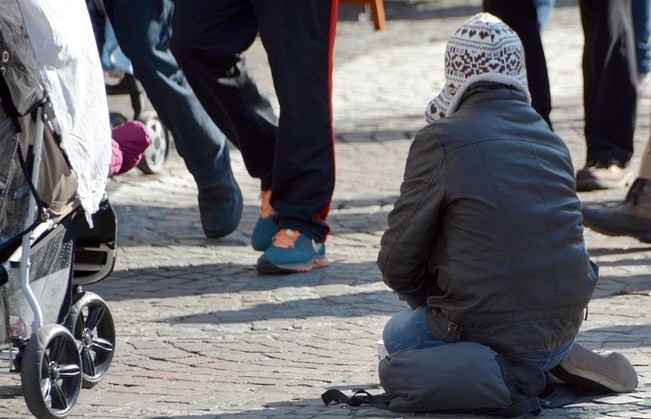
A beggar huddled on the island in the middle of the entrance/exit split off Hwy 88 and Hwy 99. To enter Starbucks, a driver had to pass him (or her) coming and going.
I shut down, as I often do when confronted with this choice. I could not tell if the person was a man or a woman, crouched as the person was under a mountain of clothing. Was he or she young, old, black, white, or any other color in between? Were they on drugs, did they have hidden weapons? He or she held a sign, but the lettering was so faded I could not read it from the car. Did it say, “Out of work,” or “Homeless,” or “Need money,” or “Clothes,” or “Food?” This was Stockton. The unidentifiable person under the mound of clothing was panhandling, either by default or by “choice,” as so many people insist.  
I entered Starbucks wrapped in thought, eager to use a gift card one of my dear students had given me for this treat, but seeing a person huddled and begging for something brought forth a deluge of anxiety I didn’t really define at the time.
When I stepped outside, the person was still there, unmoving. I took a few steps toward him or her and tried to catch their eyes, figuring I might be able to size up the situation if I could see their expression. When I couldn’t, I didn’t look twice. Truth be told, I didn’t try very hard. My heart was pounding with unreasonable fear, and I think pride was blocking my access to the real cause of that fear.
However, I blamed it on the gift card I held in my hand. There was money left on it. I could hand my gift card through the car window, but what if caffeine was detrimental to their mental or physical health? What if Starbucks wouldn’t let them in? Should I step back into the shop and buy a banana?  What if they, like me, reacted poorly to bananas? Did my student have a re-gift in mind when she gave it? For this particular student, her gift had been a tremendous act of generosity. 
From the safety of my car, I regarded the person on the island through my side mirror. My heart was crying for action, but my ego justified not acting. As a young girl, I heard grandfather stories. One story taught me, don’t give money. There was a McDonald’s next door. I didn’t have much cash on me. The amount I had wasn’t enough for a hamburger, which was at best a momentary fix. Would coffee do? What if they needed shoes, or medication? What if, what if, what if?
My anxiety told me – run away. My head argued with my heart, calculating all the ramifications of helping or not helping. Was I prolonging someone’s helplessness, the same helplessness I felt when raising two small children by myself? Was this someone taking advantage of others panhandling like this? The guilt I felt taking advantage of Food Stamps, and payment plans grew like a swarm of locusts as I sat there. People in need taking advantage was another common stereotype and one I had worked hard to get out from under.
A percentage of homeless people lacking jobs and living on the streets have severe anxieties and mental health disorders. They can’t find jobs; or if they do, they can’t keep them. Housing prices in California are astronomical, and housing is generally unavailable. It was a stroke of luck that I found the job I did. Or was it? Had that luck come from white privilege?
The question pummeled my ego which took a different tact. I was older, less equipped to defend myself should the need arise, even though I knew that it was more likely that a homeless person would be attacked rather than perpetuate an attack. Still, my ego told me, don’t get out of the car. For a few moments I sat there in conflict, trying to intuit the right course of action. 
In the end, I ignored the huddled person on the island and drove home. The treat did not slow my flight as it usually did, nor did I enjoy it.
I fumbled.

​What was this huddled person’s story? I will never know. I threw away my chance to ask. It was an opportunity to reach out, to ease a moment, to hear Story and I drove away. There are many reasons for homelessness, seldom is it a choice like some would believe.  I invite you to check out next week, Fumble – Part Three, when I explore some of those reasons. 

Fumble – Part One

My eyes snapped open. It was dark, but I didn’t need to see. A familiar, heavy weight pushed against my chest. My heart pounded against it. I gasped, frantically gulping air. Terror, a nightly visitor, was back to remind me I was one step away from losing all I had worked for.

I jumped out of bed to check on my children. They slept soundly in the second bedroom of the small apartment. I closed their door, fighting against the consuming tears that threatened to shut me down, and tiptoed to the kitchen.

It was dark and private, especially if I huddled in the corner against the cupboards under the sink. With cupboard handles digging into my back, crushing despair overwhelmed me, and I dissolved into quiet, painful, body-consuming sobs. I couldn’t handle this – single motherhood, sole support of two young children, working as an apartment manager, a job my body was not equipped to handle. There was nothing else…no job that paid enough to keep me and my two babies housed. I had made my bed. Now it was up to me to lay in it.

I was a survivor. I felt a sense of pride that while I was a single mother that received no child support, I could keep us off the streets. That sense of pride pushed me to achieve more stability, stability I had not had before.

As an artist, I was always one dollar away from destitution, but that one dollar kept me off the streets and under a roof. So, when my marriage dissolved, it took a long time for me to find the courage to initiate a divorce. Once I found courage, I took full custody of our two small children without support from their father. In fairness, he had more than he could handle fighting mental illness. It was unfair to ask for support, so I didn’t.

My parents, while available for occasional help, were not emotionally equipped to live full time with two small children. They had earned their freedom after raising four kids of their own. I felt the idea of a grown child coming home with two of her own children was too great a burden; so, I wheedled my way into an apartment manager’s job, a job set up for a married couple. It would now be handled by one, unqualified, single mother. Even though the job was more than I could handle, I never let people know what I was going through. In fact, except for shameful nighttime sob-sessions, I didn’t admit it to myself. After all, I was a strong American woman. The world could hear me roar. I had put a roof over my children’s heads. I wasn’t the daughter leaching off her parents.  

The apartment job took its toll physically, mentally, and emotionally. My five foot, two and a half inch body was not equipped to handle the manual labor part of the job. My poor little vessel had not yet fully recovered from gestation complications nor had it fully recovered from breast feeding. But payment was a free apartment in exchange for that work. All I needed money for was life in general.

In Northern California there is a lot of resentment towards people who use the welfare systems. People using it are caught in a damned if you do, damned if you don’t situation. In the State of California, at that time, to be eligible for public assistance, one could not work more than forty (40) hours per month. Let me write that again. To qualify for help, I could not legally work more than forty hours per month. I was required to be on call 24/7 as the apartment manager. I was not eligible for Welfare assistance because it was considered a full time job, but I still needed money to pay for utilities, groceries, and childrens’ needs. 

I took odd jobs on top of the management position. At the end of the first year, I discovered that the Federal and State governments counted free rent as income for which I owed taxes, but had never received a monetary exchange. My family wasn’t keen on helping me pay that. I complained but didn’t ask for help because I had been raised to believe that if you made your bed, you laid in it. I had made that bed getting divorced. The management company that hired me found out I was working off the premises and frowned upon the odd jobs I had taken because I was to be available to their clients 24/7. I could quit the jobs and be a full-time manager and not be able to buy food or keep the jobs and lose housing.

I cried on the floor of my kitchen in the middle of the night.

Because I was a single mother with two small children and had a bill for Federal taxes, I was eligible for Food Stamps. However, using this type of assistance embarrassed my family, which in turn shamed me.

I cried on the floor of my kitchen.

But what does one do? One takes care of the kids and moves on. That’s what. No matter what it takes. So I felt a sense of pride in this, or at least pretended that I did. I went without health care for myself so I could set up payment plans to pay for my children’s health care and dental needs. 

Too many times, I heard family and friends talking about “What a shame it was” that I had put myself in this situation.

I cried in the dark on the kitchen floor. 

Pride kept me going. I took out student loans to go back to school for a teaching credential, something I could do because I had a Bachelor of Arts degree in Fine Art with a minor in music, but hadn’t made a lot of money as a street or gallery artist. I had not yet made any money as a musician. “What a shame,” I heard. “So much talent going to waste.” 

Teaching brought in a steady income, something I had not experienced before. Yet, I still feared homelessness. To remind myself how close I still felt to it, I practiced the art of facing my fear by dressing every Halloween as a bag lady. My kids and family were not impressed with my choice of costume, but it helped me face the fear that was still haunting me. Dressing up in such a way confirmed that I had something to be proud of: at least I wasn’t a bag lady living on the street.


Pride of accomplishment can be a powerful smoke screen. It can hide something as huge as the terror of living through untenable uncertainty and color one’s memory of that uncertainty with self-aggrandizement. Pride-cloaked terror popped up in a mysterious, inconvenient, and unfortunate way. Next week, read Part Two of “Fumble,” when I share the memory of a missed opportunity to help someone else facing homelessness.

Guest Author Anne B. Jeffries

Dear Readers,

Have you ever tried to imagine a scene only to discover you couldn’t? Have you ever looked at a common word and suddenly it looked foreign to you, or like it wasn’t spelled correctly, or you wondered “how the heck is this word spelled?” even though you have been writing it for all your life, or maybe especially because you have been writing it your entire life? You will want to share Anne Jeffries experience.

Every Monday night, a group of women called Women Writers of the Well, meet for about an hour and a half to respond to prompts, read what we have written, and feel like we are a part of something larger than ourselves. As writers, words are important. But sometimes words are coyotes, tricksters, puzzles to brain and sanity. 

Anne is one of those rare writers whose written word is truly authentic. That is why when she shares her prompt response during our group time, the rest of us say to ourselves, “Oh yeah. Been there, done that,” or “My gosh. I wish I was that alert.” 

During the week she tends to children in need either virtually or in a physical classroom. Monday nights she joins us to get away from that, but does she? I can’t tell you how many Monday nights I have walked away from our meetings marveling at how much I have learned about spirit, authenticity and…quite frankly, prose. She is a poet, a story-teller, and a sharer of life. Words come from somewhere deep in her soul, crawl out of her psyche, or simply escape before she can catch them. We are so lucky she doesn’t catch them. 

She has published a book, filled with heart-based writing called Crossroads. Check it out. You can find it here:

Please keep reading. Her poetry shows up on this blog site after this graphic.

In the meantime, I present her offerings from the prompts of March 29, 2021. The first was a meditation. Anne connected with the word “Imagination” in a unique way, but perhaps you have experienced the same. The second was a simple one-word prompt, “Vision.” Perhaps, you identify with this dilemma. As usual, I walked away enchanted. I asked her to share them with you and she lovingly agreed.

Imagination by Anne B. Jeffries, March 29, 2021

Why don’t we say, Image -In-ation?

Because imAgine is the verb?

Imagine…from ‘image’.

When I think of the concept of imagination,

Visual imagery doesn’t come up.

It is essence, and story, and texture, and movement.

For instance, 

If I actively try to see a chicken in my mind,

It’s like a broken projector:

Flashes of clawed feet,

a smooth white back,

Maybe the uneven ground and dirt clods underfoot

But not the whole chicken.

And if I REALLY try to will an image,

There is nothing.

It’s like an imprint of “chicken”;

What it leaves behind.

My Image -in-ator is stubborn.

Vision by Anne B. Jeffries, March 29, 2021

Here we go again.

What Vision are we settling on?

20-20 Vision?

A Vision of Jesus?

What is your vision of the future?

As I repeat it in my head

What vision do I have for the word?

While I close my eyes and feel, 

See what words come,

What concept drops in place most prominently?

Which one wants to speak?

It’s less of a vision and more of an experience.

Ever say the word, “the” enough times that you wonder if it is a real word at all?

And that it cannot possibly be spelled like THAT?

What the hell?

How does my mind categorize “the” and pull it up without any conscious effort?

But, then to LOOK,

Really look at it, 

Use your conscious vision,

Your actual retinas and corneas.

The word

-Vision-

Looks like a jumble.

My God, early onset Alzheimer’s? 

Probably not far off.

Like a ViewFinder (that toy),

I turn to a new picture,

A new Vision.

Thank you, Anne, for this moment and for sharing this week’s blog space. And thank you Readers for visiting my blog and allowing me to share one of my favorite authors.

May your week be peaceful, 

AnaValarie

Twin Flame

Covid-19 gifted me Time.

So, my heart learned things.  

For instance,

You exist.

But, not in my Here.

Not in my Now.

Yet, my arms ache to hold you.

My hand misses strong muscle

Under silken cotton T-shirts,

Remembers running a course of love,

Gestures of tenderness so sweet

My heart –

A terracotta vessel, shatters

Against Dawn colored Earth.

I pick up one palm-sized piece,

Polished smooth by someone else.

Someone else’s incessant rub of stone

Softened the course grit of sand in this clay. 

I run a finger over it, feeling you.

Gloriously feeling you.

Gloriously remembering,

It was once you 

Loving me.

As I stretch my fingers.

Light catches my eye

Sunlight flashes like facets from a diamond.

Was that an answer?

Could it be so simple?

Could tangibility remove uncertainty?

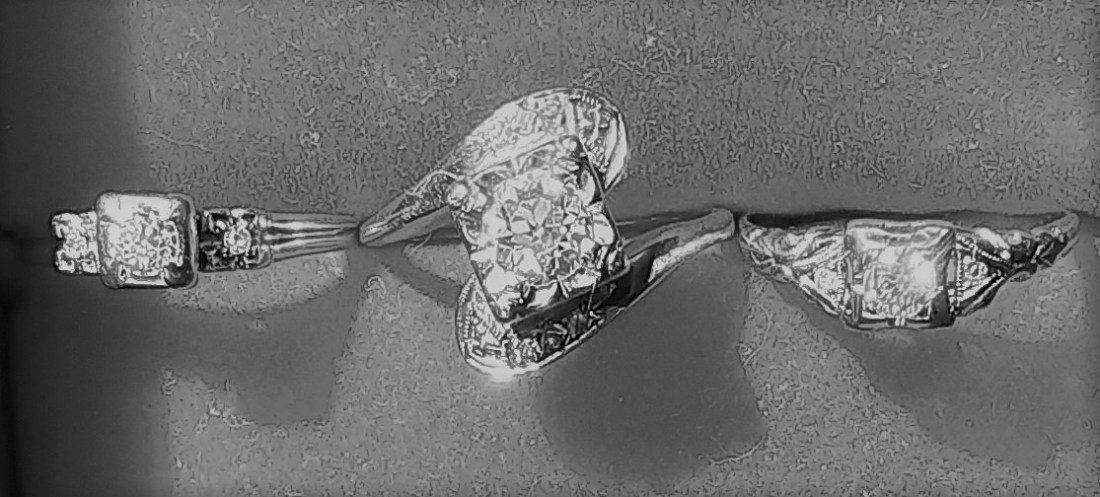
Nestled in my jewelry case.

Is a ring, the middle of three,

Not an everyday, mundane,

Get-your-hands-dirty ring,

It is loud,

An in-your-face statement.

Like you.

Is it right to consider

This seal of connection?

Would one of these other rings work better?

The first is demure and polite,

A humble token.

The other, similar in style

Flashes timidly.

You whisper in my ear.

Choose bold.

I do.

Like a hundred stars

Twinkling in the night,

This ring reminds me of your

Audacious, daring, sparkle of fireworks.

It roars I am here, We are one,

You belong to me and I to you.

Can I wear it?

Our connection flares,

Strong and sure, a knowing

So acute my heart shatters again.

Who am I?

Quantum entanglement,

Mirrored opposite,

Kindred spirit,

Ring-wearer?

How does insanity feel?

Should I know?

Can other people see it?

Will they let me wallow in delusions?  

Will pity overrule truth?

Admiring the dance of light,

My heart becomes a furnace

As I wear this ring.

Until the day the cables

Break on the bridge

We built.

Physical reality

Does not

Include

You.

What am I supposed to do?

Heartbroken,

I give up fantasy,

Become solidly three-D.

Joy steals away in the murky night.

Self-doubt colors what is right.

I wear this ring

Bravely hoping sense will rise.

But a puddle of sorrow

Is drowning me.

I take it off.

Ring set aside, will I settle?

Get my bearings?

At my keyboard, I sit to write

Firmly resigned

That foolishness led me astray.

“I am alone.

Mind-speak isn’t real.

Phantoms are illusions.

Imagination is a fool’s game.

Six thousand, seven hundred, ninety-two miles

And twenty-two years

Across any gulf of time or space

Is too far

No matter how strong the bridge is.”

You feel the same. Right?

A soft caress strokes my finger.

Nerves sing a response.

Tap, tap, tap.

My heart ignites,

And answers,

“I know.”

I walk to the bedroom,

Pick up the ring,

Take a deep breath.

Words flutter

Across my mind:

Patience.

Believe.

I put it on.

A second rhythm

Beats inside me.

Two hearts drum as one.

Imagination amends deep,

Lifelong knowledge

That you, Twin Flame

Exist

Not my Here, 

But, my NOW.

This ring,

This loud, flashy statement

Is a bond not only with you,  

But, with myself.

I am.

I AM.

I am; I am.

I am worthy of Love.

I am worthy of your Love.

I am worthy of Loving.

I am Love.

You are;

We are. 

Mother’s Gift

 Ana had to get out. Erupting, Mt. Shasta incarnate, she ran past the staleness of cigarettes and coffee on her mother’s breath and clothes, the sickly sweet Jean Nate she used to cover them up.

Bang! Hurtful words followed through the back door that slammed against the sill as if shot from a slingshot. They didn’t stop her. She jumped down all four steps off the porch, dashed out the back gate, and hit the pavement running. The slap, slap of her tennis shoes echoed like buckshot fired across the river.

Her mother called her name, once, twice, but Ana was too far along her escape route for the sharpness of her mother’s voice to pin her in place. Stares from three blocks of curious neighbors goose bumped the hair on her arms. She ran until she reached the field. There she crumbled, resting shaky and sweaty palms upon the pricks of the barbed wire. Somehow, the pain felt right.

He nickered when he looked up from grazing in the middle of the pasture. Green drooled from his mouth as he lipped a wad of succulent grass past his teeth. He shook flies from his sides, and his earthy scent beckoned.

She pulled open the wire gate and slipped through.

He took three lazy steps toward her and stopped.

She stopped and gazed at him.

He lowered his head, unsure of her intent.

She whispered his name.

He shook his head. His ears flopped from side to side. He licked his lips.

She softened and slowly walked toward him. When she reached him, she slipped her fingers under his thick mane. The soft warmth of his new, coppery, spring coat underneath the long, black, stranded curtain soothed her in ways she had yet to define, wouldn’t define, could not define. His salty scent spoke of dark woody roots, freshly turned fertile Earth, hugs, and safety.

He took another step, offering himself.

She wrapped her fingers around a handful of mane, jumped, and threw her leg over his broad back.

He sighed, lowered his head, and continued to graze. Muscles on his shoulder twitched, releasing tension between them.

She leaned back until his round rump became a welcome pillow.

The blue, Spring sky was all she could see. For a long time he rocked her with his gentle search across the field for the choicest clumps of grass.

Her heartbeat slowed. Flies buzzed. His tail swished, and flies scattered. A flock of tiny, brown birds landed in the arms of the big oak beside them, chittering from branch to branch, appearing in sunlight and then disappearing into shadow. Traffic rolled down the main road. Neighborhood boys played a rollicking game of dodgeball in the church parking lot down the street.

It seemed like just yesterday that she used to play too, not as one of the guys but not separate either. That had all changed with this awful, crushing metamorphosis.

For a moment, anger rose its ugly head like a rattler coiled at the base of a rock, daring her to come closer. But the clouds were so fluffy, so starkly white against the blue. They rolled into passing sailing vessels, which sent her dreaming about faraway places. An ostrich rose up, then melted just as fast. A wave of rolling boulders tumbled toward the Sierra Nevadas. Anger gave her up and slithered back under its rock. Beneath her, her horse shifted his weight as he grazed, swaying her back to sanity.

As the sun slipped behind a bank of heavy clouds, her thoughts turned to “mother.” Mother took bits of Ana’s soul with her words of warning: You have to watch your weight. We have to do something with that stringy hair. Must you sniff like that? Boys won’t like it. Your belly is getting too round. Put on that bra.

Why was her body betraying her? Why did her mother constantly point it out?

Her horse jerked, raising his head to watch a dog snooping around the edges of the field. For a moment, Ana’s mind blanked as she prepared for the possibility that her horse would chase the dog. But, the dog moseyed on, and her horse lowered his head to graze. She settled back onto the pillow of his rump.

Hadn’t “mother” also given her this refuge? Hadn’t she insisted upon it, even after the first mare died of extreme old age, and the second one met her fate in a tragic, heartbreaking, trailering accident? Hadn’t Mother brought the Goddess into herself to fight for this union of girl and horse?

Maybe the bits she stole were nothing more than unneeded facsimiles of self, little girl bits that would no longer serve who Ana was to become. Could that be true?

Her horse snorted. He stamped his back left foot, shaking her off the center of his back.

She scooted back into place.

Maybe this was truth, right here, on this warm, rocking back with cool breezes gentling past her under a clear, blue, Spring sky. Maybe this was all she needed. Nothing more.

The sweet scent of freshly broken grass under his feet that sent a warm, welcome rush of pleasure through her body was a portent to womanhood. Nothing more.

The awful burden of budding Goddess scared the desperate little girl living inside. Nothing more.

Her steady companion, who swayed beneath her, was a fearless steed who could carry her away from the mischief-maker of puberty for one more day.

Maybe this was all she needed. Her steed was a Mother’s gift. 

Nothing more…nothing less.

Endless Question

As I sit here avoiding the work I have to do on an illustration for a graphic novel I am working on, I try to figure out why I am so afraid of starting it. I have such confidence in other areas of my work and my life, but not this. Drawing terrifies me. As I grapple with “why,” my thoughts turn toward a question that came up in one of my illustration classes and again in a life studio class while I was in college.

What is the difference between a work of art and an illustration? When I was young, I argued that there was no difference. My fellow students disagreed with me. They were of the mind that there were two camps: those that were artists and therefore creators, and the others, those that were mere renderers.  

The argument was that an artist portrays the soul while an illustrator merely depicts what is seen.

I always took offense to this. At the time, I was preparing to become a scientific illustrator, eventually focusing on botanical illustration. When I studied a plant, was I less of an artist because I strove to capture the reality of it instead of its essence? Or did I capture both with my intense scrutiny of its architecture?

What is architecture? Everything in this three-dimensional world is built with arranged atoms, electro-magnetic force, and desire to hold a shape, the tao of becoming, if you will. Eventually, energy dissipates, chaos wins, and the physical form dissolves. However, for that moment in time when all is organized and held together in perfect order, a miracle has transpired – in the case of my study, a plant shimmers in Light. At this point, it does indeed appear that Life is the artist, and I, the mere observer of its architecture.

However, what happens the moment a person captures that plant by pencil, ink, paint, three-dimensional or soft media, or even film? Is this a mere portrait of its architecture? Do we call it illustration or art? What if that plant is captured in the agony of dissolution as chaos overwhelms it? Is this then art because of a possible emotional component, or is it still mere illustration? If not art, what is the additional ingredient that makes it more than “mere.”

In my opinion, anyone who attempts to communicate by form or picture creates art. By the very act of attempting, that extra “something” occurs. The renderer adds Self in the act of observing and recording. No one can negate this factor.

Is every attempt to intentionally render order to be considered art? I found strength for this conviction decades after attending college for the first time, when I re-enrolled to work with clay. In class, the age-old argument was still taking place. What is the difference between a potter and a sculptor? One is utilitarian; the other creates. Really? The professor was lovely, stating that even though one threw a pot that conformed to size, shape, and utility, no two could ever be alike because each potter put his or her hands on the object, thereby changing it and making it uniquely precious.

Her words struck me.

The truth is: There is no difference. The instant a person picks up a lump of clay and squishes it into his or her hand, the mille-second a thought forms as to what that lump of clay will become, creation takes place. The holder of the clay ceases to be merely human and instead becomes creator, transferring essence from Self to object, thereby creating art.

It is the same with everything we do. When clothing is folded with care into a converted shape to accommodate placement into a drawer in such a manner that it won’t lose texture, art has taken place. When dishes are lovingly stacked in a rack to dry in an order specific to the person stacking them, art has taken place. When a shovel is shoved into the ground with the intent of the shoveler’s vision of change upon Earth, art has taken place. When (insert an activity, any activity) is done with intent, art has taken place.

Finally, when an illustrator puts pen to paper and creates an image where there was none – art is created. The question “what is the difference between art and illustration?” is ridiculous, because there is no difference.

I suppose professors will continue to allow the argument to zing around their classrooms, lovingly aware that each artist has to form a conclusion for him or herself.

Right now, it is time for me to stop worrying whether or not these illustrations are “art enough” and just become the artist that I am. 

It’s time to draw.

From My Cave

(Author’s Note: The following is AV’s response to a meditative prompt offered on 1/18/2021, by a member of the writing group she belongs to. It is a 10-minute, raw (unedited) quick write, followed by a drawing she promised her writing Sisters at the Well. AV lives in California. Though it is a continent away from the US Capitol, the state of California is also prepared for upheaval. We are all trying to find our place of balance as the political world around us heaves like an earthquake.)

From the cave within, I see the ocean. The waves roll in…and out, matching my breath, washing away the detritus of anger from the glittering sand.

Why didn’t I think of coming here earlier?

This cave reminds me of life as Homo erectus, a time when hominids were territorial, before we became city builders. It seems we have returned to our brutish ways of late.

However, in this cave, I am safe. There is room for my family, which includes a tribe of people I love, people they love. There is room for any and all who need to come.

Here we have peace.

The ocean provides, in…out, in…out, bringing gifts, taking refuse. We’ve learned to be thankful for what it gives us. We’ve learned to be mindful of what we leave behind.

Sometimes I wish we could return to those simpler ways, to find a way to make life quiet, attuned to the world around us. Sometimes…I wish.

But, I must find a way to look forward, past contrived dates, to what is beyond the horizon. A vessel of change is blowing this way. I can feel it. I just don’t see it.

Yet.

EPSON MFP image