Remembrance of a Gravestone

With the publication of this short personal essay, Alton Parker, a dear friend of mine, and talented writer presents “Remembrance of a Gravestone,” about a monument he saw while on the road from Flagstaff, Arizona to Los Angeles, California. 

Thank you, Alton, for considering publishing, for the first time, on my blog. I love this story.

The setting sun gave the distant mountains a glow of flaming amber. Heading to their far off vista was a straight asphalt highway, cracked and pitted with age. On either side of the highway, a plain of gamboge prairie grass stood. It did not complain about being split by the road; it simply was. Utilitarian power lines were strung alongside the highway, periodically interspersed with poles stretching up into the twilight. Upon one of these, a speckled falcon perched, scanning the ground intently for its next unfortunate meal. Vultures circled the violet sky. 

An unusual monument stood at a point between destination and beginning: a gravestone. Long ago, eons for all I knew, a car accident had killed two people here. Artificial flowers had been collected. The roses must have been a striking crimson at some point, but they had long since been sun bleached into a dull depressing grey. 

No one stops to pay their respects. No one cares about the gravestone beside the asphalt highway. The names of those deaths have been lost, the files rotting away in the archives of some forgotten local newspaper. 

I wonder what their names are. 

I feel a burning need to know who they were and  who they left behind. Does anyone remember them? Does anyone care anymore? I continue my journey towards the amber mountains, now disappearing into ink black night. I remember the gravestone beside the asphalt highway. 

I remember.

December 12, 2025

One Single Moment of Joy

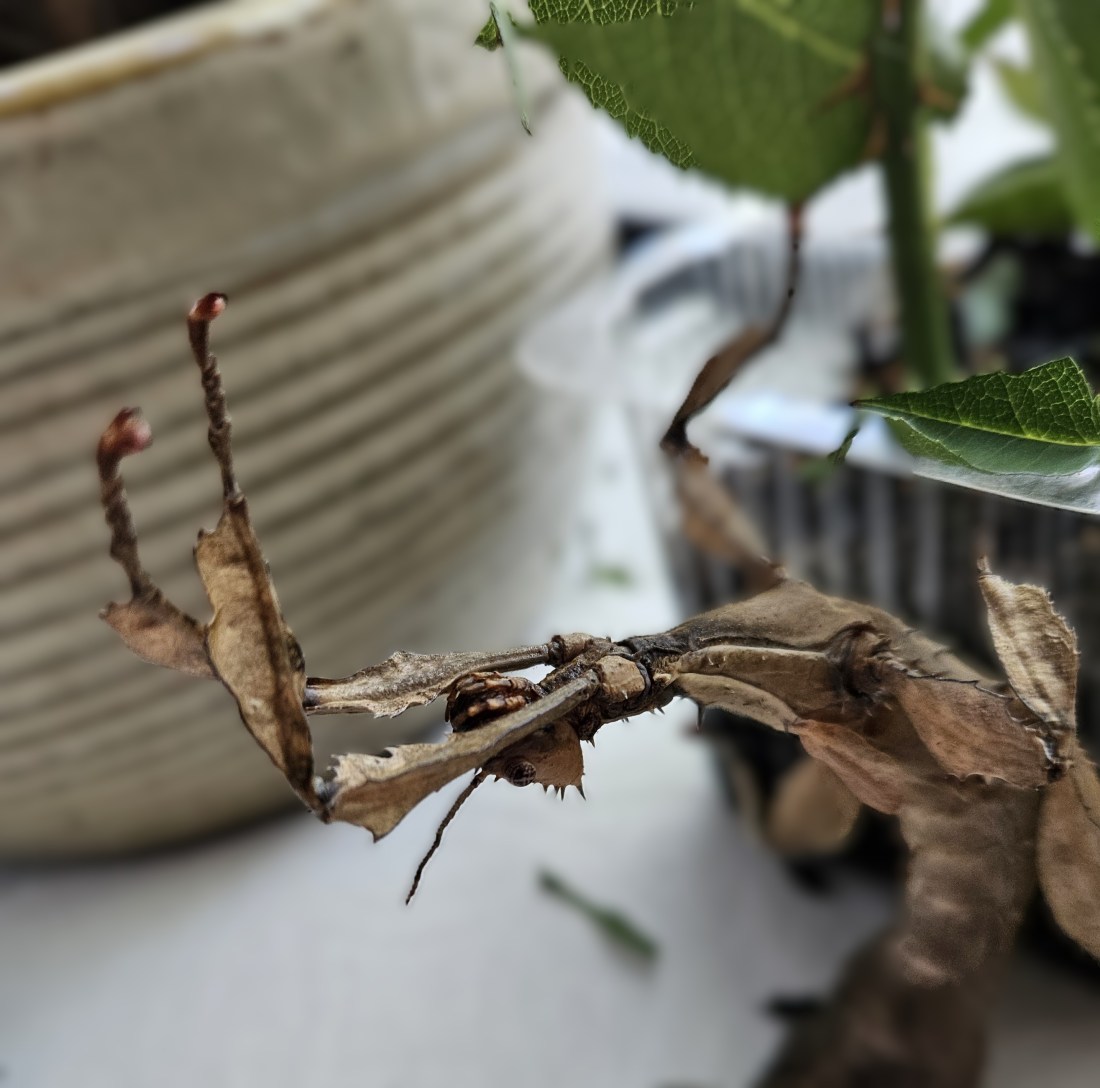
Usually, Sticky Willie, my dear Giant Australian Prickly Stick insect, recoils from my presence, especially if I open her door. She curls, rolls her tail over her back like a scorpion, and rocks frantically, trying to make it known – spikes here – be afraid.

What a poser.

One day, August 6, 2025, to be exact, magic happened: I opened her door. She looked up. Slowly, carefully, one leg at a time, she began creeping toward me. It was as if she were asking, “Who are you?”

Every few steps, she would stop and reach up with one arm as if to explore what was in front of her.

The third time she did this, she was close. Her little face seemed focused on mine. She reached out.

Gently, I touched her tiny claw with the tip of my forefinger.

She patted me.

I stayed there for her, letting her little claw explore my touch.

A sweet moment passed between us, a single moment of joy, shared by two beings of Earth, one homo sapien and one extatosoma tiaratum. 

My heart dances each time I return to that exquisite, wondrous moment.

I can’t help but think how joyful this world would be if we as humans were patient with every living thing, waiting for their energy to come to us rather than us bullying our way into their lives’ plan. What would happen if all of us stopped to learn what trees have to say, what birds are really singing about, what the lady bugs at our feet are doing?

Sticky Willie has her agenda. Her agenda does not alter mine, except with the things she cannot do for herself because I have placed her in an artificial situation. She can’t keep her cage clean, nor can she leave her cage to hunt for her own rose leaves. She cannot squirt herself with water to simulate rain. She may no longer be in her native habitat, but she chose to come here, to trust that I will take care of those things she cannot do for herself. 

I am rewarded with the chance to learn more about my world by watching her. And every once in a while we have a moment. It’s worth slowing down to wait for that one single moment of joy.

Reluctant Gardener – Tale of Two Species

As a gardener, even a reluctant one, there are some unwanted visitors that show up from time to time. Those are usually the species that attract the most attention from us because they seem to disrupt the equilibrium of the garden. But what if that is not the story? What if I don’t need to spend an inordinate amount of time trying to eradicate them?

Galium aparine, known around here as Sticky Willy, or the Hitchhiker plant has many names: Cleavers, Goosegrass, Catch-weed, or Velcro Plant. Leaves, stems, flower petals and seed pods are covered with tiny, hook-like hairs that cling to plants, animals, clothing, and human skin…literally everything.

A self-pollinating annual, I never look forward to early spring as its admittedly beautifully fanned leaf whorls begin to rise through the oxalis, prairie grasses, and three-cornered leeks. I can’t walk my sidewalks without this hitchhiker grabbing my pant legs. And of course when it does, it hangs on for dear life. In doing so, its stem breaks. Such a weakling. However, the roots stay embedded and the little suckers come right back up. 

Until this year, I was successful removing them in a timely manner. I never had a chance to see their display of delicate and beautiful light green and white flowers. I did not witness the seed pods, their means of propagation, so I don’t know how they proliferated throughout my property, but here they are. 

Here is the magic of this plant. It prefers to grow in shade, dappled shade or full sun…truth. It likes clay, sand, or loam. It grows in coastal areas, mountainous terrain or on the plains. It tolerates everything and grows EVERYWHERE. Though botanists think it is indigenous to North America, it is found in many other countries. It probably hitchhiked there. (Perhaps in some unwitting person’s pocket).

It’s useful. Seriously. According to my research it has a purpose. In fact it has many uses. Flowers curdle milk for cheese making. It’s used for stuffing mattresses. It’s edible.

“Wait. It is edible? What?”  

That’s right. People can eat Sticky Willy. The stems and leaves can be cooked with other greens. They are used for tea. The fruit can be dried and used as a coffee substitute. It actually has caffeine. 

(Why am I trying to get rid of this????)

It’s an herbal medicine. An infusion can help reduce swelling, treat infections, or boost energy. There are topical uses as well: ease psoriasis, eczema, and acne. It supports the immune system, and can help support the liver when detoxifying the body. It isn’t reactive with other herbal treatments nor does it affect medications. Sticky Willy is more effective used fresh and not dried, but it grows throughout the spring and summer here. 

(Note: always test a plant on your skin before you try to eat it. Then try a tiny amount, to see how your tongue reacts. Spit out if your body reacts negatively to it.) 

My body did not react negatively to this plant. I might have to create zones for this plant because I think I am going to have to learn to love this plant and look forward to its appearance every year instead of dreading it. 

This leads me to my next tale, also about Sticky Will(ie). On April 12th, 2025 family and friends gathered for my son’s birthday. It’s important to remember that my son seems to be coexisting just fine with the plant called Sticky Will(y). I sat on a bench at his party to admire a flower bed, and there it grew galium aparine, with sparkling fans shining in the string of lights lit for the party.

Go figure. 

The love of his life, his wife, invited a ‘bug lady’ to come to the party to share exotic and interesting insects. My son is a biologist with a love of all things that have multiple legs and sometimes wings. 

The first insect she shared with all the party goers was a monstrous looking thing called extatosoma tiaratum, otherwise known as Giant Prickly Stick Insect. 

I have held stick insects and at the party held another species that looked exactly how you would imagine an insect that imitates a stick should look. Extatosoma tiaratum like its name is GIANT and covered with spiky armor that reminded me of rose thorns. When alarmed, which they all were, they looked like ferocious scorpions of some kind. I did not want to hold this one and didn’t even pet it. It was interesting to “look at.” 

 I was glad when they all went back into their travel carrier.

She loved them though and told us all about it. Native to Australia, they live in trees, usually eucalyptus trees. Herbivorous, they eat the leaves. The insect isn’t harmful, but it does kick when it is angry or scared. 

Then, she gleefully showed us the poop as compared to the eggs that were dropped on the paper towel substrate she was using to transport them. The poop was long and rectangular, the eggs were round. This particular colony was parthenogenetic. 

My listening became more focused. Parthenogenesis, all female colonies – not needing males to breed: I have written about other insects that have this trait. 

She explained that the eggs are dropped to the ground, because the insects don’t come out of the trees willingly. The eggs are coated with a sugary substance that attracts ants. The ants gather them to take them home to feast upon. After eating the sugary shell, they cannot eat through the hard layer underneath so they discard them in their compost piles. (I am interested enough to do some research on ant composting practices in a later blog post.) The babies incubate in the heat of the compost, then hatch, resembling baby ants with black bodies and red heads. 

(Okay, at this point, you have to understand, I was maternally and intellectually interested. The fact that they were born as redheads intrigued me, since my own children are genetically redheads, and my daughter had vivid red hair when she was born.) 

From egg to hatchling takes nine months to 400 days. Wow. That’s a long time. By six molts they look like tiny versions of their mothers. They are quite literally clones of her, since this is a parthenogenetic colony, but there are colonies with both male and female insects. They tend to live longer, and the reproduction cycle may be faster. Each female that is born of a parthenogenetic colony is capable of producing approximately 800 eggs per year, but they only live about eighteen months.  

She continued for at least an hour and a half, perhaps two, sharing many different species with the party crowd which was as intellectually curious as I was. We held and played with many other insects, amphibians, snakes, and even an Amblypygi, the arachnid of Harry Potter fame. I spent a lot of time with a lovely creature that I fell in love with, a small Crested Gecko. 

As she packed up, all of us went to eat food, use the facilities, sit in the living room or around the outside firepit to talk. My daughter and I stayed for about another hour, later than we usually do because this was the best party ever. 

When we got into the car, we fastened our seatbelts for the thirty minute drive to her house. I planned to tank up on coffee for the next leg of my own journey, another forty minutes to my front door. I used the facilities again, made some coffee, and sat down in a chair to review the party. I got up to clean my coffee cup, and pulled a handkerchief from my pocket, which I had done repeatedly during the party to wipe my nose, because it was irritated by the fire pit smoke and my clothes reeked of it.

I felt something prickly in my pocket. Sticky Willy. I didn’t realize I had sat next to some of it, while playing with the animals. Ugh. The tiny green hitchhiker was stuck in my pocket. 

I pulled out the prickliness. It felt like velcro, just like it always did. I felt a pang of disgust because I had not yet come to terms with this plant. (This was pre-research.) 

Instead, I pulled out something brown that clung to my fingers for dear life. I held it up to my daughter. She slowly backed down the hallway away from my outstretched hand, shaking her head. I said, “This isn’t what I think it is, is it?”

She nodded her head, “Yes.” 

A Giant Prickly Stick Insect had hitch hiked home with me. What are the chances that a native tree dweller from Australia, in a yard full of people and TREES would choose my pocket to hide in? 

WHAT ARE THE CHANCES????

My daughter quickly found a jar. We called her brother, and said, “Happy Birthday. You have a new insect,” to which he replied, “No. I am leaving for Ireland tomorrow. You have a new insect.” 

My daughter shook her head, vehemently. “I don’t a don’t have a new insect,” she informed me.

I got home around midnight. I sat in my car, staring at the pint canning jar I had nestled in my cup holder. I sighed, picked it up and trudged into the house. 

My cat greeted me, and I fed her again. I stared at the pint jar on my dining table. “What am I going to do with you?” The tiaratum stayed hidden under the leaves we’d thrown at her from my daughter’s backyard. 

Finally, I threw my hands up into the air and said to the powers of the universe, “Well, I guess I am going to learn how to love an insect.”  

As I write this, she is in a two gallon canning jar, with a makeshift screen lid made for screening I’d bought to repair a door. She is happily munching on oak and rose leaves, while laying eggs. 

Oh goody for me. 

She has huge but peaceful energy, and I am starting to like her. I bought some supplies to make her a better house. I hope she lives the whole eighteen months so I can get to know her better. 

It’s amazing what one can learn and who one can find common ground with when one decides to love, whether that new love is a plant, an animal or another human. 

Works Cited

  1. https://plants.ces.ncsu.edu/plants/galium-aparine/#:~:text=Phonetic%20Spelling%20GAL%2Dee%2Dum,flowering%20and%20seed%20production%20commences
  2. https://www.verywellhealth.com/cleavers-health-benefits-5084341 
  3. https://www.inaturalist.org/taxa/141860-Extatosoma-tiaratum 
Neighbors

Strength wanes

long tenticles of grasses strangle

roses 

bridges between total death

and life

simplicity in purpose

if not grace

grasses

cover earth

otherwise scorched

by relentless sun.       

I am left with the question, what should I annihilate: my desire to destroy the strangling grasses that cling to my roses, or the plants themselves. These unwanted neighbors take nutrients and sunlight from my precious plants. They resist all attempts to eradicate them year after year after year. Where did these insidious creepers come from? What is the reason for their existence? Why can’t they go back where they came from?

As a tree lover, there are only small patches of land in which to grow sun loving plants. As a reluctant gardener, I am tired of fighting. Do I have resources for both?  

Bermuda grass is a sought-after perennial that is lush to walk upon and stays green all season. Intolerant of shade, it is drought tolerant, preferring at least seven hours of sun daily, which is why it is growing where my roses love to be. Bermuda belongs to the family Poaceae. Its official name is Cynodon dactylon. The name sounds like a creature from a monster movie and perhaps it is. Native to the Mediterranean, not Bermuda as its name suggests, people most likely brought it to this continent during the slave trade where it hid in contaminated hay used as bedding. Later, during the 1930’s it was used as a turf grass for golf courses, and in California’s early agriculture days, especially in the Central Valley, it thrived even when irrigated with salinated water. It is tough enough to withstand the trampling of grazing cattle with tenacious root systems. The roots I dig up are bright orange, and can dive as deep as six feet underground. Needless to say, at age seventy, I am not digging holes deep enough to eradicate it.

There is a close look-alike to Bermuda that also plagues my roses. 

Crabgrass. 

Native to Eurasia, it was accepted by the U.S. in 1849, an oddly specific date. The Patent Office named it a “potential forage crop.” Now it is EVERYWHERE. I have even found it growing up the walls of my basement. The most common species in Central California is Digitalis ischaemum. It spreads by scattering seeds, which unfortunately I have facilitated by ripping out the whorls it makes from the ground. Considered a tiller grass, new shoots develop on the crown of a parent plant and while they send down seminal root systems, they still depend upon the parent. And finding that parent can be a scavenger hunt. The good news: Crabgrass actually happily crowds out Bermuda. The bad news….

While researching I discovered there is another invasive pest in my yard that I have actually encouraged and now grows at the base of my roses…Quackgrass. 

Elymus repens, i.e. Quackgrass arrived on this continent sometime during the 16th century. My own ancestors were probably responsible for carrying what is now considered an invasive species over the Atlantic when they escaped…uhh…immigrated, from persecution in Europe. This plant from Eurasia and North Africa, commonly known as Common Couch or Creeping Wild Rye, spreads really fast. Sometimes the rhizomes grow an inch per day. The offspring can be found as far as ten feet from the parent plant. Unwittingly, I find the seed heads to be quite beautiful. It is one of the few grasses I don’t physically react to so naturally, I invited it to stay.

A quick dive through the internet taught me that Quackgrass, of the three of them, probably has a place in this yard as it is nutritious as forage, and good for humans. In early spring, the young shoots are tasty in salads. As well as providing healthy fiber, they are sweet and crunchy. Rhizomes can be dried, ground, and used as flour or as a coffee substitute. Even the sweet, fibrous roots can be eaten. Unfortunately, this plant is allelopathic, which means it uses chemical warfare to repel other plants. My poor roses. 

I probably introduced it into my yard in the bales of straw used to feed and bed my children’s 4-H rabbit projects. However, after learning about this plant, I may take it off my pest list, providing I can move the roses out of its reach. 

I have come to the conclusion that it may be easier to learn to live with these plants than try to fight them. This plant war has been fought on one of the steepest grades in my yard. It would be a thousand times easier to deal with the grasses without the roses getting in the way. The only way to save the roses is to move them to the other side of the house. That’s doable. There’s enough room for everyone here.

Citations

Kaffka, Stephen (2009) – “Can feedstock production for biofuels be sustainable in California?” Original printed in California Agriculture 63 (4): 202-207, 2013

Kaffka, Grattan, Corwi, Alonso, Brown Jr. “Bermuda Grass Yield and Quality in Response to Salinity and N, Se, Mo, and B Rates in West San Joaquin Valley.” UC Center for Water Resources, September 27, 2015.

https://ag.umass.edu/turf/fact-sheets/biology-management-of-crabgrass

https://forages.oregonstate.edu/regrowth/how-does-grass-grow/developmental-phases/vegetative-phase/tillering

https://www.canr.msu.edu/news/pain-in-the-grass-bermudagrass

https://thenatureofhome.com/bermuda-grass-vs-crabgrass/

https://www.thespruce.com/all-about-bermuda-grass-7151762

https://turf.arizona.edu/tips103.htm

Reality Check

San Francisco – 1978

All ten toes tightly grip the precipice of youthful choice. Across a career chasm, a queue of breasty blondes vie for a chance to become the next Marilyn.

“You could have that and more, Miss Singer. You have one of those rare faces that can be either very young…virginal really, or old and wise. You have what it takes.” 

I nod. All the high school and college experiences are worth something after all. The queue telescopes closer.

He lifts my resume and waves it. “The resume is impressive. You’ve answered all my questions. Do you have any?”

Is it too soon to say, “When do I start?” Instead, I shake my head no. 

He says, “I just need one more thing. Pictures.”

Pictures. The last step before my place in that queue.

“Please remove your clothes.”

What? Do I hear that correctly?

“Ahh. There’s no need to remove your panties, at least not yet.”

Details of the queue, hidden by distance, suddenly crystallize: bruised and tear-stained faces, slipped bra straps hanging from bare shoulders, torn blouses, snagged nylons on too much leg flashing beneath dish towel-length skirts. Eyes filled with hunger, desperation, regret….

Is this what it takes? I lift one foot and –

– step back. “No sir. I will not be doing that.”

“I misunderstood. I thought you were hungry. Everyone who is anyone has gone through this.” Disappointment in my choice taints his words, colors his features. 

I bow my thanks and back up to the door. Shaking, I grab the doorknob. It turns easily. I escape into the dank hallway. 

Funny. 

I didn’t notice the squalor upon entering.

I fly from the building and slam into sunshine. San Francisco is warm today. 

“Did-I-do-the-right-thing?” quickly dissipates in the golden light. 

Tick-tick-tick

Tick, tick, tick.

The clock ticks with relentless accuracy while I wait for a shiver of connection. In the trunk of this tree of self, I realize it’s on me now. I am my own advisor. If I were to actually act in that capacity, what would I tell myself? “RIght now there is nothing.

“Nothing about which to worry, nothing about which to rejoice, no aches, nor pains, no elation, nor disheartening ennui.”

There is only a moment of quiet – the tick, tick, tick of a clock, counting the seconds of this empty moment of peace.

I wonder if this is the normal truth of most lives, or am I alone here? Is this why we are driven toward busy-ness? Would life seem to last forever if this moment lasted the length of it? 

Tick, tick, tick.

This was the kind of thing running through my mind while waiting for the voice of inspiration during the ten minutes of writing time on August 8, 2022 after the opening meditation. For that ten minutes, the voice of inspiration never came. I had no words to address the meditative prompt, no words to tell a story. Just emptiness…so, that’s what I wrote about. I kept this, because even when the muse is absent, one can still write something. For me, these moments occur. 

All. 

The. 

Time.

Later that night, for our last prompt, the muse brought me an acrostic. The prompt was Beyond the Beyond: 

Beautiful dreamers create
Everything they see.
Your life is
One like this
Never empty, always budding
Day after Day.

This is
How we
Endure.

Beginning with one thought
Each trmbling into the next
Yearning for substance
Otherworld to ours.
Now is the time.
Dream.

Thoughts About Spring

Four writers from the collective, Wise Women Write share thoughts about Spring and creating space for light. 

Beauty of Spring

Amel Tafsout

After so many weeks of rain, I feel revived by these first spring days. The sky is wearing its azureus color, and the trees are waking up from their sleep. In one day, they transformed themselves, dressed in their most magnificent shimmering leaves and letting their blossoms burst to celebrate the awakening. The lawns covered with fresh grass look like a velvet jade carpet of bright green with tiny wildflowers. People are coming out of their homes starting to work on their garden making sure to decorate them with the gorgeous colorful flowers. Singing Birds are flying, interacting with each other, and announcing that the spring is back. I love seeing the tree blossoms in white and pink; the tulip tree rising, opening its gorgeous pink blossoms looking like bells of silk petals.

The weeping willows are wearing their lacy leaves, bending on a small lake giving shade to everyone. Why do they have such a sad name? I would call them the lacey whispering willow. Life is back, joy is here. My heart is open. Let’s breathe the spring breeze!

Anne B. Jeffries

The cherry Blossoms

Lilt white around their edges

Pink tunneling down

Silky plum petals

Spiral towards their soft centers

Brown stamens stand up

Lynnea Paxton-Honn

New blooms in this vintage yard – surprises. Tiny white blossoms climb the wire fabric draping the cement wall. Clusters light the drab gray. “Look,” I say, “Look, we have new blooms!” I am excited. Every Spring the yard presents us with something brilliant and new – a treasure missed by the weed whacker or mower. The soil is so moist, and nutrient filled, home to earthworms accidentally uncovered as weeds are pulled.

I am entranced, enchanted, bewitched, charmed, enamored.

AV Singer

Bumble bees

Connect dot to dot

Flower to flower

Not a care

About dallying visitors

They earn their name.

Honey bees

Make plans

Hovering

Deciding, diving

Or flying elsewhere

Unceasing, determined.

I pause  

Sit on my walnut stump

Mesmerized warm

By sunshine

Lulled by beesong

The exquisite dance

Brings peace.

Peace

Follows me indoors

Baby lemon trees

Stretch on a windowsill

Safely sprouted in 

An empty Toasted Nori container.

A young grapefruit tree

Reminds me with

A sweet scent of citrus

I am thirsty now.

Please water me.

I counsel

A tiny avocado

Growing next to an older

Brother

I am going to trim you

Right here 

Be prepared.

Nature

Inside and out

Becomes my family

My heart swells with love

Love for bees

Love for trees

Love for Spring.

Simplify to Amplify

Amel Tafsout

All my life I moved to various places, cities, and countries. I packed and unpacked, repacked then packed, repacked and unpacked again. I needed to get rid of so much, pieces of memories, giving books and clothes away, leaving furniture behind. What an amazing feeling to be able to do so. I remember my nomadic ancestors, who had nothing, they faced hardship and challenging weather and managed to live with less. The feeling of simplifying my life starts with having less.

I never heard the term “hoarding” until I came to the US. Why keep so much stuff when it would be great to let other people in need enjoy it, and feel the freedom to have less?

Having the flood in my storage unit enabled me to release more stuff.

The more I give things away, the more I amplify my life. I feel light, free, and at peace. My life is amplified with my memories and my life experience. That is what I will take with me. Loving people, beautiful moments, laughter, and kindness.

Anne B. Jeffries

A jutting cliff edge

My body the narrow ledge

Itself

Nothing beside

Or above

Or below 

Except

Everything 

The sea, a perpetual cycle of depth and layer

All metaphors exhausted

The sky

A wide, domed light show that shoots 

Gulls across its face

All the previous noise released as music

Lynnea Paxton-Honn

How could she get this across to her audience? Such a big concept – PEACE. Too many words just detract – words create unrest as brains worry to get understanding.

PEACE

Even one thought can distort the unity and cohesion of PEACE.

PEACE is unconditional Love. Is that too simple? PEACE is not the absence of antagonism but the fullness of Joy. It is our true HOME –  our infinite, eternal  dwelling space.

AV Singer

Pesky fleas jump. Their burning bites instigate a purge, an urge to rid this house, and consequently my mind, of all that no longer matters.

Demented flies swim upside down across the newly serene floors in a mad attempt to capture my attention. “Persist, adapt, transform.”

I text my children. “I feel a burning desire to simplify.” They’ve seen it before, this need to get rid of dusty, outgrown treasures to amplify Light.

If you are interested in reading more from the writers in Wise Women Write, here is the link: 

River of Words:Wise Women Write

What Do Rocks Know?

As an intuitive I get a lot of information from a lot of places, and it’s presented multiple ways. The knowledge doesn’t just blossom, it bursts into my awareness like a supernova. Sometimes I can make sense of it: an ah-ha that feels so right that chinks that had heretofore been missing, suddenly click into place. Other times I wonder, “What the heck just happened?”

This year my guides nudged me to practice. Intuition isn’t something that just happens, although it used to seem that way. Over time I have learned it is something that can be practiced, like music. While meditating upon this notion I heard: Practice psychometry. Learn to read objects.

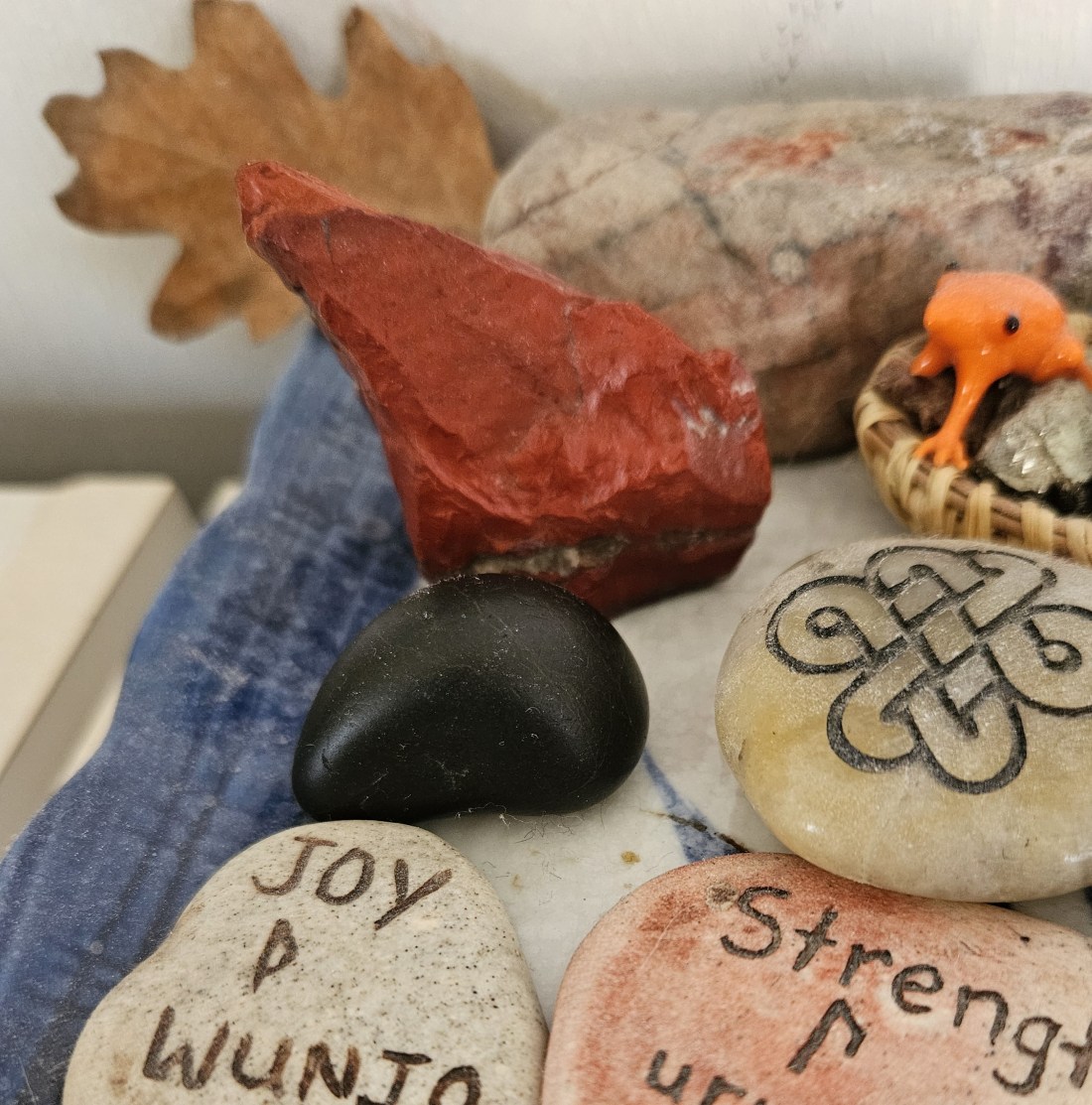
Objects? Where should I start? I look around my house. I know the history and value of almost everything, but then my eyes settle on a basket of rocks. Why not?

I have always been a rock collector, picking up specimens, not only as keepsakes from my travels, but also from my yard. Somehow, they become coveted objects. I had never thought much about them, I just collected them, took them home, and put them into baskets.

One day, after nightfall, while walking in my garden, the scant light of a half-moon shone upon a small, kidney-shaped rock. It was smooth, soft to the touch, and as black as the velvet of the sky.

A comfort rock.

I slipped it into my pocket and rubbed it as I walked about. When I went inside, I placed it upon my altar. From time to time, I picked it up to rub its silkiness, then I put it back among the other treasures that remind me of who I am. It’s been there for several years.

For this new practice, my perfect little comfort stone was not my first choice. Another altar stone caught my attention, a chunk of red jasper from Patagonia, Arizona. 

I held it in my hands, cradled between my palms. First, the stone felt cold, then colder still. Odd. The more I held it, the colder it got.

“Follow the cold,” I told myself. “Follow the cold.”

In my mind’s eye a migration of people passes, wind howls. Darkness, ice, snow blow against them. They shuffle on, heads down, dressed in fur. 

Profound cold. Ice-aged people in an ice-aged world.

Excited, I practiced for several days. I was learning to let go of preconceived notions. It was an important lesson because often intuition is skewed by personal ideas or desires. 

On the fourth day, feeling as if I was learning how to read these rocks, and to let go of what I expected to learn about them, I picked up my comfort stone.

The lesson of preconceived notions didn’t stop my monkey mind forming them. “It is most likely black basalt, washed and tumbled smooth from a creek bed. Where did it come from? Somewhere atop the Sierra Nevada.”

I nestled it between my palms. Immediately I saw a tumbling washing machine. 

“Well, that can’t be right.”

I focused on the feel of the rock as I had been doing, expecting this one, as had all the others, to be cold and either remain cold or get colder. 

Not so. 

There is heat. And the more I held it the hotter it became. It became so hot I was compelled to let go, and when I picked it up, I placed it against my cheek. It was as if a tiny furnace burned inside it.

I followed the heat. 

Suddenly, there was the washer again. 

What?

Ahh! Then it came to me. This tiny rock was tumbled in an industrial rock polisher! It was sold as gravel, “polished” to resemble river rock and used as a blanket to line decorative waterways or patios. In my yard, it lined a drainage ditch. Before that, it knew only pressurized heat, not volcanic, pressurized. Pressurized heat seemed very important to this reading.

I pressed the lingering warmth against my cheek, cherishing it, and then set the tiny, black rock onto my altar. 

How surprising. 

As I left my bedroom, a notion hit me. Is it possible that some of the major psychic events I experience come from the very rocks I stand upon? How much do rocks know?

Backed-up Stories

Thich Nhat Hanh wrote in his book, Interbeing: Fourteen Guidelines for Engaged Buddhism, “in this piece of paper is a cloud.” Inspired by his words, Anne B. Jeffries gave the women in my writing group this prompt on August 28th: In this tear is everything.

Lynnea Honn wrote:

Foretelling

Foreshadowing of

winter shadow stretches out

and yawns Preparing

Shari Anderson wrote:

Cascading 

         Sounds, tones,   

Ideas, words

                           Water-falling

          Pummeling

                     Cleansing

                            Rubbing

      Wearing away

                                            His-story

                 Revealing Myself

     Wholly New

I wrote:

In this tear is everything – every story ever told, from the inception of our Earth until this very moment, and this one, and this one, and this one…and…this…one.

Writer’s block is not a myth. It exists. Most writers experience it. What is it? In my opinion, writer’s block is a symptom of all our tears – the backed up stories carried inside – stories one does not want to face.

You know what I mean. We all tell ourselves stories to get through life. When we tell them long enough, they seemingly become truth. I bet writers have more than their share because they tend to narrate moment by moment.

As a writer, I dumped bits and pieces of my story onto my characters and into their plots. I’m beginning to wonder, can I continue to pass off my life to imaginary others or should I own up to my stories and claim them? By claiming them, might they become part of your story as well, just as yours would become part of mine?