Reluctant Gardener – Tale of Two Species

As a gardener, even a reluctant one, there are some unwanted visitors that show up from time to time. Those are usually the species that attract the most attention from us because they seem to disrupt the equilibrium of the garden. But what if that is not the story? What if I don’t need to spend an inordinate amount of time trying to eradicate them?

Galium aparine, known around here as Sticky Willy, or the Hitchhiker plant has many names: Cleavers, Goosegrass, Catch-weed, or Velcro Plant. Leaves, stems, flower petals and seed pods are covered with tiny, hook-like hairs that cling to plants, animals, clothing, and human skin…literally everything.

A self-pollinating annual, I never look forward to early spring as its admittedly beautifully fanned leaf whorls begin to rise through the oxalis, prairie grasses, and three-cornered leeks. I can’t walk my sidewalks without this hitchhiker grabbing my pant legs. And of course when it does, it hangs on for dear life. In doing so, its stem breaks. Such a weakling. However, the roots stay embedded and the little suckers come right back up. 

Until this year, I was successful removing them in a timely manner. I never had a chance to see their display of delicate and beautiful light green and white flowers. I did not witness the seed pods, their means of propagation, so I don’t know how they proliferated throughout my property, but here they are. 

Here is the magic of this plant. It prefers to grow in shade, dappled shade or full sun…truth. It likes clay, sand, or loam. It grows in coastal areas, mountainous terrain or on the plains. It tolerates everything and grows EVERYWHERE. Though botanists think it is indigenous to North America, it is found in many other countries. It probably hitchhiked there. (Perhaps in some unwitting person’s pocket).

It’s useful. Seriously. According to my research it has a purpose. In fact it has many uses. Flowers curdle milk for cheese making. It’s used for stuffing mattresses. It’s edible.

“Wait. It is edible? What?”  

That’s right. People can eat Sticky Willy. The stems and leaves can be cooked with other greens. They are used for tea. The fruit can be dried and used as a coffee substitute. It actually has caffeine. 

(Why am I trying to get rid of this????)

It’s an herbal medicine. An infusion can help reduce swelling, treat infections, or boost energy. There are topical uses as well: ease psoriasis, eczema, and acne. It supports the immune system, and can help support the liver when detoxifying the body. It isn’t reactive with other herbal treatments nor does it affect medications. Sticky Willy is more effective used fresh and not dried, but it grows throughout the spring and summer here. 

(Note: always test a plant on your skin before you try to eat it. Then try a tiny amount, to see how your tongue reacts. Spit out if your body reacts negatively to it.) 

My body did not react negatively to this plant. I might have to create zones for this plant because I think I am going to have to learn to love this plant and look forward to its appearance every year instead of dreading it. 

This leads me to my next tale, also about Sticky Will(ie). On April 12th, 2025 family and friends gathered for my son’s birthday. It’s important to remember that my son seems to be coexisting just fine with the plant called Sticky Will(y). I sat on a bench at his party to admire a flower bed, and there it grew galium aparine, with sparkling fans shining in the string of lights lit for the party.

Go figure. 

The love of his life, his wife, invited a ‘bug lady’ to come to the party to share exotic and interesting insects. My son is a biologist with a love of all things that have multiple legs and sometimes wings. 

The first insect she shared with all the party goers was a monstrous looking thing called extatosoma tiaratum, otherwise known as Giant Prickly Stick Insect. 

I have held stick insects and at the party held another species that looked exactly how you would imagine an insect that imitates a stick should look. Extatosoma tiaratum like its name is GIANT and covered with spiky armor that reminded me of rose thorns. When alarmed, which they all were, they looked like ferocious scorpions of some kind. I did not want to hold this one and didn’t even pet it. It was interesting to “look at.” 

 I was glad when they all went back into their travel carrier.

She loved them though and told us all about it. Native to Australia, they live in trees, usually eucalyptus trees. Herbivorous, they eat the leaves. The insect isn’t harmful, but it does kick when it is angry or scared. 

Then, she gleefully showed us the poop as compared to the eggs that were dropped on the paper towel substrate she was using to transport them. The poop was long and rectangular, the eggs were round. This particular colony was parthenogenetic. 

My listening became more focused. Parthenogenesis, all female colonies – not needing males to breed: I have written about other insects that have this trait. 

She explained that the eggs are dropped to the ground, because the insects don’t come out of the trees willingly. The eggs are coated with a sugary substance that attracts ants. The ants gather them to take them home to feast upon. After eating the sugary shell, they cannot eat through the hard layer underneath so they discard them in their compost piles. (I am interested enough to do some research on ant composting practices in a later blog post.) The babies incubate in the heat of the compost, then hatch, resembling baby ants with black bodies and red heads. 

(Okay, at this point, you have to understand, I was maternally and intellectually interested. The fact that they were born as redheads intrigued me, since my own children are genetically redheads, and my daughter had vivid red hair when she was born.) 

From egg to hatchling takes nine months to 400 days. Wow. That’s a long time. By six molts they look like tiny versions of their mothers. They are quite literally clones of her, since this is a parthenogenetic colony, but there are colonies with both male and female insects. They tend to live longer, and the reproduction cycle may be faster. Each female that is born of a parthenogenetic colony is capable of producing approximately 800 eggs per year, but they only live about eighteen months.  

She continued for at least an hour and a half, perhaps two, sharing many different species with the party crowd which was as intellectually curious as I was. We held and played with many other insects, amphibians, snakes, and even an Amblypygi, the arachnid of Harry Potter fame. I spent a lot of time with a lovely creature that I fell in love with, a small Crested Gecko. 

As she packed up, all of us went to eat food, use the facilities, sit in the living room or around the outside firepit to talk. My daughter and I stayed for about another hour, later than we usually do because this was the best party ever. 

When we got into the car, we fastened our seatbelts for the thirty minute drive to her house. I planned to tank up on coffee for the next leg of my own journey, another forty minutes to my front door. I used the facilities again, made some coffee, and sat down in a chair to review the party. I got up to clean my coffee cup, and pulled a handkerchief from my pocket, which I had done repeatedly during the party to wipe my nose, because it was irritated by the fire pit smoke and my clothes reeked of it.

I felt something prickly in my pocket. Sticky Willy. I didn’t realize I had sat next to some of it, while playing with the animals. Ugh. The tiny green hitchhiker was stuck in my pocket. 

I pulled out the prickliness. It felt like velcro, just like it always did. I felt a pang of disgust because I had not yet come to terms with this plant. (This was pre-research.) 

Instead, I pulled out something brown that clung to my fingers for dear life. I held it up to my daughter. She slowly backed down the hallway away from my outstretched hand, shaking her head. I said, “This isn’t what I think it is, is it?”

She nodded her head, “Yes.” 

A Giant Prickly Stick Insect had hitch hiked home with me. What are the chances that a native tree dweller from Australia, in a yard full of people and TREES would choose my pocket to hide in? 

WHAT ARE THE CHANCES????

My daughter quickly found a jar. We called her brother, and said, “Happy Birthday. You have a new insect,” to which he replied, “No. I am leaving for Ireland tomorrow. You have a new insect.” 

My daughter shook her head, vehemently. “I don’t a don’t have a new insect,” she informed me.

I got home around midnight. I sat in my car, staring at the pint canning jar I had nestled in my cup holder. I sighed, picked it up and trudged into the house. 

My cat greeted me, and I fed her again. I stared at the pint jar on my dining table. “What am I going to do with you?” The tiaratum stayed hidden under the leaves we’d thrown at her from my daughter’s backyard. 

Finally, I threw my hands up into the air and said to the powers of the universe, “Well, I guess I am going to learn how to love an insect.”  

As I write this, she is in a two gallon canning jar, with a makeshift screen lid made for screening I’d bought to repair a door. She is happily munching on oak and rose leaves, while laying eggs. 

Oh goody for me. 

She has huge but peaceful energy, and I am starting to like her. I bought some supplies to make her a better house. I hope she lives the whole eighteen months so I can get to know her better. 

It’s amazing what one can learn and who one can find common ground with when one decides to love, whether that new love is a plant, an animal or another human. 

Works Cited

  1. https://plants.ces.ncsu.edu/plants/galium-aparine/#:~:text=Phonetic%20Spelling%20GAL%2Dee%2Dum,flowering%20and%20seed%20production%20commences
  2. https://www.verywellhealth.com/cleavers-health-benefits-5084341 
  3. https://www.inaturalist.org/taxa/141860-Extatosoma-tiaratum 

Neighbors

Strength wanes

long tenticles of grasses strangle

roses 

bridges between total death

and life

simplicity in purpose

if not grace

grasses

cover earth

otherwise scorched

by relentless sun.       

I am left with the question, what should I annihilate: my desire to destroy the strangling grasses that cling to my roses, or the plants themselves. These unwanted neighbors take nutrients and sunlight from my precious plants. They resist all attempts to eradicate them year after year after year. Where did these insidious creepers come from? What is the reason for their existence? Why can’t they go back where they came from?

As a tree lover, there are only small patches of land in which to grow sun loving plants. As a reluctant gardener, I am tired of fighting. Do I have resources for both?  

Bermuda grass is a sought-after perennial that is lush to walk upon and stays green all season. Intolerant of shade, it is drought tolerant, preferring at least seven hours of sun daily, which is why it is growing where my roses love to be. Bermuda belongs to the family Poaceae. Its official name is Cynodon dactylon. The name sounds like a creature from a monster movie and perhaps it is. Native to the Mediterranean, not Bermuda as its name suggests, people most likely brought it to this continent during the slave trade where it hid in contaminated hay used as bedding. Later, during the 1930’s it was used as a turf grass for golf courses, and in California’s early agriculture days, especially in the Central Valley, it thrived even when irrigated with salinated water. It is tough enough to withstand the trampling of grazing cattle with tenacious root systems. The roots I dig up are bright orange, and can dive as deep as six feet underground. Needless to say, at age seventy, I am not digging holes deep enough to eradicate it.

There is a close look-alike to Bermuda that also plagues my roses. 

Crabgrass. 

Native to Eurasia, it was accepted by the U.S. in 1849, an oddly specific date. The Patent Office named it a “potential forage crop.” Now it is EVERYWHERE. I have even found it growing up the walls of my basement. The most common species in Central California is Digitalis ischaemum. It spreads by scattering seeds, which unfortunately I have facilitated by ripping out the whorls it makes from the ground. Considered a tiller grass, new shoots develop on the crown of a parent plant and while they send down seminal root systems, they still depend upon the parent. And finding that parent can be a scavenger hunt. The good news: Crabgrass actually happily crowds out Bermuda. The bad news….

While researching I discovered there is another invasive pest in my yard that I have actually encouraged and now grows at the base of my roses…Quackgrass. 

Elymus repens, i.e. Quackgrass arrived on this continent sometime during the 16th century. My own ancestors were probably responsible for carrying what is now considered an invasive species over the Atlantic when they escaped…uhh…immigrated, from persecution in Europe. This plant from Eurasia and North Africa, commonly known as Common Couch or Creeping Wild Rye, spreads really fast. Sometimes the rhizomes grow an inch per day. The offspring can be found as far as ten feet from the parent plant. Unwittingly, I find the seed heads to be quite beautiful. It is one of the few grasses I don’t physically react to so naturally, I invited it to stay.

A quick dive through the internet taught me that Quackgrass, of the three of them, probably has a place in this yard as it is nutritious as forage, and good for humans. In early spring, the young shoots are tasty in salads. As well as providing healthy fiber, they are sweet and crunchy. Rhizomes can be dried, ground, and used as flour or as a coffee substitute. Even the sweet, fibrous roots can be eaten. Unfortunately, this plant is allelopathic, which means it uses chemical warfare to repel other plants. My poor roses. 

I probably introduced it into my yard in the bales of straw used to feed and bed my children’s 4-H rabbit projects. However, after learning about this plant, I may take it off my pest list, providing I can move the roses out of its reach. 

I have come to the conclusion that it may be easier to learn to live with these plants than try to fight them. This plant war has been fought on one of the steepest grades in my yard. It would be a thousand times easier to deal with the grasses without the roses getting in the way. The only way to save the roses is to move them to the other side of the house. That’s doable. There’s enough room for everyone here.

Citations

Kaffka, Stephen (2009) – “Can feedstock production for biofuels be sustainable in California?” Original printed in California Agriculture 63 (4): 202-207, 2013

Kaffka, Grattan, Corwi, Alonso, Brown Jr. “Bermuda Grass Yield and Quality in Response to Salinity and N, Se, Mo, and B Rates in West San Joaquin Valley.” UC Center for Water Resources, September 27, 2015.

https://ag.umass.edu/turf/fact-sheets/biology-management-of-crabgrass

https://forages.oregonstate.edu/regrowth/how-does-grass-grow/developmental-phases/vegetative-phase/tillering

https://www.canr.msu.edu/news/pain-in-the-grass-bermudagrass

https://thenatureofhome.com/bermuda-grass-vs-crabgrass/

https://www.thespruce.com/all-about-bermuda-grass-7151762

https://turf.arizona.edu/tips103.htm

The Reluctant Gardener

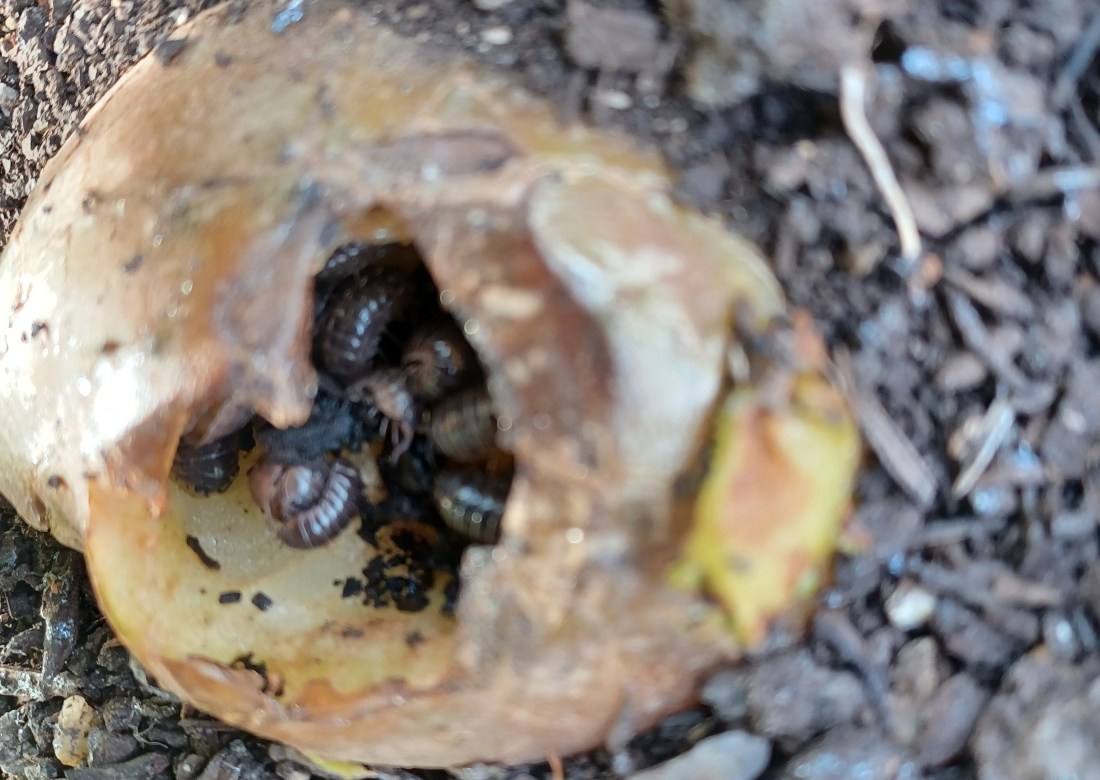
Armadillidiidae (photo by Lisa DeRosa)

Wee boy
Flipped a rock
Found a crawly
Picked it up
Watched it curl
Perfect ball
Rolling on his palm.
What a wonder.
Did you pop it
Into your nose
To keep it safe
To keep it close?

While I discourage this behavior, especially after a trip to the doctor to remove the little beastie, it did prove that Armadillidium vulgare, a terrestrial crustacean, can live quite happily in a dark, moist environment. (Yes, it was still alive when the doctor removed it.)

It was difficult to research A. vulgare. They are not considered agricultural pests. They are so common in our country that people take them for granted and mostly ignore them. They did not originate here though. Possibly as early as two-hundred million years ago,
sometime after the end of the Triassic period, tiny, gill-breathing crustaceans
crawled onto what would now be considered European shores and adapted to stay
land-bound. The species found in California, Armadillidium vulgare, is usually
bluish gray with plates that allow them to conglobate, or curl into a ball,
which they do for protection and water conservation. This species was
introduced to New England from mediterranean regions sometime during the
1800’s. I could not find any documentation about how they arrived in California.
Maybe they came during the Gold Rush.

Here's what we do know about them. They are nocturnal, and like dark moist places. They breathe with a gill system. Apparently, the hind-most set of their seven pairs of legs adapted to become air tubes that feed into a gill system on the underside of their body. They
roll into a ball to conserve moisture, because gills need wet surfaces to stay
healthy. One usually finds them under rocks, or leaf litter on moist ground, but
if you are a pet-keeper, it is a good idea to create some dry, warm places as
well, because they need an outside source of heat to regulate body temperature.
 

Pill bugs, or as they are commonly known in my area, roly-polies, are detritivores, consuming decomposing plants and animals. In terrarium conditions, they are helpful as they will also clean-up their own shed exoskeletons and any mold or fungus that grows in an enclosed, moist habitat.

Though not a pest, they will consume young plants. I learned the hard way that using leaf litter as a mulch only attracts them…By. The. Thousands. (Okay, maybe hundreds.) My point is nothing has a chance to grow with a large population of hungry decomposers who eat seedlings as dessert.

There have been some recent studies that claim that because they also eat fungi they help with global warming. Fungi release CO2 into the atmosphere as they perform decomposition
tasks. Armadillidiidae keep fungi populations in check, mitigating CO2 production.
Every little bit helps.

Another fun fact is that when they are cleaning up, they eat trace amounts of heavy metals, thereby preventing food plants from absorbing them. The more I learn about these little treasures, the more I am tempted to create attractions for them in my garden on purpose
instead of by accident.

Roly-polies are hatched about a week after fertilization into a brood sack on the underside of an adult female. Yes, they are marsupials. I was so thrilled to learn that. I now know that I have mammalian and crustaceous marsupials in my backyard. Yay!

The babies stay in the marsupial pouch for about two weeks. Upon exiting the pouch, these young ones molt every two weeks for about four and a half months, at which point they are considered adults. (I think. No source actually said that.) Females can store deposited sperm
for up to a year, picking the prime time for survival. This may be why some
sites claim the females can reproduce asexually. However, in my opinion, the
male courting dance seems quite elaborate: males wave their antennae at the
females to get their attention. Once they get it, they choose a mate. They then
lick and tap her to convey intention. In my mind, that refutes the notion that
females can reproduce asexually. It just seems that the male roly-poly uses a
lot of energy to get the female to like him. Why would she put up with that if she
could do it without him?

Even though I could not find much scientific research about them, because roly-polies are not agricultural pests, I had a great time researching pet sites on YouTube. Did you know they live three to five years? That’s plenty of time to form relationships with these
tiny creatures.

If you want to attract roly-polies, pile up some fallen leaves, or place a corn cob, half of a cantaloupe, or even a rotting potato outside in the shade. Leave whatever you have chosen in place for a few days, then move the waste along with scores of attracted pill bugs. I
have included links to videos that show how to set up a house for your newly
adopted pets.

Or, you can just let them mind your garden, knowing that this gift from the sea is protecting your land.

Sources Cited
https://entnemdept.ufl.edu/creatures/MISC/Armadillidium_vulgare.htm
https://www.pbs.org/newshour/science/pill-bugs-emerged-sea-conquer-earth
https://www.treehugger.com/roly-poly-pill-bug-facts-important-environment-4864410
https://en.wikipedia.org/wiki/Armadillidiidae
https://en.wikipedia.org/wiki/Armadillidium_vulgare

Videos
https://www.youtube.com/watch?v=Ij7VDu6iWCg
https://www.youtube.com/watch?v=9oUkDOI_QmI
https://www.youtube.com/watch?v=p-dTokDjn14   
(This is about A. vulgare in particular)

Fig Leaf

My neighbor worried that my fig tree was giving up. There were several reasons: I cut her back so she doesn’t have to work so hard while Californians ration water.  She lost the shade to which she was accustomed when the large companion tree that sheltered her was trimmed. As a reluctant gardener, my plants fend for themselves. I am not heartless, instead I am desperate to help conserve our water supply, so I wait and watch wondering what grows here naturally, and hoping some of it will be good to eat.  

Who will survive the new, harsher conditions? 

My Black Mission fig leafed earliest. The first inflorescences began to bud late this Spring. 

What makes her so successful? 

Figs have fed hominids and others throughout history. Uniquely adapted for harsh conditions, it grows where other plants fail. Technically, that which we call a fruit is actually an enclosed collection of flowers. Stem growth forms a bulb within which this cluster of flowers develops. Each blossom is destined to become a single, tiny drupelet. Encased within a protective womb, they do not need to fight heat or dry conditions. Some species, forming both male and female flowers, do not need assisted pollination. Others invite a miniscule female wasp into their chambers to spread pollen while she lays her eggs. These flowers then grow into a cluster of drupes, all encased within their pristine environment. (No worries, the babies escape before we eat the figs.)    

This year, a few flowers ripened early, oh so sweet. I await the others. My fig  thrives in this hot, dry climate and can live a century. Planted during my lifetime, she will be my companion as long as I am here. 

On Monday July 17th, Shari, one of the members of the writing group to which I belong, threw us this prompt: fig leaf.  A short ten minutes later, we had the following offerings. I am thrilled to present my writing sisters and their responses to her prompt.

Fig Leaf – Shari Anderson 

When I was a young child, my father planted a grapevine and a fig tree in our backyard. It was

biblical 

“Every man under his vine and his fig tree” 

inspired. 

I don’t remember the grapes –

maybe they never fruited, but the figs were juicy and delicious. The leaves of that tree were 

wonderful, 

unusually shaped with lots of rounded edges, sensual, with female curves.

Why a man, under his fig tree? Why not a woman? Why not just the fig tree itself, shapely,

verdant, simply divine?!

But, my favorite backyard plant was a wild cherry bush, which we used as a hideout, gorging ourselves with fruit while fighting off attacking pirates.

Fig Leaf – Dianne McCleery 

The other day, I had to duck under fig leaves to reach Valarie’s front door. And I loved it. I love the hugeness of fig leaves. I love their shape. And, of course, I love to eat figs, especially since they are really flowers, not fruit. I’ve always appreciated adding pansies or nasturtiums to salads, but their tastes are “eh,” not like the deep deliciousness of figs. Yes, I am a fan.

Fig Leaf – Joyce Campbell 

The fig leaf reminds me of an outstretched hand

Welcoming and offering a space to land.

Winged beings pause there, some large and some small,

And those with vibrations I can’t see at all.

Hidden below in the cool of the shade

Sprout tiny green nuggets, a prize for their fame.

Soon to be wrinkled and golden with age,

Dried to perfection a treat with no shame.

Fig Leaf – Anne Jeffries

As far as I’m concerned,

Eve’s “transgression” freed humanity 

From an unconscious tunnel of an existence.

Imagine Utopia:

Yours different than mine, I suppose

But however that flowered garden is laid out before you

Without the snake

Slithering it’s SINewy offerings

There is no Will

No humanness at all:

Our choices and failings, our triumphs and joys, our sufferings and lessons.

Eve took us, perhaps out of our pure animal nature.

She gave way for the fig leaf of shame

To eventually free us from innocence

Fig Leaf – Amel Tafsout

Covered with a gentle morning frost.

Stretching your fingers to many directions

The lines of your open palm

Go back to the beginning of creation.

Your soft green color soothes the sight

Attached to the blessed tree.

You share shade generously.

You hold your sweet biblical fruit with care.

Then leave with the wind.

Blowing to a new world

Moving with lightness

Dancing your way freely

Ending on Adam’s private part

Covering up Humankind

Living in the complexity of reality.

Afternoon Delight – Barbara S Thompson

Do you remember the scene from

A Woman In Love

When the meal slowly unfolds 

at the garden table

like luscious lovemaking?

As guests

caress and stroke

kiss and swallow plump red grapes,

black olives and

cheeses, soft and hard.

In slow, sultry nibbles.  

Alan Bates leans back in his chair

with heavy lidded eyes

 preparing to explain 

the proper way to eat a fig,

It is an English garden after all.

When Eleanor Bron selects a smallish fig

piercing it’s base with one long, elegant finger

splitting it open to reveal the pale purple fruit within

Heavy with seed and fragrance

Slowly she opens her mouth 

biting into the flesh 

her soft moan echoing around the table.

Fig Tales – Betsy Rich Gilon

Ancient one, your leaves flutter,

The desert wind  murmurs,

Camels leave footprints.

Would I have felt

The stories you tell,

Had I bitten into your flesh

Fig Leaf – Symbol of Shame? – AV Singer

Protection from sun

Invitation to hunt

hidden treasures,

Oh, fig leaf,

Why you?

           ∞

Fingers of mercy

on palm so large, 

how long

must you

hide me?

           ∞

Figs ripen

hidden behind

green curtain.

Why is this 

forbidden?

Please connect in the comments, or by clicking on the Like button. For more information about figs, follow these sources:

Sources:

https://journals.ashs.org/hortsci/view/journals/hortsci/42/5/article-p1083.xml

https://www.thespruceeats.com/history-of-figs-1807598

Post #2 Reluctant Gardener

Works Cited

Flint, Mary Louise, Docent; Galls on the Valley Oaks of Effie Yeaw; October 11, 2018     https://sacnaturecenter.net/visit-us/nature-blog/news.html?NewsID=56742

Sousa, Marcy; What are Oak Galls? Here’s what you need to know about these insect breeding grounds; Home and Garden September 16, 2021,

https://www.recordnet.com/story/lifestyle/home-garden/2021/09/16/what-oak-galls-what-know-these-insect-breeding-grounds/8368800002/