Breathed By

I just noticed that last week’s title was about breath. We’re doing a lot of breath work in California right now.

I always get excited when I can share my blog space with other artists and writers. Lynnea Paxton-Honn teaches presence and oneness in meditation. An avid horsewoman she bridges the Tao of horse with the Tao of human. Her compassion is boundless, yet she considers herself a student. She joins me today in response to the title of a new song by Shari Anderson, shared on the evening of August 9th at our meeting of the Women Writers of the Well.

Breathed By

Lynnea Paxton-Honn, 8/9/2021

Sitting in meditation

I breathe,

Inhale and exhale,

Stretching exhale into silence,

Jump starting with inhale.

Is it me that is breathing?

And what part of me?

How often do I

Breathe with awareness?

Not near as often

As my body

Breathes me,

As the changing weather,

Changing emotions

Breathe my body,

Lungs attached to

Passing breezes, passing winds.

Only in full conscious awareness

Do I know I breathe

With the cosmos.

When we breathe consciously, of what might we be capable? Life is magical. Even when there is a probable, logical explanation for any given event that happens in this three-dimensional existence, it is always more fun, and many times, more impactful to embrace serendipity and enjoy the magic that unfolds. Breathe with consciousness. Who knows; someone might find the way home.

Nighttime Miracle, based on a true story.

AnaValarie, (remembered lines from Shari’s song: breathes in the light, travels through darkness, breathes out the light.)

A little boy woke up screaming.

As usual, his mother woke, was out of bed, and by his side before she had a chance to breathe out the dream she was in and breathe in the moment. “Shh, shush. It’s only a dream,” she crooned, smoothing the hair off his face.

“No,” he wailed. “Look. There.” He pointed to a shadowy darkness in the corner nearest the closet.

If she squinted, she could almost believe something was there. “Hush, Darling. It’s just a shadow.”

“It’s not. He’s, he’s talking to me. It’s a monster.” He hid his tear-stained face in his pillow. His shoulders shook, his breath labored. Worried that her little one wouldn’t sleep the rest of the night, and quite frankly, neither would she, she said, “This is what we’re gonna do. Sit in my lap.”

The boy climbed out of bed and grabbed her neck. She wrapped him into her arms. “You know how much I love you.”

“Bigger than the Earth? Bigger than forever?”

“Yes. Bigger than all the Earth. Bigger than forever. Let that big love fall right into your lap and hold it there.”

The little boy’s tummy expanded and then tightened as breath filled him with remembered love.

“When you let the air go, blow all that love right into the center of that shadow.” She pointed to the blackness near the closet.

The little boy’s breath whooshed outward as he stared into the shadow, blowing with all his might.

“Let’s keep doing that together; remembering our love, letting it fall into our laps, and then blowing that loving energy right at that monster.”

They hugged each other tightly.

“Stare right into the shadow and think about how much I love you and you love me,” she reminded him.

He nodded.

As they sat together, breathing love into a monster, she felt warmth build between herself and her son. A strong connection had always been there, but she perceived that this was a special moment. She stared at the shadow and pushed that feeling toward it, mother and son breathing in love, breathing out love, sending it to the shadow in the corner by the closet.

The shadow began to quiver.

Must be a trick of the eyes, she thought but she held her concentration, thinking only of the love she had for her son, and offering that love to his monster.

Slowly, a glow of light began around the edges, diffusing its darkness. Suddenly, bright white light flashed in that corner by the closet and disappeared.

She blinked. The corner looked normal again.

“There,” she said, “All gone.”

She couldn’t let on how mystified she felt by what just happened.

“Mom, Mom. It went home. It belongs with angels.”

“Yes. I believe it did,” she replied. She looked into his bright eyes. “That’s what happens when you send monsters love instead of fear. Can you sleep now?”

“Yes,” he said. He climbed off her lap and snuggled into his bed.

His little boy snores greeted her ears by the time she reached his door to return to her own room. What were the chances that someone had flashed car lights in this quiet cul-de-sac at the exact moment a little boy and his mother needed comfort and strength?

She sat on her bed and replayed the event. She was not aware of hearing a car’s engine roar to life, or tires against the gravely road, but…she shrugged. Snuggling under her own covers, she lay content that for this night, something happened that made life a little easier and a little more magical. 
Just Breathe

I present two offerings this week.

The first is by Lyla Fain, a poet who through her writing constantly pushes to see beyond Self, thereby teaching us to do so as well. It only takes a moment to calm down and see through another’s eyes, to see through one’s heart.

Life Time, by Lyla Fain: Meditation response, Women Writers of the Well, 8/4/21

Breath in love. 

Breath out love. 

Damn. 

That truck guy 

cut in front of my car. 

Now I’ve waited 

five minutes 

of my life 

in line 

to get my prescription, 

which I prepaid 

for faster service. 

Breathe in, breathe out.

Oh, 

the sign 

on the back bumper 

says, Vietnam Vet. 

I’m totally against armed conflict, handgun to military weapon, 

having read, “The Red Badge of Courage” in high school 

and still grieving 

my brother, David’s, 

death, 

while at work, 

shot and killed by a robber. 

World conflict continues. 

Breath in love. 

Feel so relieved 

this veteran survived that war 

alive. 

Breath out love.

Such a calming thought 

to let go of my anger. 

All it takes is a moment, as Lyla reminds us. Breath is life.

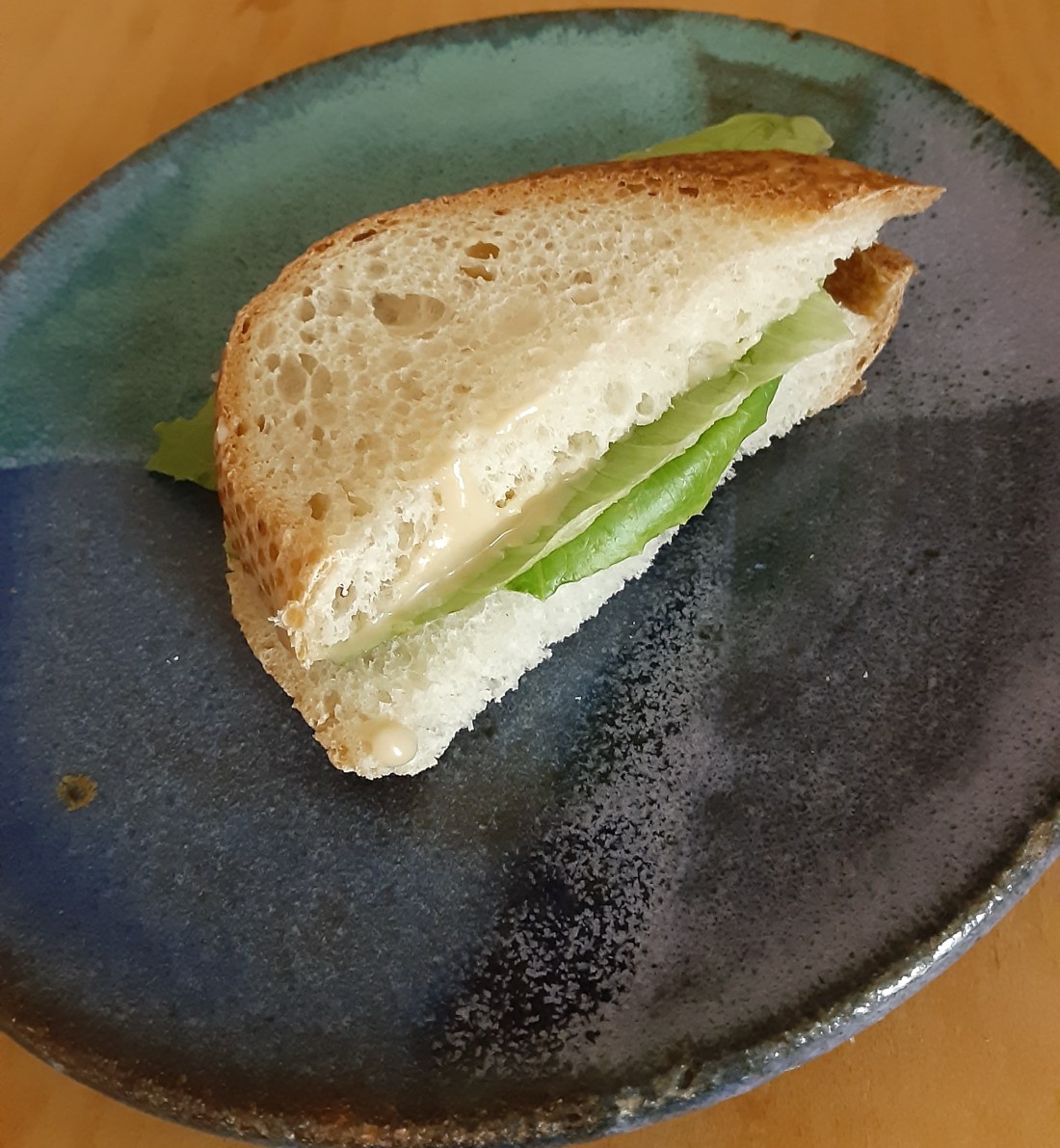
The second offering was inspired by Nadia Colburn’s class 31+ Days Meditation and Writing Course. The prompt was from Marie Howe’s poem, “The Gate,” and the line “This is what you’ve been waiting for – this.” Nadia asked, “What is this ness?” The word bank she offered was: sheet, water, gate, sandwich. In this class, we have 10 minutes to synthesize and then write, but really, she expects open-heart writing. A memory popped up for me.

This is what you’ve been waiting for…  AnaValarie Singer, 8/8/21

The evening my father died

my sister and I waited,

watching him breathe.

In, out, pause…in, out, pause.

The room at Kit Carson

was calm and quiet

like my father’s breath. 

We dared not touch him.

Those that had come earlier

in sobbing regret, held his hand,

stroked his cheek.

He rallied,

fighting a body that no longer wished to carry him.

We had a pact, the three of us.

None of that.

We sat calmly,

Quietly chatting, playing cards, telling

stupid silly stories,

packed peanut butter and pickle sandwiches

in case the wait was long.

We were ready.

Except, it just didn’t feel right

to eat in front of someone who

could no longer enjoy sandwiches.

A nurse stepped in.

We are fine, we said.

Glancing at my father’s peaceful form,

she stepped to his side to check on him

then gently rubbed his left ear.

My sister and I stared at each other.

“This is comforting,” whispered the nurse

as she smiled at him.

He did not rally to her touch.

This is what we were waiting for,

that small reassurance that all was well,

even as he stood before that last gate.

She smoothed the sheet over him.

Ready to leave, she stopped when

my sister said,

“How long?”

The nurse nodded.

“Not long now,”

and then somehow

knowing our need for

a short break,  “You

have plenty of time to stretch

and get some water,”

she gifted us Time.

We followed her,

leaving my father to his walk

while we took ours.

Mid-way around the darkened hospital corridors

I saw a light to my left.

When I looked, a voice said,

“Now. You need to return now.”

I touched my sister’s arm softly,

“It’s time.”

Miraculously, she didn’t question.

I could not have said more anyway.

We retraced our steps to the

chairs by his bed.

My father’s breathing had slowed

alarmingly.

My sister, playful spirit,

began to count,

sixteen between, twenty, twenty-two

twenty-five.

The rest between each breath stretching

mile by mile.

She winked at me.

“He’s playing the game.”

“What?” I said.

“Look, he’s so happy when he can make

the between space last

longer and longer.”

A quick glance at her watch, “Thirty-five.”

My father’s lips curled into a definite smile.

The in-between seconds increased until

the space stretched to infinity.

My father’s expression

was full, triumphant, elation.

He had walked beyond this world.

His beauty was beyond reckoning.

It was his final gift for

his beloved daughters.

Desperation in a Public Space

Pre-Covid-19,

small town 

just want to be home bones

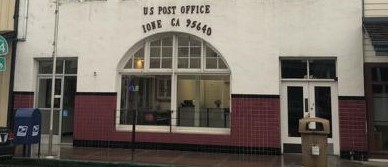
rattle into the local post office.

Older than old after excruciating day

grateful; the line is short.

A small crowd shuffles in.

Buzzing draws my gaze from floor to behind.

Dream stands there, haloed with life.

Room long forgot opens.

Runaway information slams me senseless:

starving cougar snarls

blackbirds flush my heart

mind swirls misty.

Private desperation screams

don’t stare.

Don’t.

Stare.

One furtive glance makes your discomfort clear.

Defensive wall does not stop

roar of attraction.

Shattered

shards of glass at our feet reflect disaster.

Hidden by frump,

I have no breath to fight, BreathTaker.

You are beautiful, and too young.

Cloak of unworthiness is

small comfort to Shame.

Society rules

this day in the post office.

I walk away.

If by chance another day,

we meet in this dimension,

would I step through that open door?

In the long forgot room 

would I close my mind? 

Would I open heart?

Would I stay?

Post Script Haiku

You opened your heart.

I stepped in and I sat down.

Here, I plan to stay.

Caretaker

Caring For Others – May 31, 2021 Women Writers of the Well

The week prior to May 31st was rough for most of us in the writers group. I was in the middle of a course called Healing the Mother Wound, an exploration of shadows held within me, some created by myself, some by my own mother in our dance together, some passed down to the two of us from the women who came before us. I was in a fragile spot. A tiny shimmer of compassion for all involved slowly blossomed and I wanted to care for it.

Another woman had an awakening encounter with a homeless man, and realized her first reaction was fear, fear of him simply because he was a man and then because he lived wild, and looked it. It was the learned behavior of a woman growing up in the United States of America, most probably the reaction of any woman meeting a man in an unpredictable situation anywhere in the world. In the end, this one experience was positive, opening a door for both of them, but it left her in a fragile space wondering how, as women, we had come to fear men so.

A third woman in our group was caring for a devastatingly ill family member. She was inexorably disappearing as the ‘caretaker’ role took over. Alone with the task and afraid of losing herself, she was extremely fragile. Because many of us in the group have grappled with the same situation, her story, along with the meditative prompt, sent us over an emotional edge, which became public to each other when we read our pieces aloud.

This was mine:

“As a woman, caring for others is easier than caring for self. Caring for self requires looking too closely at who we are, what we are, how we define ourselves. Healing ancestral mother wounds has opened my eyes to how much my personal definition has been shaped by patriarchal conditioning handed down, not by the men in our lives, but the women.”

While reading, I looked up at the screen. Heads were nodding, eyes filled with tears. I thought, Oh dear, how will I read the rest of this to them?

I took a breath, and continued, “All of us define our worth according to how we care for others, whether on the job, in the home or within our communities. We ignore Self because we are valued only as Helper. We keep the machinery of life running.

“As I breathe in, I realize how much I don’t know about the “who” of me. I know what I am, I know what I do, I know about the people I tend. As I breathe out, do I freely let go, giving to others, or is there a part that I zealously hold onto, knowing there is not enough, not enough – not enough. Who am I? How do I define myself? What information could I give so that you could decide whether or not we would trust each other? If I don’t have full Self on board, I don’t have full Self to give and right now, in today’s world, it is paramount we offer full Self.”

Some of the comments to this piece were:

We are sic not whole if not perfect.

You can murder a woman without taking her life.

We are always whole, but it’s hard to see it if we tired, distracted, or sick.

How do we fill empty moments, spaces of silence?

How do we choose to fill them? Who are we in those empty moments not spent tending others? Recently, my Guides advised me to sit at the base of one of my trees to ground myself. It was less a suggestion and more an imperative. I was to sit and let the tree do the work. This is not easy for me, to sit and let others do…even trees. The Guides advised me that if I wanted to continue journaling, I should do it grounded at the base of a tree. After these past three weeks of doing so, I finally started asking, Who am I? – not my placement in the world as daughter, wife, mother, ex-wife, teacher, retiree – not that which I do to fill the empty moments and spaces of silence: writer, artist, singer, gardener, housekeeper, reader, student, dreamer, (well, maybe dreamer).

Who.

Am.

I?

What snippet of information could I come up with to give you a hint of who I am? What bits do you need to decide whether or not we will enjoy each other’s company, work well as a team, or just simply “be” together. What do you need to know to decide a friend stands before you?

Who am I?

I calculate risks before I take them,

Then jump in with my whole, tenacious heart.

Extreme imagination

Informs me of past, present, and future

I dream in color

A seamless wave

Of knowledge.

I see the path before me

Before I take a single step.

I fly on wings of music.

Therefore, sound distracts me because

Music is EVERYWHERE.

Profound quiet

Creates a space to regroup

But then,

I want to fly again,

Let the beats of a song

Erase my stasis.

I am an empath.

Your pain,

Your joy,

Your fear, your sorrow

I feel it; I feel you.

Sometimes I cannot tell

The difference between us.

Oh yeah.

You wear that separate meat suit.

Intuition guides me

To recognize and honor authenticity

But, I have no time for masks

Or deceit.

Once I see your true self

Shining from your eyes

I will love and honor you

And steadfastly

Hold space for you.

I soften with sensuality

Drawn by sound, texture,

Color, smell and taste.

I lose myself

With a single touch.

In the trappings of sensation

I have to work to stay present.

Therefore,

I am grateful for trees.

 …so very grateful for trees. I am learning a lot from them. I plan to make sitting under trees a regular part of my meditation practice. For the first time, I am beginning to feel as if I belong, as if I am a part of Earth, as if I am an amazing contribution to all there is. I am re-establishing who I am.

Who are you?

I would love to know you. Are you a risk taker? Are you someone who will reach out, leave a comment? Have I given you enough information to make such a decision?

Thank you, Dear Reader, for waiting these last three weeks for another post. I appreciate your interest and the time you are willing to spend with me. May you find Peace and a sense of Self as you go about your days.

AV

Fumble – Part Three

(Author’s Note: I want to start this last installment with the words of two writers I admire. Their words speak to me.). 

David Roddy co-writes the podcast “Worker’s Cauldron” with Mercedas Castillo. He advocates for the marginalized and homeless. The “Worker’s Cauldron” originally called “Sh!t Gets Weird” focuses on “the cultural politics of the paranormal.” Each program is a lesson about history you probably did not learn in school, at least not here in the United States. You can catch the podcast at: https://podcasts.apple.com/gb/podcast/the-workers-cauldron

David states: 

The most dangerous person is one who never questions the efficacy of his or her hard work to overcome adversity, who doesn’t take into account circumstance, outside help, or sheer luck. It is dangerous to disconnect racial disadvantages, disadvantages that are especially hard for those who are single mothers. A person is doomed to callousness and a heartless inconsideration of others as long as they idealize that hard work is the sole cause of success. 

The other is poet Lyla Osmundsen, a member of the Women Writers of the Well. At our Monday evening meeting, she responded to the prompt: “Have I invented the world I see?” Vibrant with emotion, shining Love with the heart of an angel, Lyla wrote from the core of her being, which she does – always. She completed the first two lines during our meeting and read them to us. I was so touched I asked if she could complete it to add to this blog entry. Thankfully, she agreed. Her book is available at: Wa(o)ndering to Poetry (9781717396556): Osmundsen, Lyla Fain: Books 

Have I Invented the World I See? – Lyla Osmundsen, 3/10/21

Does my anger vibrate in unison

with the anger of others,

causing volcanic eruptions of

daily gun violence?

Does my careless waste

of food

constitute a crime

against a starving individual?

Does stuffing my house

with thoughtless trifle

transform into the tragedy

of a child with no home?

Lyla asked the hard questions of herself. Those of us that hear her words, in turn ask them of ourselves. What are the ramifications of our emotions, our patterns, our wants and desires? We all need to ask, “What world have I created?” Is it the one we want to see?

To live, a human needs water, food, and shelter. These are not privileges. These are necessities. According to most articles that I read, the top four reasons for homelessness are: lack of affordable housing, unemployment, poverty, and low wages. Contrary to popular belief, more than one third of people who are homeless are not jobless. They work long hours, sometimes more than one job, even more than two or three jobs at a time. Housing is too expensive and there aren’t enough developments to house all the people that need housing. Even if there were, the average wages for the average worker cannot cover mortgages, or even skyrocketing rental costs.  

The housing problem compounded in California when yearly firestorms became the norm, forcing people to leave established living accommodations. As a teacher, I worked with families displaced by fire. Some lived out of their cars, more fortunate ones found safety with family or friends. Others, unable to find work in California, left the state, abandoning their old lives entirely. These were the lucky people.

The rest careened into homelessness and took to the streets, or the edges of parks, or under overpasses of highways. People of small towns and rural areas, areas with limited job availability especially develop an attitude of looking down on the displaced citizens that hover in their areas. The typical response I heard was that the hardworking taxpayer shouldn’t have to subsidize lazy vagrants.   

Then Covid-19 hit. Stimulus packages were not enough and came too late. Workplaces were shut down, people lost their businesses, mortgage holders weren’t compassionate enough because their own livelihood was compromised. Homelessness was no longer an issue of “you just have to work hard.” I wonder, do those angry people bemoaning their taxes still feel the same? Are some of them now living on the edges of society, possibly still working hard, still paying taxes, living under makeshift tents on the edges of town?

Covid-19 gave most of us time to realize our good fortune is largely due to luck. Having or not having is often a matter of who you know. It’s almost always a matter of what color am I?

As early as the 1970’s Federal investment in housing was threatened. In the 1980’s there was already an unwarranted number of families with children considered homeless. In 2008, financial crises created foreclosures forcing people to give up their homes and take rentals instead. Unfortunately, affordable and safe rental construction could not meet the demand of displaced homeowners. Rents rose, but working class wages did not. By the time Covid-19 was a pandemic, rents were too high for most people working full time year round as minimum wage workers. According to the U.S. Bureau of Labor Statistics in a survey completed in 2019, 82.3 million workers 16 years and older, represent well over half (58.1 percent) of all wage and salary workers in the United States. These are people struggling to maintain shelter. Six percent of white households are extremely low-income renters. (2,3,4)

For people of color, the statistics are bleak. “Twenty percent of Black households, 17 percent of American Indian or Alaska Native households, 15 percent of Hispanic households, and 10 percent of Asian households (compared to the white households), are extremely low-income renters and are often locked out of affordable housing due to systemic and structural racism and decades of racist policies.” (1)

I think about other single mothers like myself. What are those statistics?  Over 85% of homeless families are headed by women, specifically, by single women with children, and domestic violence is a principal cause of homelessness among single mother families. (5) 

Reading a statistic such as this raises the ugly face of my own fear. My fear was real. I was afraid of homelessness, however, that fear was as irrational then as it is now. I always had people who cared for me. I had places I could go. I am white. Job opportunities, even in this rural area, were presented to me, largely because of who my family knew. There was no way I would find myself on the street.

Even now, as a retired person living on barely adequate retirement wages, when the fear stops me in my tracks, the truth is – I remember that money is adequate. I have shelter. I have water. I have food.  

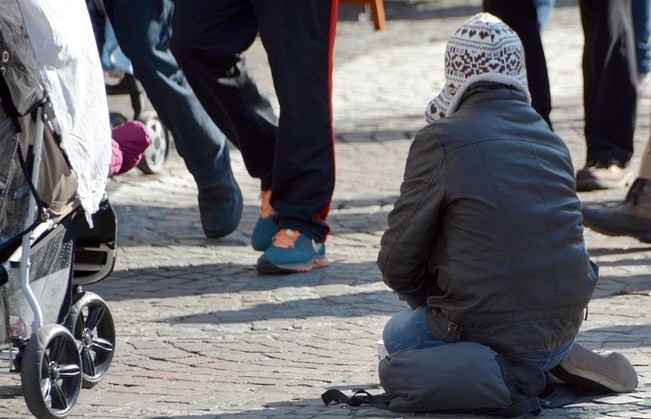
I will never know who that huddled person in front of Starbucks was. I didn’t stop to ask their story. Where was that person’s luck? Did my callousness leak some of it away? Were they as terrified of me, as I was of them? Were they huddled under the mound of clothing in defense and shame? Could I have alleviated part of that shame for one transitory moment if I had stopped to smile, at the very least? Could that one moment have made all the difference in the world for that one person?

December 31, 2019 was a lost opportunity. Today, as I rewrite this article, terror washes over me again as I remember being a single mother of two very young children. My heart crumbles as I remember the person I left behind at Starbucks. Before my fingers touched the keyboard, I sat on my bed sobbing. I lived on the brink of disaster, that person lives the disaster.

I have to own that terror and let it go. I also have to own the pride that covered it up and made me callous. Yes, I worked hard, but I was fortunate. I was presented with opportunities that I was in a position to grab; opportunities that a great many of us don’t have.

In the future, will I find, at the very least, the courage to smile if I have nothing else to give? I need to look behind the pride that covers my near miss and move forward one encounter, one opportunity, one story at a time.

Works Cited

Aurand, Andrew, Dan Emmanuel, Dan Threet, Ikra Rafi, and Diane Yentel. 2020. “The Gap: A Shortage of Affordable Homes,” p.13. Washington, DC: National Low Income Housing Coalition. https://reports.nlihc.org/sites/default/files/gap/Gap-Report_2020.pdf.

 Chetty, Raj, Nathaniel Hendren, and Lawrence Katz. 2016. “The Effects of Exposure to Better Neighborhoods on Children: New Evidence from the Moving to Opportunity Project.” American

Economic Review 106 (4). https://scholar.harvard.edu/hendren/publications/effects-exposure-better-neighborhoods-children-new-evidence-moving-opportunity.

Gowan, Peter and Ryan Cooper. 2017. “Social Housing in the United States,” p.1. Washington, DC: People’s Policy Project. https://www.peoplespolicyproject.org/wp-content/uploads/2018/04/SocialHousing.pdf.

Twin Flame

Covid-19 gifted me Time.

So, my heart learned things.  

For instance,

You exist.

But, not in my Here.

Not in my Now.

Yet, my arms ache to hold you.

My hand misses strong muscle

Under silken cotton T-shirts,

Remembers running a course of love,

Gestures of tenderness so sweet

My heart –

A terracotta vessel, shatters

Against Dawn colored Earth.

I pick up one palm-sized piece,

Polished smooth by someone else.

Someone else’s incessant rub of stone

Softened the course grit of sand in this clay. 

I run a finger over it, feeling you.

Gloriously feeling you.

Gloriously remembering,

It was once you 

Loving me.

As I stretch my fingers.

Light catches my eye

Sunlight flashes like facets from a diamond.

Was that an answer?

Could it be so simple?

Could tangibility remove uncertainty?

Nestled in my jewelry case.

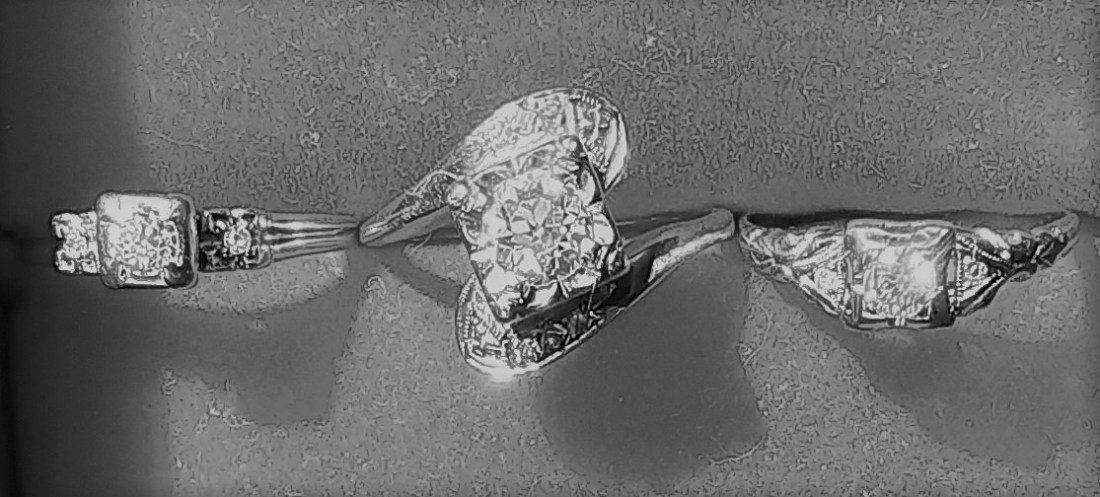
Is a ring, the middle of three,

Not an everyday, mundane,

Get-your-hands-dirty ring,

It is loud,

An in-your-face statement.

Like you.

Is it right to consider

This seal of connection?

Would one of these other rings work better?

The first is demure and polite,

A humble token.

The other, similar in style

Flashes timidly.

You whisper in my ear.

Choose bold.

I do.

Like a hundred stars

Twinkling in the night,

This ring reminds me of your

Audacious, daring, sparkle of fireworks.

It roars I am here, We are one,

You belong to me and I to you.

Can I wear it?

Our connection flares,

Strong and sure, a knowing

So acute my heart shatters again.

Who am I?

Quantum entanglement,

Mirrored opposite,

Kindred spirit,

Ring-wearer?

How does insanity feel?

Should I know?

Can other people see it?

Will they let me wallow in delusions?  

Will pity overrule truth?

Admiring the dance of light,

My heart becomes a furnace

As I wear this ring.

Until the day the cables

Break on the bridge

We built.

Physical reality

Does not

Include

You.

What am I supposed to do?

Heartbroken,

I give up fantasy,

Become solidly three-D.

Joy steals away in the murky night.

Self-doubt colors what is right.

I wear this ring

Bravely hoping sense will rise.

But a puddle of sorrow

Is drowning me.

I take it off.

Ring set aside, will I settle?

Get my bearings?

At my keyboard, I sit to write

Firmly resigned

That foolishness led me astray.

“I am alone.

Mind-speak isn’t real.

Phantoms are illusions.

Imagination is a fool’s game.

Six thousand, seven hundred, ninety-two miles

And twenty-two years

Across any gulf of time or space

Is too far

No matter how strong the bridge is.”

You feel the same. Right?

A soft caress strokes my finger.

Nerves sing a response.

Tap, tap, tap.

My heart ignites,

And answers,

“I know.”

I walk to the bedroom,

Pick up the ring,

Take a deep breath.

Words flutter

Across my mind:

Patience.

Believe.

I put it on.

A second rhythm

Beats inside me.

Two hearts drum as one.

Imagination amends deep,

Lifelong knowledge

That you, Twin Flame

Exist

Not my Here, 

But, my NOW.

This ring,

This loud, flashy statement

Is a bond not only with you,  

But, with myself.

I am.

I AM.

I am; I am.

I am worthy of Love.

I am worthy of your Love.

I am worthy of Loving.

I am Love.

You are;

We are. 

The Promise of Spring

Here in Northern California the angle of the sun speaks Spring, but at this moment, it is only a promise, not reality. I want to nurture plants, sit in the sun, and enjoy time spent outdoors. The weather is capricious, and it is too cold. Outside my backdoor, the temperature gauge reads 36ºF. Winter’s wood smoke hangs in the air. Cats snuggle on chairs and the back of the couch.

Yesterday, a cold wind roared through the valley and slammed tree branches with their fragile buds against my windows, ratcheting a level of anxiety I could barely contain. My friendly, Yellow Warbler, Jenn, did not come to visit.

Yet Spring’s promise compels me.

Those wiser than I am remind me again and again, “Be patient. It is not yet time.”

Monday night, during a meeting of the Women Writers at the Well, one of our prompts was “The Promise of Spring.” A perfect antidote to this malaise of waiting, my sister writers poured out their hearts during ten, intense minutes of recording an inspiration based on that prompt. Then we read our offerings to each other. Marilyn Crnich Nutter, scholar and author of “On the Path of Sophia – A Catholic Woman’s Journey to Wholeness,” a brilliant book speaking to anyone’s spiritual journey no matter the path, offered this and touched all of us.

The Promise of Spring

Marilyn Crnich Nutter, 3/22/2021

Winter lags on and on, or so it seems.  Like the song says, “Funny, that rainy day is here,” the Winter of our lives comes all too quickly and memories enter in, which we cannot relive in flesh but only in thought, snap shots held close in hopes that time will somehow go backwards and we are there again with loved ones long gone and babies now grown.

So, in the Winter we wait, for Spring comes in ways we least expect.  Hugs from grandchildren, a husband’s sweet recollections of our first meeting, laughing about past events that make us blush with embarrassment—how much of life we lived, and loved, and worked, and made those memories that keep us warm while waiting for spring blossoms to come once again.

Thank you, Marilyn, for allowing me to share this here.

I offer a humble wish:

The Promise of Spring

AnaValarie – 3/22/2021

Promise of Spring – 

Sing.

This time of year quickens our mood, sends our souls to the stars, and makes laughter bubble up over the tiniest act of silliness.

I will bury a sliver of Spring in my heart where it will prick the oppressing heat of Summer into a remembering that when the sun sets, the cool of night will be delicious.

I want that sliver to itch when the leaves fall, reminding me that here there is also joyous color.

Let that sliver of Spring ache during the cold, harsh dark of Winter when I miss a warm touch most of all. Remind me that Spring is just under the surface, waiting to sprout into a rush of glory.

Promise of Spring – sing.

Sing to me

Of Love.

Dear Readers,

May Spring quicken your mood; send your soul to the stars, and make laughter bubble up over the tiniest act of silliness.

Peace be yours,

AV Singer