Plea to Voters of California

Proposition 50 has been presented as an act of leveling the playing field so that we can preserve our right to choose how voters are represented.

My writing does not usually seem political, but I do write to fight for my principles. I feel that voting is more than a right; it is a citizen’s responsibility to let their voice be heard. 

Like Governor Newsom, I know that sometimes to fight fire, one has to use fire. 

It’s a common practice here in California. We stop the spread of wildfires with controlled burned defense lines. Ranchers in the northern counties will back-burn safety belts around valuable grazing land. Fighting fire with fire is a proven safety practice.

Controlled fire is good for the land and has been practiced in California for centuries. Some of the cover-crop foliage plants of pastureland need fire to burst seed shells. Grasses need some of the more invasive and noxious plants eradicated to make room for roots that capture the supply of scant rain. Fire has its purpose.

So now I find myself offering information about Prop.50 and the upcoming special election scheduled for November 4, 2025. 

First, a small back-story.

Gerrymandering is like a noxious weed that popped into the political pasturelands of this country in the early 1800’s. It was designed to redistrict voter populations to favor one side or the other, thereby allowing politicians to choose their voters, rather than the voters choosing their politicians. That is the very reason the practice was planted:  Politicians Get to Choose Voters instead of Voters Choosing Politicians.

In 2010, Californians added an independent commission to enact redistricting according to current census population data. This is the best way to make sure elections are fair. However, very few states have independent commissions building districts according to the census data. Texas is one of the many that doesn’t. Without restrictions in place, like the ones California created in 2010, politicians can easily grab elections to meet their own desires and manipulate district maps for their own power. 

Unfortunately, a decision made by a Texan governor to honor a federal executive’s request has changed maps at a time when maps aren’t changed for any reason other than to support politicians’ interests.

This year the executive branch of our federal government asked the governor of the State of Texas to gerry-rig their representational districts so that five more representatives could support and favor the decisions made by the present executive branch of the federal government of the United States of America. These decisions are being made without checks and balances as constitutionally ratified by our Founding Fathers. The Texan executive branch made the changes as requested without consulting the will of the people of Texas. This tipped the scale to favor politician decisions rather than decisions of the people, nationwide. 

Governor Newsom has called upon California to rebalance this decision by creating a special election whereby the people of our state decide whether or not to stand with him as he tries to fight fire with fire. 

In my opinion–we are a United States, a united people, not the minions of the federal executives nor the minions of the Texan executive branch. I am terrified of the authoritarian firestorm that is quickly raging across the United States.

I grew up believing the PEOPLE of this country choose their representatives to protect THEIR interests, not the executive branch’s interests. While it is true this government is a republic and not a democracy, we still hold democratic ideals expressed through those representatives. Representation is the will of the people. That means our will, our needs, our wants and wishes. US. The United States electorate. 

Is the will of the people being honored by current requests of our federal executives, or are we being plagued by a wildfire of gerrymandering? And will fighting fire with fire create a defense line?

In California, the will of the people will be heard when we choose whether or not to fight fire with fire on November 4, 2025. Is California’s 2010 enactment of an independent commission for redistricting going to be in the best interests of the people at this time, or can we look away temporarily to back-burn a defense line? Which is the best course of action?

Here is the flame thrower that a yes vote will give us, word for word. (I have taken the liberty to highlight in bold–key words.) 

Proposition 50 August 27, 2025

ACA8 AUTHORIZES TEMPORARY CHANGES TO CONGRESSIONAL DISTRICT MAPS IN RESPONSE TO TEXAS’ PARTISAN REDISTRICTING. LEGISLATIVE CONSTITUTIONAL AMENDMENT. 

• In response to Texas’ mid-decade partisan congressional redistricting, this measure temporarily requires new congressional district maps, as passed by the Legislature in August 2025, to be used in California’s congressional elections through 2030

 • Retains California’s independent Citizens Redistricting Commission and directs the Commission to resume enacting congressional district maps in 2031 after the 2030 census and every ten years thereafter. 

• Establishes state policy supporting use of fair, independent, and nonpartisan redistricting commissions nationwide. 

Summary of Legislative Analyst’s Estimate of Net State and Local Government Fiscal Impact: One-time costs to counties of up to a few million dollars statewide. County costs would be to update election materials to reflect new congressional district maps. 

A few million dollars seems like a lot to each of us as single individuals or even for a single county, but there are 58 counties in the state of California, and California is the 4th biggest economy in the world. Our legislators would not have agreed to this if we couldn’t afford it. The important issue is that we get to see the maps before we vote, and then we get to vote for or against it, unlike Texans who didn’t have that choice. Their legislative and executive branches made their choice for them.  

This is a pivotal moment: My opinion about this is–Please Vote. If this country becomes authoritarian, we will not get that chance again, and I have seen this president say, “Don’t worry. When you elect me, you will never have to go to the trouble of voting again.”

Let that sink in. 

As a voter, election outcomes don’t always match our wishes, but at least right now, for this special election, we still have the right to express our desires. We have that choice. We declare our own needs and wishes, and in doing so create our own destiny. What do you want?

A no vote says you want our independent redistricting to stay as it is.

A yes vote lights a torch to back-burn defense lines for an authoritarian fire that seems to be headed our way. 

It is up to us, each of us, to declare our choice by voting in the November 4, 2025 special election. (@1000 wds) 

Neighbors

Strength wanes

long tenticles of grasses strangle

roses 

bridges between total death

and life

simplicity in purpose

if not grace

grasses

cover earth

otherwise scorched

by relentless sun.       

I am left with the question, what should I annihilate: my desire to destroy the strangling grasses that cling to my roses, or the plants themselves. These unwanted neighbors take nutrients and sunlight from my precious plants. They resist all attempts to eradicate them year after year after year. Where did these insidious creepers come from? What is the reason for their existence? Why can’t they go back where they came from?

As a tree lover, there are only small patches of land in which to grow sun loving plants. As a reluctant gardener, I am tired of fighting. Do I have resources for both?  

Bermuda grass is a sought-after perennial that is lush to walk upon and stays green all season. Intolerant of shade, it is drought tolerant, preferring at least seven hours of sun daily, which is why it is growing where my roses love to be. Bermuda belongs to the family Poaceae. Its official name is Cynodon dactylon. The name sounds like a creature from a monster movie and perhaps it is. Native to the Mediterranean, not Bermuda as its name suggests, people most likely brought it to this continent during the slave trade where it hid in contaminated hay used as bedding. Later, during the 1930’s it was used as a turf grass for golf courses, and in California’s early agriculture days, especially in the Central Valley, it thrived even when irrigated with salinated water. It is tough enough to withstand the trampling of grazing cattle with tenacious root systems. The roots I dig up are bright orange, and can dive as deep as six feet underground. Needless to say, at age seventy, I am not digging holes deep enough to eradicate it.

There is a close look-alike to Bermuda that also plagues my roses. 

Crabgrass. 

Native to Eurasia, it was accepted by the U.S. in 1849, an oddly specific date. The Patent Office named it a “potential forage crop.” Now it is EVERYWHERE. I have even found it growing up the walls of my basement. The most common species in Central California is Digitalis ischaemum. It spreads by scattering seeds, which unfortunately I have facilitated by ripping out the whorls it makes from the ground. Considered a tiller grass, new shoots develop on the crown of a parent plant and while they send down seminal root systems, they still depend upon the parent. And finding that parent can be a scavenger hunt. The good news: Crabgrass actually happily crowds out Bermuda. The bad news….

While researching I discovered there is another invasive pest in my yard that I have actually encouraged and now grows at the base of my roses…Quackgrass. 

Elymus repens, i.e. Quackgrass arrived on this continent sometime during the 16th century. My own ancestors were probably responsible for carrying what is now considered an invasive species over the Atlantic when they escaped…uhh…immigrated, from persecution in Europe. This plant from Eurasia and North Africa, commonly known as Common Couch or Creeping Wild Rye, spreads really fast. Sometimes the rhizomes grow an inch per day. The offspring can be found as far as ten feet from the parent plant. Unwittingly, I find the seed heads to be quite beautiful. It is one of the few grasses I don’t physically react to so naturally, I invited it to stay.

A quick dive through the internet taught me that Quackgrass, of the three of them, probably has a place in this yard as it is nutritious as forage, and good for humans. In early spring, the young shoots are tasty in salads. As well as providing healthy fiber, they are sweet and crunchy. Rhizomes can be dried, ground, and used as flour or as a coffee substitute. Even the sweet, fibrous roots can be eaten. Unfortunately, this plant is allelopathic, which means it uses chemical warfare to repel other plants. My poor roses. 

I probably introduced it into my yard in the bales of straw used to feed and bed my children’s 4-H rabbit projects. However, after learning about this plant, I may take it off my pest list, providing I can move the roses out of its reach. 

I have come to the conclusion that it may be easier to learn to live with these plants than try to fight them. This plant war has been fought on one of the steepest grades in my yard. It would be a thousand times easier to deal with the grasses without the roses getting in the way. The only way to save the roses is to move them to the other side of the house. That’s doable. There’s enough room for everyone here.

Citations

Kaffka, Stephen (2009) – “Can feedstock production for biofuels be sustainable in California?” Original printed in California Agriculture 63 (4): 202-207, 2013

Kaffka, Grattan, Corwi, Alonso, Brown Jr. “Bermuda Grass Yield and Quality in Response to Salinity and N, Se, Mo, and B Rates in West San Joaquin Valley.” UC Center for Water Resources, September 27, 2015.

https://ag.umass.edu/turf/fact-sheets/biology-management-of-crabgrass

https://forages.oregonstate.edu/regrowth/how-does-grass-grow/developmental-phases/vegetative-phase/tillering

https://www.canr.msu.edu/news/pain-in-the-grass-bermudagrass

https://thenatureofhome.com/bermuda-grass-vs-crabgrass/

https://www.thespruce.com/all-about-bermuda-grass-7151762

https://turf.arizona.edu/tips103.htm

Backed-up Stories

Thich Nhat Hanh wrote in his book, Interbeing: Fourteen Guidelines for Engaged Buddhism, “in this piece of paper is a cloud.” Inspired by his words, Anne B. Jeffries gave the women in my writing group this prompt on August 28th: In this tear is everything.

Lynnea Honn wrote:

Foretelling

Foreshadowing of

winter shadow stretches out

and yawns Preparing

Shari Anderson wrote:

Cascading 

         Sounds, tones,   

Ideas, words

                           Water-falling

          Pummeling

                     Cleansing

                            Rubbing

      Wearing away

                                            His-story

                 Revealing Myself

     Wholly New

I wrote:

In this tear is everything – every story ever told, from the inception of our Earth until this very moment, and this one, and this one, and this one…and…this…one.

Writer’s block is not a myth. It exists. Most writers experience it. What is it? In my opinion, writer’s block is a symptom of all our tears – the backed up stories carried inside – stories one does not want to face.

You know what I mean. We all tell ourselves stories to get through life. When we tell them long enough, they seemingly become truth. I bet writers have more than their share because they tend to narrate moment by moment.

As a writer, I dumped bits and pieces of my story onto my characters and into their plots. I’m beginning to wonder, can I continue to pass off my life to imaginary others or should I own up to my stories and claim them? By claiming them, might they become part of your story as well, just as yours would become part of mine?

Stuck in a Box

From a very young age, we look at the reflection of ourselves in others’ eyes. If someone takes the time to see who we really are, we know ourselves. We learn to trust and love our core being. Instead, I fear, most of us see how others measure us against cultural standards, especially women in my generation, the first generation to deal with contrived image saturation in visual media. 

Recently, I went with friends and family to see Barbie, a movie about a doll designed to perfectly depict a contrived image of beauty that saturates television, magazines, book covers, and advertisements. We all expected fantasy, a perfect woman in a perfect world gone awry. What I didn’t expect was a profound statement about the way each of us as women see ourselves. We need to sit up and take a look at this.

As the movie progressed, Weird Barbie was introduced. Just the mention of her made me sit up. When I saw her I thought, “My God. This is the first time I have seen myself depicted in the media.” I can’t say it’s the equivalent of the reaction that women or men of color have, but it certainly was a reaction that I couldn’t ignore. 

I saw myself. 

Weird Barbie. 

Huh. 

This set off a chain reaction. I started to remember and notice things I never had before.

As a young prepubescent woman, I didn’t hear sex ed in school, nor did I hear it from my mother. She never spoke of such things. I believe my father worried about me because my self-esteem was poor. He taught me how to be a woman with his Playboy magazines as examples. 

He loved me, but that was not the right approach for a little tomboy that developed quickly into a BIG girl at age ten.  

To say I wasn’t ready is a gross understatement. I loved climbing trees, riding horses, playing imaginary games of hunt, shoot, and capture, playing the saxophone in marching band, swimming, tennis, jumping (I loved to jump off roofs and balconies). You name it, my blossoming got in the way of all I loved to do. Big breasts were the bane of my existence.

Later, when I was old enough to have crushes, I learned from magazines that men liked big-bosomed women. 

Why didn’t they like mine?

What turned them off? My legs? My teeth? My hair? My eyes, hands, feet, intellect (I was a smart girl.) Was it because I didn’t do girly things? I didn’t play with dolls or other girly toys. I felt uncomfortable in dresses.I found lizards and brought them home. I had a pet crawdad. Once, I had a pet fly. I continued to ride horses, to play tennis, to swim with a team, and chuck hay bales out of a barn. I talked to frogs.

I was weird. 

I wanted to fit in. I wanted to be the stereotypical girl that boys sought. I had breasts, dammit. 

As a teenager I felt comforted by The Velveteen Rabbit. It wasn’t  because I loved soft, worn things. Rather, it was because I felt pitted against my culture’s vision of ‘ideal woman’ and didn’t believe I fit it. I thought if I could allow myself to be loved, to get shabby with attending to others’ needs, it would prove I was worthy. 

It turns out, life doesn’t work that way. 

I practiced yoga to keep perfect proportions. As I aged, I found it was more meditative for me. Recently, I learned a new way for me to practice meditation. I found it in a book called, belonging here: A Guide for the Spiritually Sensitive Person, by Dr. Judith Blackstone. In it, she teaches a technique to fully inhabit one’s body. During it, one focuses breath in the feet. I couldn’t do it. 

I didn’t acknowledge my feet. 

I really only noticed them when they hurt. 

As I moved my breath into my ankles, it was easier to focus, though I worried I didn’t have the delicate ankles I was supposed to have.

Then I moved breath into my legs. 

With devastating clarity, I realized I saw my legs as objects – not part of self – objects! 

Did I classify other parts of self as objects? My hair? My hands, my eyes, my breasts, hips, belly? OMG! My neck, my chin, my nose? Is there anything about my person that wasn’t an object to be presented and judged as worthy, or in my case, not?

Then it occurred to me. If I have this problem, do other women my age suffer this way? How about men? Do men suffer this way? 

I suddenly resented Mattel for not giving us Weird Barbie before this, because now I am old and can never become stereotypical again. 

My daughter asks, “Why would you want to be?” 

That’s an excellent question. I can only answer that I have spent a lifetime worrying about it. Am I good enough? Am I thin enough? Am I desirable? Are my breasts big enough? Are they too big?(Yes, dammit.) Do I meet the code that others impose upon me?

Why, indeed, should I worry about this?

I fear I am not the only one with such self-conscious judgment. What can be done?

For me, seeing Weird Barbie has been a god-send. 

While I resent Mattel for not presenting her earlier, I am also grateful she has finally made her appearance. After meeting her, I am beginning to see my own body as the finely tuned instrument it is. Without it, I could not produce the tone I have when I sing. Without it, I could not have birthed my babies. Without it, I could not have fed them for as long as they needed. Without it, I could not have jumped off roofs, or out of trees and felt that exquisite moment of flight. Without it I wouldn’t feel the pain of a stubbed toe, or the caress of ocean waves. Without it, the cool evening breezes wouldn’t thrill me as they have. Without it, I wouldn’t remember what it is like to touch another human, or pet my favorite cat, or feel the earth beneath my bare feet. Without it, I couldn’t smell the deliciousness of Spring or see the vibrating color of a bright orange rose.

When I asked my daughter if she remembered her Barbies, she said, “No. I didn’t have Barbies.”

Trust me. She did. I know. I spent hours making clothing for them. 

As we talked more, she did mention she had dolls that rode her Breyer horses. I looked it up. The Barbies in her day had knees that bent. 

She had Barbies. How Barbie looked did not define my daughter’s self-image. If anything about Barbie defined something for my daughter it was what she did. 

Barbie rode her horses. Nothing more. 

Nothing less.

Looking back, I don’t think boys turned away from me. I am fairly certain I turned away from them because I didn’t believe I was stereotypical enough. Physically, I may have been, (I have breasts, dammit) but, psychologically, I am Weird Barbie. I don’t claim that proudly, I just am. I always have been. The image I see in a mirror does not define me. 

The Barbie movie says it best. If you get a chance, watch it. I’d be interested to hear about any awakening you might have had after the experience. Now, wouldn’t it be wonderful if someone were to design an Old Weird Barbie with saggy bits? And a Ken to adore her?

Big Heart

In June of 2020 I ‘graduated’ from teaching. Teaching requires mindfulness and extreme focus, a one-hundred percent investment of love during time spent one-on-one with a child or with a group in the classroom. It requires setting aside self to see and hear others instead.

One of my sister writers, author of “Cross Roads,” Anne B. Jeffries, agreed to post on my blog this week. She had just finished a full day of commitment at school but she came to write with us.  She is adept at pouring Heart. When she attends our Wise Women Writing group, she feeds our souls. In a mere ten minutes, she addresses each prompt with profound honesty. Her act is an inspiration for the rest of us. She demands authenticity for herself, while maintaining curiosity, joy, love, and compassion for the rest of us.

Dear Readers, I don’t know what some of you do, but I do know that if you are reading my blog you have a sincere desire to connect with heart. Anne’s heart makes a big connection.

Anne, thank you. I feel honored that you have  given me your words to give to my readers. Fellow teacher, fighter for children, fighter for people, Anne, I love your heart. You pour out all it carries every day and I know your students feel your intent. Your writing takes away my breath and reminds me that teaching is something I still love to do. 

Memories Sleeping

It’s not just my memories sleeping,

It’s all of it.

A honey drip slowness.

I can catch up tomorrow.

Just want to sink down in sleep.

Rest.

Like a frenetic fall.

What is the charge?

Is it my nervous system that signals the experience to fizzle,

Lose its edges?

Then, sink away in categories and compartments,

With no present security access?

Where is my agency?

Who is filing these memories and who granted permission for this protocol?

Or, maybe, it’s all chaos and no “thing” has access.

My consciousness just sifts above it all like a metal detector pulling up old coins.

What about the pieces made of wood and plastic?

What loosens those?

Eternal Minutes

He said it’s like wearing a lie on his face.

I feel that way all the time.

In class- with him- with them.

Like I’m a puppet driven by a motor I did not program, or know how to run.

Today, 

For hours,

I peered out from below the lip where I stuffed myself down into a pouring cup,

Until all the drops of the eternal minutes,

Ran out against the automaticity

Of that forced time.

Family Dynamics

There is something about the inability to walk away.

A fabric woven together?

Fabric doesn’t work

because it’s made of thread that can be woven into something else.

My sentiment is too deep to separate out –

Like color in the sky?

Nope

Color is only light.

What holds us together?

Is it, in fact,

A choice?

Check it out

If you would like to read more of Anne’s work, check it out here:

Anne B. Jeffries, Author

Memories Sleeping

Author’s Notes: Writer’s block. Everyone has heard about it, jokes made, condolences offered. It’s a real thing, a time most Creatives face. The well of ideas runs dry, the lake of inspiration empties and a desert of despair stretches farther than one can see. I had it bad, wandering that desert for at least six months.

One of my writing sisters sympathized, stating her creativity had recently become dormant. We discussed the idea. She was taking a course by David Whyte who offered a solution.  

She shared it with me. “Ask yourself,  what do you want to say that you are not saying?” 

It is a question any creative person can mold to unblock many avenues of stagnation. For an artist, “What do I need to see that I won’t look at?” For musicians, dancers, actors, “What do I need to feel that I haven’t allowed?”  

When Lynnea Paxton-Honn shared this with me, my re-awakening began. “What do I want to say that I am not saying?” 

In California, where we live, January roared into our state with a deluge capable of filling dry lakes and ponds, and creating new ones, seemingly overnight. It ferociously filled rivers, washing away many things. Tides surged, waves plundered. From Earth’s perspective the rain was needed even though it was so destructive. From a spiritual viewpoint, it was a physical expression of the need to wash away all that no longer serves, a process that caused great grief, but also opened new solutions and opened hearts. It awakened memories, and filled our creative lakes and wells with words for both of us…I am thrilled to present Lynnea’s poem Memories Sleeping

Water–Life Giving

drips, drips, drips

through layers of rock

and sediment,

leaks out through fissures

into the outer air,

trickling from mountain aquifers,

runoff gullies down

spilling over rocks,

around root tangles,

debris caught and bundled

catching all the matter

torn from banks

barricading the streaming water,

damming the flow,

holding the power

of the stream no longer streaming,

but pooling, pooling as it pushes

against the barricade, blocked

until it’s not

and tiny tear trickles

begin to slide through the micro

cracks in the barricade.

The things I do not want to say come forth.

Lynnea Paxton-Honn  January 2023

To read more from Lynnea, you can visit her blog site: heartofahorsewoman.blog

Or her author page at: Author Central – Amazon

Post #2 Reluctant Gardener

Works Cited

Flint, Mary Louise, Docent; Galls on the Valley Oaks of Effie Yeaw; October 11, 2018     https://sacnaturecenter.net/visit-us/nature-blog/news.html?NewsID=56742

Sousa, Marcy; What are Oak Galls? Here’s what you need to know about these insect breeding grounds; Home and Garden September 16, 2021,

https://www.recordnet.com/story/lifestyle/home-garden/2021/09/16/what-oak-galls-what-know-these-insect-breeding-grounds/8368800002/

A Big Hole

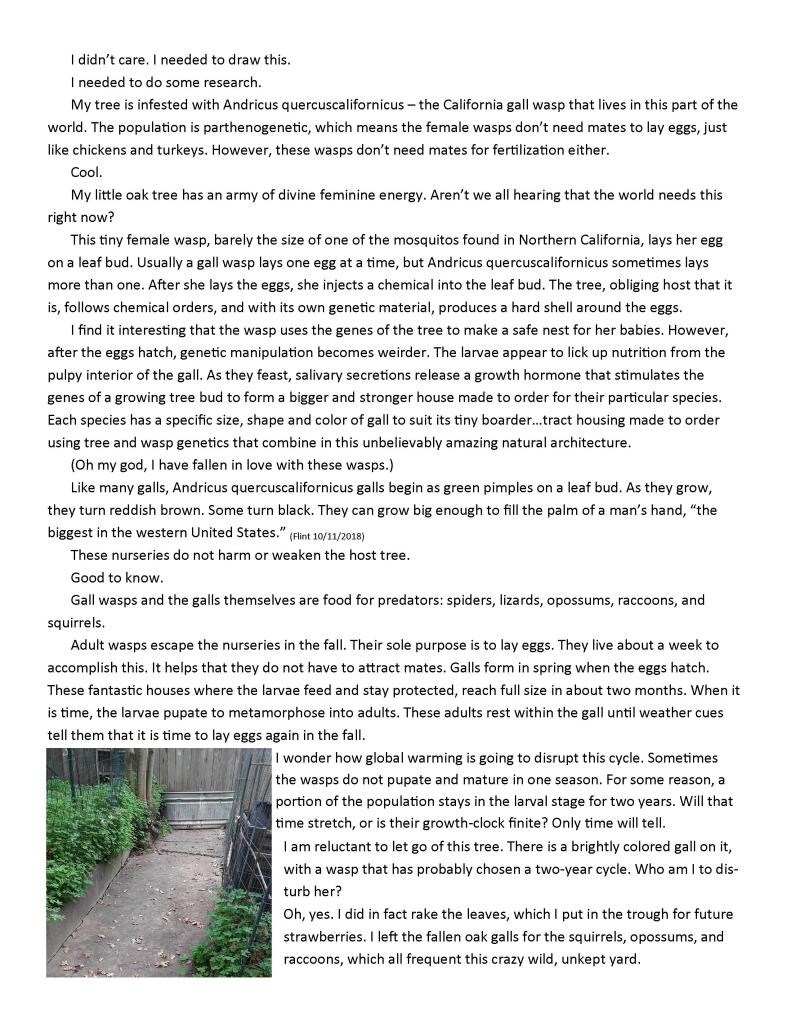
Plants are teachers. Their lessons are as subtle as their language; lesson that are easy to ignore if one isn’t mindful, and time moves so slowly for them, requests never seem urgent.

I felt the Liquid Ambers’ threats. Occasionally I would feel a slight shudder when I walked under them. I envisioned one or both crashing to the Earth. If that happened they would take out fences, smash windows, perhaps hurt animals, or gods-forbid – people. The Chinese Hackberry needed a trim, as did all the trees on this property, but I felt I had time. I made a decision. I would tend to this in January, after leaf fall. It was healthier for the trees.

The trees had another plan.

I was minding my own business when I received a call from a neighbor. “Have you eaten?” He often does this.

There have been times I forget about food. When he offers, I accept with deep gratitude because I am creative and become too caught up in whatever it is I do to deal with simple acts of three-dimensionality like eating.

That day I remembered. “I just ate,” I said.

“I’m bringing it over, anyway. You can reheat it later.”

I said, “Okay.”

Perhaps I should have refused him.

Since moving here less than two years ago, he has hated my trees. I am the crazy tree lady. For him, my yard is an eyesore. There are too many trees. When oxalis and three-corner leaks spread underneath the trees in the spring, the yard looks wild and unkempt. He hates the seedpods that the Ambers drop. Leaf fall upsets him. The trees obstruct his view of the corner above us. But, what he really hates is the shade in his yard. He worries it will kill his grass. There hasn’t been a single time that we have spoken across the fence that he hasn’t complained about my trees. Usually, it seems like banter, a conversation opener, a place to meet in the middle.

However, that day when he brought over the food, he very cautiously informed me that he had called a tree specialist to get a diagnosis for my Chinese Hackberry. It was very sick and needed to come down before it killed somebody.

I was puzzled and said, “My arborist didn’t notice that. Why wouldn’t he tell me that?”

I then explained to him my worry about the Liquid Ambers. They are fragile trees and have grown quite tall, but arborists don’t like to trim them because it makes them weaker. “I plan to deal with them in January.”

“Well that front tree is very sick. It has ants.”

Around here, all trees have ants. “I think my arborist would have told me if there was a problem,” I said.

“I knew you would be like this. You are so irresponsible.”

Really?

“Why do you have to be such an immature baby about this?”

Ego raised one eyebrow.

It suddenly occurred to me that this had been a plan before he bought the house next to mine. He intended to get rid of the tall, offensively shading trees next door. Wow! Was it possible he shared food with me so that he could wear me down? Was he thinking I now owed him? Did he expect I would cut my trees for him because he had fed me so often?

Ego insisted, “Give the food back. Right now!”

I tried. It was sad letting go of Nori sprinkled rice with pickled plums, but I pushed the dish toward him.

He backed away. “Just take it,” he shouted. “Take it.”

My mistake occurred when I said, “Oh, I see now. This was a plan. Well it works for you, doesn’t it? You have wanted this since you moved in.”

The instant the words left my mouth, I felt my mistake.

He retorted, “My house isn’t made of cardboard. It will be expensive to rebuild, and I will be suing for it.” As an afterthought he added, “It will be way more money than you have.”

Ego snapped. An avenging tree angel took over my voice. I have no idea what it said, but I know it called him out.  

“I knew it,” he said as he stormed back toward his house. “You are crazy. God-damned fucking crazy.”

I felt crazy.   

Shaking and dazed, I called my tree specialist. He came that evening.

“This is probably the healthiest Hackberry I have ever seen,” he said.

I knew this but…, “I need proof. Something in writing from an expert that says my tree is healthy.”

“Who are you doing this for?” he asked.

“My neighbor wants to sue me.”

He shook his head, but he called in another specialist who came later that night who confirmed what we all knew. My tree was healthy. If I wanted to trim it, I didn’t have to wait until leaf fall. He understood my misgivings about the Ambers. He said they could wait until leaf fall, or come down right now. Either way, I was right, Ambers in general weren’t suited for this climate or in such close proximity to houses.

Would my neighbor approach the City with a complaint about my trees while I waited for leaf fall? Would I have to take them all down? Would the unprecedented heat of California cause some unforeseen disaster? “Will you write a report? I need to protect myself,” I said.

He had to drive to the Bay Area that night, but he promised to write and send it when he arrived.

I received it that night.

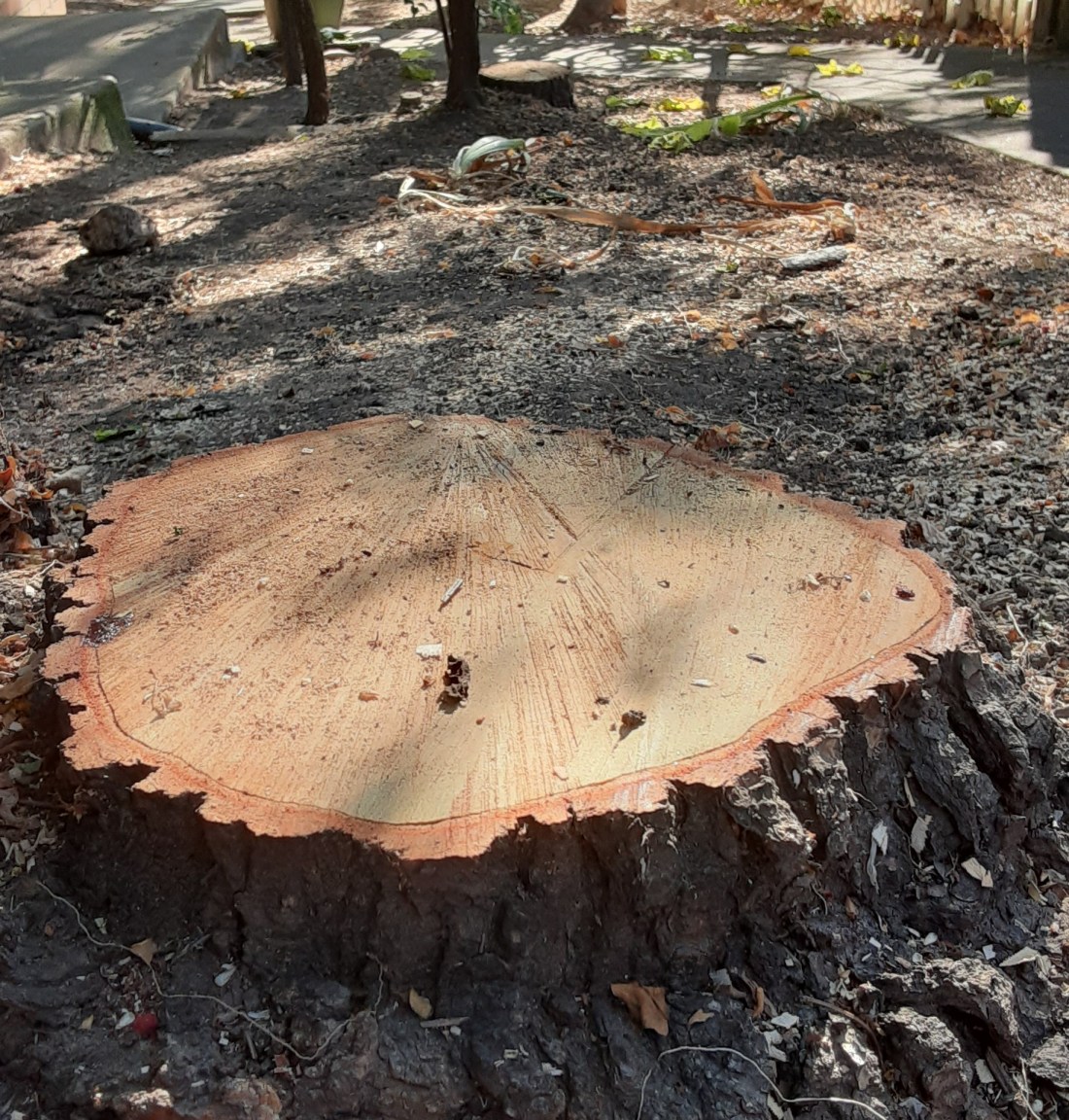
Two weeks later, my Ambers felled and Hackberry severely trimmed, acts that bring pain and tears even today, the neighbor had the nerve to write me a thank you letter for fixing my trees for him.

Ego awakened again and said, “Shit.”

How does one shut up inner dialog when every step onto the front porch reminds my poor little Ego that it no longer has the protection of three loyal trees? How can I stop anger when I see my burned roses, and dead blackberry vines no longer sheltered from the brutal sun? How can I stop the tears as I watch my generous fig tree that has lived its life as understory burn away in the heat?

A few nights after that tragedy, I went to my weekly meeting with the Women Writers of the Well. Driving there, I promised myself I wouldn’t write about this event. It was time to let go.

Who was I kidding? I couldn’t find equilibrium. I didn’t know who I had turned into that day. What kind of person blindly lashes out after downloading information that should have remained a hidden knowing? I wish I could have quelled his fears instead of adding to the insanity of his accusations.

Then, one of the writers shared this prompt: a big hole.

A door opened. My pen flew across the page.

I picked up Ego, along with Anger and threw them into a big hole. I watched them fall, until darkness sucked them up.

Like all things, Valarie, they didn’t stay in that deep oblivion. As I turned, Anger grabbed me.

“Fix this,” it growled.

“No,” I said, fully prepared to kick whatever crawled out of that hole back into its depths.

“Where is this going?” Ego pleaded.

“Back into the hole, with you,” I shouted, pointing an angry finger.

Shaking my head, I stormed off. Sometimes it’s best to turn your back on a thing. 

As if reading my mind, it shouted, “Not true. I’ve always been there for you. You need someone to protect you, guard against that world out there that doesn’t understand.”

I flashed a middle finger at it. “I can protect myself. I make good decisions. I don’t need anybody telling me how to run my life. I have rights, you know. I deserve to be free of the likes of you.”

“You’re ungrateful.”

“Oooh. And you’re gone,” I said, shoving at it, hard enough to knock it back into the big hole.

It wouldn’t stay there. I knew better than to expect that, but I didn’t want to listen anymore.

“You need me,” I heard it shout from a deep, deep place. It wasn’t going to leave me alone until I grappled with it.

“Dammit!” I hate when Ego whines like that.

Sometimes it is hard to see a train wreck coming. Sometimes we can’t step out of the way. So, here I stand in front of the computer, grappling with the story I started during a writer’s meeting a few weeks ago; writing and rewriting, wondering if it will ever be smooth enough for a blog. Time will tell.

In the meantime, does anyone have a shovel I can borrow?

Caretaker

Caring For Others – May 31, 2021 Women Writers of the Well

The week prior to May 31st was rough for most of us in the writers group. I was in the middle of a course called Healing the Mother Wound, an exploration of shadows held within me, some created by myself, some by my own mother in our dance together, some passed down to the two of us from the women who came before us. I was in a fragile spot. A tiny shimmer of compassion for all involved slowly blossomed and I wanted to care for it.

Another woman had an awakening encounter with a homeless man, and realized her first reaction was fear, fear of him simply because he was a man and then because he lived wild, and looked it. It was the learned behavior of a woman growing up in the United States of America, most probably the reaction of any woman meeting a man in an unpredictable situation anywhere in the world. In the end, this one experience was positive, opening a door for both of them, but it left her in a fragile space wondering how, as women, we had come to fear men so.

A third woman in our group was caring for a devastatingly ill family member. She was inexorably disappearing as the ‘caretaker’ role took over. Alone with the task and afraid of losing herself, she was extremely fragile. Because many of us in the group have grappled with the same situation, her story, along with the meditative prompt, sent us over an emotional edge, which became public to each other when we read our pieces aloud.

This was mine:

“As a woman, caring for others is easier than caring for self. Caring for self requires looking too closely at who we are, what we are, how we define ourselves. Healing ancestral mother wounds has opened my eyes to how much my personal definition has been shaped by patriarchal conditioning handed down, not by the men in our lives, but the women.”

While reading, I looked up at the screen. Heads were nodding, eyes filled with tears. I thought, Oh dear, how will I read the rest of this to them?

I took a breath, and continued, “All of us define our worth according to how we care for others, whether on the job, in the home or within our communities. We ignore Self because we are valued only as Helper. We keep the machinery of life running.

“As I breathe in, I realize how much I don’t know about the “who” of me. I know what I am, I know what I do, I know about the people I tend. As I breathe out, do I freely let go, giving to others, or is there a part that I zealously hold onto, knowing there is not enough, not enough – not enough. Who am I? How do I define myself? What information could I give so that you could decide whether or not we would trust each other? If I don’t have full Self on board, I don’t have full Self to give and right now, in today’s world, it is paramount we offer full Self.”

Some of the comments to this piece were:

We are sic not whole if not perfect.

You can murder a woman without taking her life.

We are always whole, but it’s hard to see it if we tired, distracted, or sick.

How do we fill empty moments, spaces of silence?

How do we choose to fill them? Who are we in those empty moments not spent tending others? Recently, my Guides advised me to sit at the base of one of my trees to ground myself. It was less a suggestion and more an imperative. I was to sit and let the tree do the work. This is not easy for me, to sit and let others do…even trees. The Guides advised me that if I wanted to continue journaling, I should do it grounded at the base of a tree. After these past three weeks of doing so, I finally started asking, Who am I? – not my placement in the world as daughter, wife, mother, ex-wife, teacher, retiree – not that which I do to fill the empty moments and spaces of silence: writer, artist, singer, gardener, housekeeper, reader, student, dreamer, (well, maybe dreamer).

Who.

Am.

I?

What snippet of information could I come up with to give you a hint of who I am? What bits do you need to decide whether or not we will enjoy each other’s company, work well as a team, or just simply “be” together. What do you need to know to decide a friend stands before you?

Who am I?

I calculate risks before I take them,

Then jump in with my whole, tenacious heart.

Extreme imagination

Informs me of past, present, and future

I dream in color

A seamless wave

Of knowledge.

I see the path before me

Before I take a single step.

I fly on wings of music.

Therefore, sound distracts me because

Music is EVERYWHERE.

Profound quiet

Creates a space to regroup

But then,

I want to fly again,

Let the beats of a song

Erase my stasis.

I am an empath.

Your pain,

Your joy,

Your fear, your sorrow

I feel it; I feel you.

Sometimes I cannot tell

The difference between us.

Oh yeah.

You wear that separate meat suit.

Intuition guides me

To recognize and honor authenticity

But, I have no time for masks

Or deceit.

Once I see your true self

Shining from your eyes

I will love and honor you

And steadfastly

Hold space for you.

I soften with sensuality

Drawn by sound, texture,

Color, smell and taste.

I lose myself

With a single touch.

In the trappings of sensation

I have to work to stay present.

Therefore,

I am grateful for trees.

 …so very grateful for trees. I am learning a lot from them. I plan to make sitting under trees a regular part of my meditation practice. For the first time, I am beginning to feel as if I belong, as if I am a part of Earth, as if I am an amazing contribution to all there is. I am re-establishing who I am.

Who are you?

I would love to know you. Are you a risk taker? Are you someone who will reach out, leave a comment? Have I given you enough information to make such a decision?

Thank you, Dear Reader, for waiting these last three weeks for another post. I appreciate your interest and the time you are willing to spend with me. May you find Peace and a sense of Self as you go about your days.

AV

Fumble – Part Three

(Author’s Note: I want to start this last installment with the words of two writers I admire. Their words speak to me.). 

David Roddy co-writes the podcast “Worker’s Cauldron” with Mercedas Castillo. He advocates for the marginalized and homeless. The “Worker’s Cauldron” originally called “Sh!t Gets Weird” focuses on “the cultural politics of the paranormal.” Each program is a lesson about history you probably did not learn in school, at least not here in the United States. You can catch the podcast at: https://podcasts.apple.com/gb/podcast/the-workers-cauldron

David states: 

The most dangerous person is one who never questions the efficacy of his or her hard work to overcome adversity, who doesn’t take into account circumstance, outside help, or sheer luck. It is dangerous to disconnect racial disadvantages, disadvantages that are especially hard for those who are single mothers. A person is doomed to callousness and a heartless inconsideration of others as long as they idealize that hard work is the sole cause of success. 

The other is poet Lyla Osmundsen, a member of the Women Writers of the Well. At our Monday evening meeting, she responded to the prompt: “Have I invented the world I see?” Vibrant with emotion, shining Love with the heart of an angel, Lyla wrote from the core of her being, which she does – always. She completed the first two lines during our meeting and read them to us. I was so touched I asked if she could complete it to add to this blog entry. Thankfully, she agreed. Her book is available at: Wa(o)ndering to Poetry (9781717396556): Osmundsen, Lyla Fain: Books 

Have I Invented the World I See? – Lyla Osmundsen, 3/10/21

Does my anger vibrate in unison

with the anger of others,

causing volcanic eruptions of

daily gun violence?

Does my careless waste

of food

constitute a crime

against a starving individual?

Does stuffing my house

with thoughtless trifle

transform into the tragedy

of a child with no home?

Lyla asked the hard questions of herself. Those of us that hear her words, in turn ask them of ourselves. What are the ramifications of our emotions, our patterns, our wants and desires? We all need to ask, “What world have I created?” Is it the one we want to see?

To live, a human needs water, food, and shelter. These are not privileges. These are necessities. According to most articles that I read, the top four reasons for homelessness are: lack of affordable housing, unemployment, poverty, and low wages. Contrary to popular belief, more than one third of people who are homeless are not jobless. They work long hours, sometimes more than one job, even more than two or three jobs at a time. Housing is too expensive and there aren’t enough developments to house all the people that need housing. Even if there were, the average wages for the average worker cannot cover mortgages, or even skyrocketing rental costs.  

The housing problem compounded in California when yearly firestorms became the norm, forcing people to leave established living accommodations. As a teacher, I worked with families displaced by fire. Some lived out of their cars, more fortunate ones found safety with family or friends. Others, unable to find work in California, left the state, abandoning their old lives entirely. These were the lucky people.

The rest careened into homelessness and took to the streets, or the edges of parks, or under overpasses of highways. People of small towns and rural areas, areas with limited job availability especially develop an attitude of looking down on the displaced citizens that hover in their areas. The typical response I heard was that the hardworking taxpayer shouldn’t have to subsidize lazy vagrants.   

Then Covid-19 hit. Stimulus packages were not enough and came too late. Workplaces were shut down, people lost their businesses, mortgage holders weren’t compassionate enough because their own livelihood was compromised. Homelessness was no longer an issue of “you just have to work hard.” I wonder, do those angry people bemoaning their taxes still feel the same? Are some of them now living on the edges of society, possibly still working hard, still paying taxes, living under makeshift tents on the edges of town?

Covid-19 gave most of us time to realize our good fortune is largely due to luck. Having or not having is often a matter of who you know. It’s almost always a matter of what color am I?

As early as the 1970’s Federal investment in housing was threatened. In the 1980’s there was already an unwarranted number of families with children considered homeless. In 2008, financial crises created foreclosures forcing people to give up their homes and take rentals instead. Unfortunately, affordable and safe rental construction could not meet the demand of displaced homeowners. Rents rose, but working class wages did not. By the time Covid-19 was a pandemic, rents were too high for most people working full time year round as minimum wage workers. According to the U.S. Bureau of Labor Statistics in a survey completed in 2019, 82.3 million workers 16 years and older, represent well over half (58.1 percent) of all wage and salary workers in the United States. These are people struggling to maintain shelter. Six percent of white households are extremely low-income renters. (2,3,4)

For people of color, the statistics are bleak. “Twenty percent of Black households, 17 percent of American Indian or Alaska Native households, 15 percent of Hispanic households, and 10 percent of Asian households (compared to the white households), are extremely low-income renters and are often locked out of affordable housing due to systemic and structural racism and decades of racist policies.” (1)

I think about other single mothers like myself. What are those statistics?  Over 85% of homeless families are headed by women, specifically, by single women with children, and domestic violence is a principal cause of homelessness among single mother families. (5) 

Reading a statistic such as this raises the ugly face of my own fear. My fear was real. I was afraid of homelessness, however, that fear was as irrational then as it is now. I always had people who cared for me. I had places I could go. I am white. Job opportunities, even in this rural area, were presented to me, largely because of who my family knew. There was no way I would find myself on the street.

Even now, as a retired person living on barely adequate retirement wages, when the fear stops me in my tracks, the truth is – I remember that money is adequate. I have shelter. I have water. I have food.  

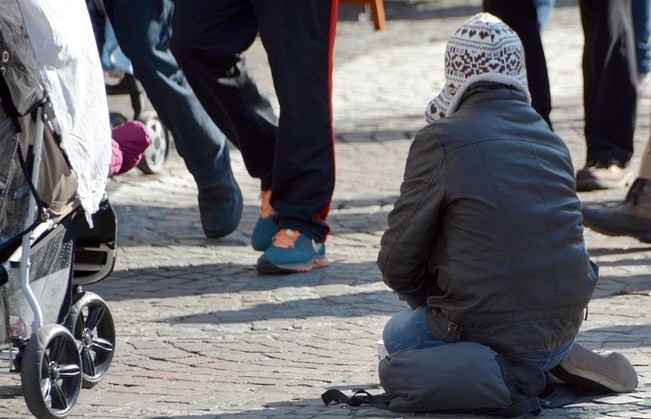
I will never know who that huddled person in front of Starbucks was. I didn’t stop to ask their story. Where was that person’s luck? Did my callousness leak some of it away? Were they as terrified of me, as I was of them? Were they huddled under the mound of clothing in defense and shame? Could I have alleviated part of that shame for one transitory moment if I had stopped to smile, at the very least? Could that one moment have made all the difference in the world for that one person?

December 31, 2019 was a lost opportunity. Today, as I rewrite this article, terror washes over me again as I remember being a single mother of two very young children. My heart crumbles as I remember the person I left behind at Starbucks. Before my fingers touched the keyboard, I sat on my bed sobbing. I lived on the brink of disaster, that person lives the disaster.

I have to own that terror and let it go. I also have to own the pride that covered it up and made me callous. Yes, I worked hard, but I was fortunate. I was presented with opportunities that I was in a position to grab; opportunities that a great many of us don’t have.

In the future, will I find, at the very least, the courage to smile if I have nothing else to give? I need to look behind the pride that covers my near miss and move forward one encounter, one opportunity, one story at a time.

Works Cited

Aurand, Andrew, Dan Emmanuel, Dan Threet, Ikra Rafi, and Diane Yentel. 2020. “The Gap: A Shortage of Affordable Homes,” p.13. Washington, DC: National Low Income Housing Coalition. https://reports.nlihc.org/sites/default/files/gap/Gap-Report_2020.pdf.

 Chetty, Raj, Nathaniel Hendren, and Lawrence Katz. 2016. “The Effects of Exposure to Better Neighborhoods on Children: New Evidence from the Moving to Opportunity Project.” American

Economic Review 106 (4). https://scholar.harvard.edu/hendren/publications/effects-exposure-better-neighborhoods-children-new-evidence-moving-opportunity.

Gowan, Peter and Ryan Cooper. 2017. “Social Housing in the United States,” p.1. Washington, DC: People’s Policy Project. https://www.peoplespolicyproject.org/wp-content/uploads/2018/04/SocialHousing.pdf.