One Single Moment of Joy

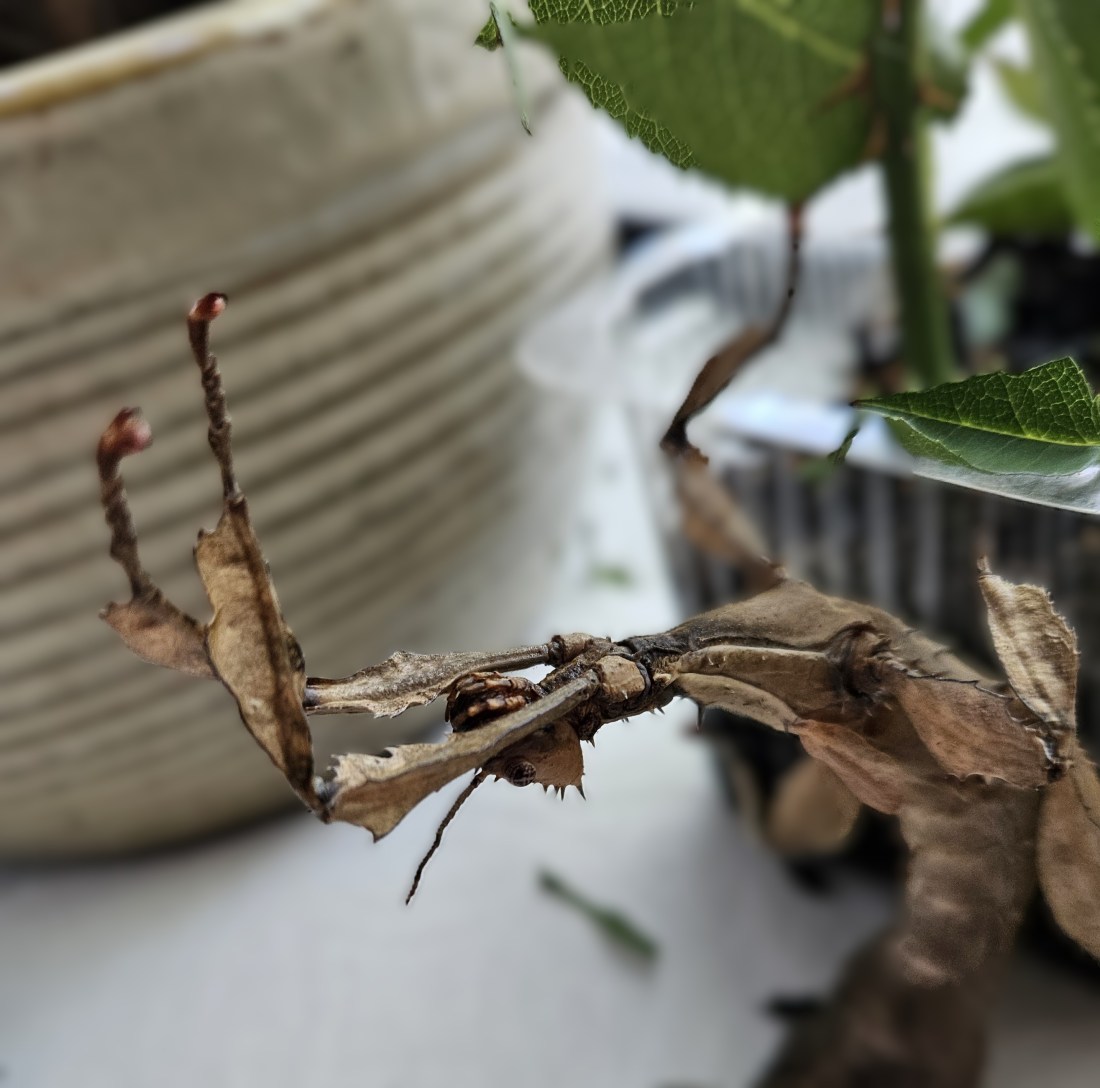
Usually, Sticky Willie, my dear Giant Australian Prickly Stick insect, recoils from my presence, especially if I open her door. She curls, rolls her tail over her back like a scorpion, and rocks frantically, trying to make it known – spikes here – be afraid.

What a poser.

One day, August 6, 2025, to be exact, magic happened: I opened her door. She looked up. Slowly, carefully, one leg at a time, she began creeping toward me. It was as if she were asking, “Who are you?”

Every few steps, she would stop and reach up with one arm as if to explore what was in front of her.

The third time she did this, she was close. Her little face seemed focused on mine. She reached out.

Gently, I touched her tiny claw with the tip of my forefinger.

She patted me.

I stayed there for her, letting her little claw explore my touch.

A sweet moment passed between us, a single moment of joy, shared by two beings of Earth, one homo sapien and one extatosoma tiaratum. 

My heart dances each time I return to that exquisite, wondrous moment.

I can’t help but think how joyful this world would be if we as humans were patient with every living thing, waiting for their energy to come to us rather than us bullying our way into their lives’ plan. What would happen if all of us stopped to learn what trees have to say, what birds are really singing about, what the lady bugs at our feet are doing?

Sticky Willie has her agenda. Her agenda does not alter mine, except with the things she cannot do for herself because I have placed her in an artificial situation. She can’t keep her cage clean, nor can she leave her cage to hunt for her own rose leaves. She cannot squirt herself with water to simulate rain. She may no longer be in her native habitat, but she chose to come here, to trust that I will take care of those things she cannot do for herself. 

I am rewarded with the chance to learn more about my world by watching her. And every once in a while we have a moment. It’s worth slowing down to wait for that one single moment of joy.

Neighbors

Strength wanes

long tenticles of grasses strangle

roses 

bridges between total death

and life

simplicity in purpose

if not grace

grasses

cover earth

otherwise scorched

by relentless sun.       

I am left with the question, what should I annihilate: my desire to destroy the strangling grasses that cling to my roses, or the plants themselves. These unwanted neighbors take nutrients and sunlight from my precious plants. They resist all attempts to eradicate them year after year after year. Where did these insidious creepers come from? What is the reason for their existence? Why can’t they go back where they came from?

As a tree lover, there are only small patches of land in which to grow sun loving plants. As a reluctant gardener, I am tired of fighting. Do I have resources for both?  

Bermuda grass is a sought-after perennial that is lush to walk upon and stays green all season. Intolerant of shade, it is drought tolerant, preferring at least seven hours of sun daily, which is why it is growing where my roses love to be. Bermuda belongs to the family Poaceae. Its official name is Cynodon dactylon. The name sounds like a creature from a monster movie and perhaps it is. Native to the Mediterranean, not Bermuda as its name suggests, people most likely brought it to this continent during the slave trade where it hid in contaminated hay used as bedding. Later, during the 1930’s it was used as a turf grass for golf courses, and in California’s early agriculture days, especially in the Central Valley, it thrived even when irrigated with salinated water. It is tough enough to withstand the trampling of grazing cattle with tenacious root systems. The roots I dig up are bright orange, and can dive as deep as six feet underground. Needless to say, at age seventy, I am not digging holes deep enough to eradicate it.

There is a close look-alike to Bermuda that also plagues my roses. 

Crabgrass. 

Native to Eurasia, it was accepted by the U.S. in 1849, an oddly specific date. The Patent Office named it a “potential forage crop.” Now it is EVERYWHERE. I have even found it growing up the walls of my basement. The most common species in Central California is Digitalis ischaemum. It spreads by scattering seeds, which unfortunately I have facilitated by ripping out the whorls it makes from the ground. Considered a tiller grass, new shoots develop on the crown of a parent plant and while they send down seminal root systems, they still depend upon the parent. And finding that parent can be a scavenger hunt. The good news: Crabgrass actually happily crowds out Bermuda. The bad news….

While researching I discovered there is another invasive pest in my yard that I have actually encouraged and now grows at the base of my roses…Quackgrass. 

Elymus repens, i.e. Quackgrass arrived on this continent sometime during the 16th century. My own ancestors were probably responsible for carrying what is now considered an invasive species over the Atlantic when they escaped…uhh…immigrated, from persecution in Europe. This plant from Eurasia and North Africa, commonly known as Common Couch or Creeping Wild Rye, spreads really fast. Sometimes the rhizomes grow an inch per day. The offspring can be found as far as ten feet from the parent plant. Unwittingly, I find the seed heads to be quite beautiful. It is one of the few grasses I don’t physically react to so naturally, I invited it to stay.

A quick dive through the internet taught me that Quackgrass, of the three of them, probably has a place in this yard as it is nutritious as forage, and good for humans. In early spring, the young shoots are tasty in salads. As well as providing healthy fiber, they are sweet and crunchy. Rhizomes can be dried, ground, and used as flour or as a coffee substitute. Even the sweet, fibrous roots can be eaten. Unfortunately, this plant is allelopathic, which means it uses chemical warfare to repel other plants. My poor roses. 

I probably introduced it into my yard in the bales of straw used to feed and bed my children’s 4-H rabbit projects. However, after learning about this plant, I may take it off my pest list, providing I can move the roses out of its reach. 

I have come to the conclusion that it may be easier to learn to live with these plants than try to fight them. This plant war has been fought on one of the steepest grades in my yard. It would be a thousand times easier to deal with the grasses without the roses getting in the way. The only way to save the roses is to move them to the other side of the house. That’s doable. There’s enough room for everyone here.

Citations

Kaffka, Stephen (2009) – “Can feedstock production for biofuels be sustainable in California?” Original printed in California Agriculture 63 (4): 202-207, 2013

Kaffka, Grattan, Corwi, Alonso, Brown Jr. “Bermuda Grass Yield and Quality in Response to Salinity and N, Se, Mo, and B Rates in West San Joaquin Valley.” UC Center for Water Resources, September 27, 2015.

https://ag.umass.edu/turf/fact-sheets/biology-management-of-crabgrass

https://forages.oregonstate.edu/regrowth/how-does-grass-grow/developmental-phases/vegetative-phase/tillering

https://www.canr.msu.edu/news/pain-in-the-grass-bermudagrass

https://thenatureofhome.com/bermuda-grass-vs-crabgrass/

https://www.thespruce.com/all-about-bermuda-grass-7151762

https://turf.arizona.edu/tips103.htm

Reality Check

San Francisco – 1978

All ten toes tightly grip the precipice of youthful choice. Across a career chasm, a queue of breasty blondes vie for a chance to become the next Marilyn.

“You could have that and more, Miss Singer. You have one of those rare faces that can be either very young…virginal really, or old and wise. You have what it takes.” 

I nod. All the high school and college experiences are worth something after all. The queue telescopes closer.

He lifts my resume and waves it. “The resume is impressive. You’ve answered all my questions. Do you have any?”

Is it too soon to say, “When do I start?” Instead, I shake my head no. 

He says, “I just need one more thing. Pictures.”

Pictures. The last step before my place in that queue.

“Please remove your clothes.”

What? Do I hear that correctly?

“Ahh. There’s no need to remove your panties, at least not yet.”

Details of the queue, hidden by distance, suddenly crystallize: bruised and tear-stained faces, slipped bra straps hanging from bare shoulders, torn blouses, snagged nylons on too much leg flashing beneath dish towel-length skirts. Eyes filled with hunger, desperation, regret….

Is this what it takes? I lift one foot and –

– step back. “No sir. I will not be doing that.”

“I misunderstood. I thought you were hungry. Everyone who is anyone has gone through this.” Disappointment in my choice taints his words, colors his features. 

I bow my thanks and back up to the door. Shaking, I grab the doorknob. It turns easily. I escape into the dank hallway. 

Funny. 

I didn’t notice the squalor upon entering.

I fly from the building and slam into sunshine. San Francisco is warm today. 

“Did-I-do-the-right-thing?” quickly dissipates in the golden light. 

Tick-tick-tick

Tick, tick, tick.

The clock ticks with relentless accuracy while I wait for a shiver of connection. In the trunk of this tree of self, I realize it’s on me now. I am my own advisor. If I were to actually act in that capacity, what would I tell myself? “RIght now there is nothing.

“Nothing about which to worry, nothing about which to rejoice, no aches, nor pains, no elation, nor disheartening ennui.”

There is only a moment of quiet – the tick, tick, tick of a clock, counting the seconds of this empty moment of peace.

I wonder if this is the normal truth of most lives, or am I alone here? Is this why we are driven toward busy-ness? Would life seem to last forever if this moment lasted the length of it? 

Tick, tick, tick.

This was the kind of thing running through my mind while waiting for the voice of inspiration during the ten minutes of writing time on August 8, 2022 after the opening meditation. For that ten minutes, the voice of inspiration never came. I had no words to address the meditative prompt, no words to tell a story. Just emptiness…so, that’s what I wrote about. I kept this, because even when the muse is absent, one can still write something. For me, these moments occur. 

All. 

The. 

Time.

Later that night, for our last prompt, the muse brought me an acrostic. The prompt was Beyond the Beyond: 

Beautiful dreamers create
Everything they see.
Your life is
One like this
Never empty, always budding
Day after Day.

This is
How we
Endure.

Beginning with one thought
Each trmbling into the next
Yearning for substance
Otherworld to ours.
Now is the time.
Dream.

What Do Rocks Know?

As an intuitive I get a lot of information from a lot of places, and it’s presented multiple ways. The knowledge doesn’t just blossom, it bursts into my awareness like a supernova. Sometimes I can make sense of it: an ah-ha that feels so right that chinks that had heretofore been missing, suddenly click into place. Other times I wonder, “What the heck just happened?”

This year my guides nudged me to practice. Intuition isn’t something that just happens, although it used to seem that way. Over time I have learned it is something that can be practiced, like music. While meditating upon this notion I heard: Practice psychometry. Learn to read objects.

Objects? Where should I start? I look around my house. I know the history and value of almost everything, but then my eyes settle on a basket of rocks. Why not?

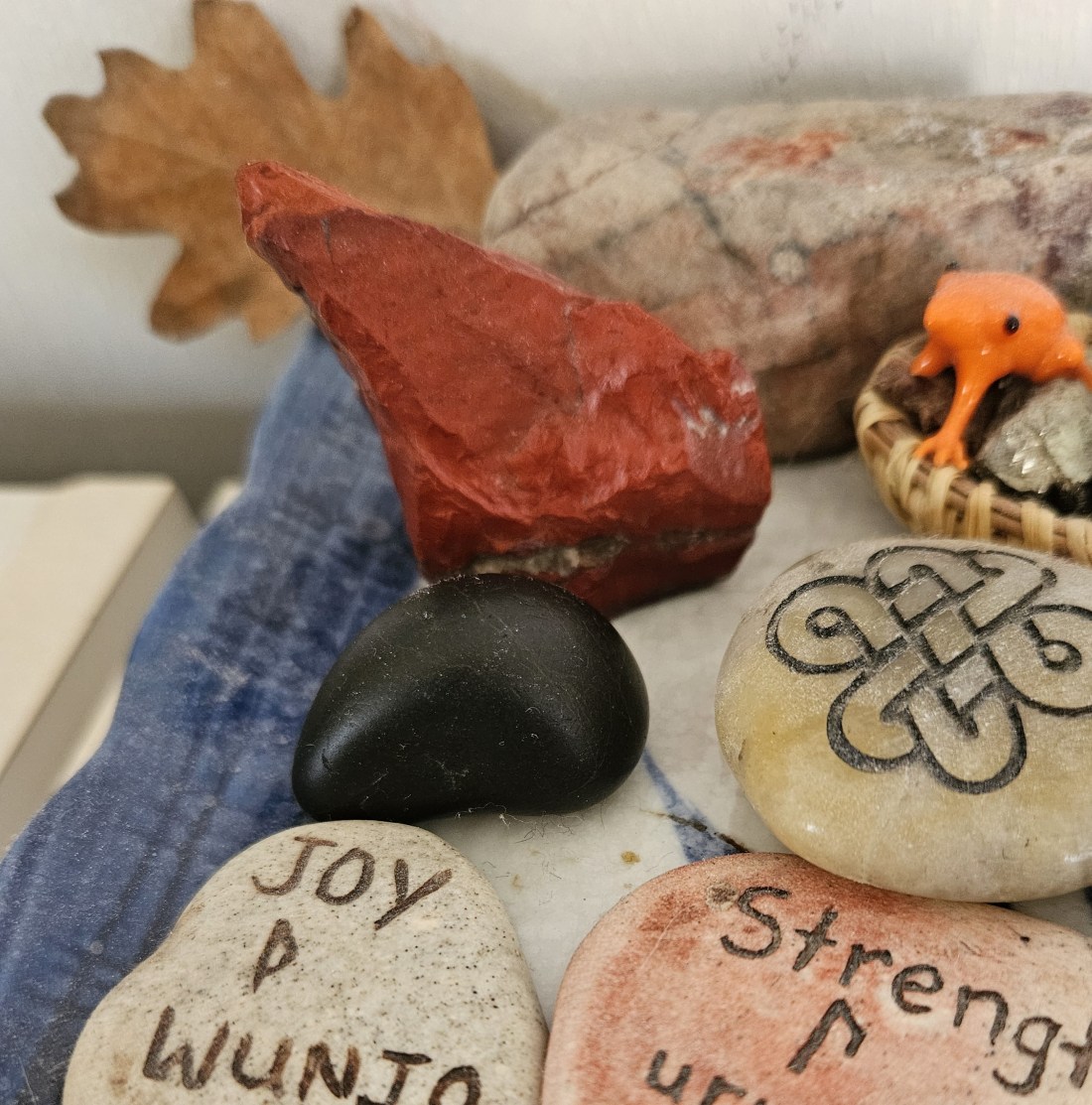
I have always been a rock collector, picking up specimens, not only as keepsakes from my travels, but also from my yard. Somehow, they become coveted objects. I had never thought much about them, I just collected them, took them home, and put them into baskets.

One day, after nightfall, while walking in my garden, the scant light of a half-moon shone upon a small, kidney-shaped rock. It was smooth, soft to the touch, and as black as the velvet of the sky.

A comfort rock.

I slipped it into my pocket and rubbed it as I walked about. When I went inside, I placed it upon my altar. From time to time, I picked it up to rub its silkiness, then I put it back among the other treasures that remind me of who I am. It’s been there for several years.

For this new practice, my perfect little comfort stone was not my first choice. Another altar stone caught my attention, a chunk of red jasper from Patagonia, Arizona. 

I held it in my hands, cradled between my palms. First, the stone felt cold, then colder still. Odd. The more I held it, the colder it got.

“Follow the cold,” I told myself. “Follow the cold.”

In my mind’s eye a migration of people passes, wind howls. Darkness, ice, snow blow against them. They shuffle on, heads down, dressed in fur. 

Profound cold. Ice-aged people in an ice-aged world.

Excited, I practiced for several days. I was learning to let go of preconceived notions. It was an important lesson because often intuition is skewed by personal ideas or desires. 

On the fourth day, feeling as if I was learning how to read these rocks, and to let go of what I expected to learn about them, I picked up my comfort stone.

The lesson of preconceived notions didn’t stop my monkey mind forming them. “It is most likely black basalt, washed and tumbled smooth from a creek bed. Where did it come from? Somewhere atop the Sierra Nevada.”

I nestled it between my palms. Immediately I saw a tumbling washing machine. 

“Well, that can’t be right.”

I focused on the feel of the rock as I had been doing, expecting this one, as had all the others, to be cold and either remain cold or get colder. 

Not so. 

There is heat. And the more I held it the hotter it became. It became so hot I was compelled to let go, and when I picked it up, I placed it against my cheek. It was as if a tiny furnace burned inside it.

I followed the heat. 

Suddenly, there was the washer again. 

What?

Ahh! Then it came to me. This tiny rock was tumbled in an industrial rock polisher! It was sold as gravel, “polished” to resemble river rock and used as a blanket to line decorative waterways or patios. In my yard, it lined a drainage ditch. Before that, it knew only pressurized heat, not volcanic, pressurized. Pressurized heat seemed very important to this reading.

I pressed the lingering warmth against my cheek, cherishing it, and then set the tiny, black rock onto my altar. 

How surprising. 

As I left my bedroom, a notion hit me. Is it possible that some of the major psychic events I experience come from the very rocks I stand upon? How much do rocks know?