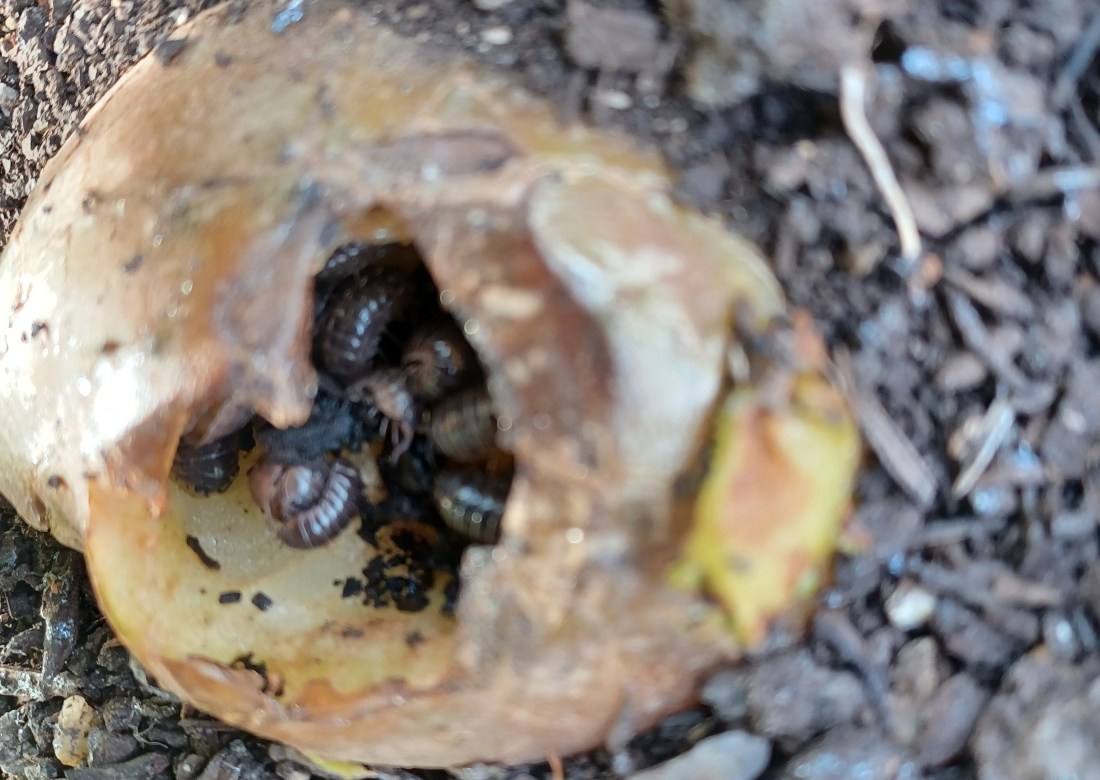
Armadillidiidae (photo by Lisa DeRosa)

Wee boy
Flipped a rock
Found a crawly
Picked it up
Watched it curl
Perfect ball
Rolling on his palm.
What a wonder.
Did you pop it
Into your nose
To keep it safe
To keep it close?

While I discourage this behavior, especially after a trip to the doctor to remove the little beastie, it did prove that Armadillidium vulgare, a terrestrial crustacean, can live quite happily in a dark, moist environment. (Yes, it was still alive when the doctor removed it.)

It was difficult to research A. vulgare. They are not considered agricultural pests. They are so common in our country that people take them for granted and mostly ignore them. They did not originate here though. Possibly as early as two-hundred million years ago,
sometime after the end of the Triassic period, tiny, gill-breathing crustaceans
crawled onto what would now be considered European shores and adapted to stay
land-bound. The species found in California, Armadillidium vulgare, is usually
bluish gray with plates that allow them to conglobate, or curl into a ball,
which they do for protection and water conservation. This species was
introduced to New England from mediterranean regions sometime during the
1800’s. I could not find any documentation about how they arrived in California.
Maybe they came during the Gold Rush.

Here's what we do know about them. They are nocturnal, and like dark moist places. They breathe with a gill system. Apparently, the hind-most set of their seven pairs of legs adapted to become air tubes that feed into a gill system on the underside of their body. They
roll into a ball to conserve moisture, because gills need wet surfaces to stay
healthy. One usually finds them under rocks, or leaf litter on moist ground, but
if you are a pet-keeper, it is a good idea to create some dry, warm places as
well, because they need an outside source of heat to regulate body temperature.


Pill bugs, or as they are commonly known in my area, roly-polies, are detritivores, consuming decomposing plants and animals. In terrarium conditions, they are helpful as they will also clean-up their own shed exoskeletons and any mold or fungus that grows in an enclosed, moist habitat.

Though not a pest, they will consume young plants. I learned the hard way that using leaf litter as a mulch only attracts them…By. The. Thousands. (Okay, maybe hundreds.) My point is nothing has a chance to grow with a large population of hungry decomposers who eat seedlings as dessert.

There have been some recent studies that claim that because they also eat fungi they help with global warming. Fungi release CO2 into the atmosphere as they perform decomposition
tasks. Armadillidiidae keep fungi populations in check, mitigating CO2 production.
Every little bit helps.

Another fun fact is that when they are cleaning up, they eat trace amounts of heavy metals, thereby preventing food plants from absorbing them. The more I learn about these little treasures, the more I am tempted to create attractions for them in my garden on purpose
instead of by accident.

Roly-polies are hatched about a week after fertilization into a brood sack on the underside of an adult female. Yes, they are marsupials. I was so thrilled to learn that. I now know that I have mammalian and crustaceous marsupials in my backyard. Yay!

The babies stay in the marsupial pouch for about two weeks. Upon exiting the pouch, these young ones molt every two weeks for about four and a half months, at which point they are considered adults. (I think. No source actually said that.) Females can store deposited sperm
for up to a year, picking the prime time for survival. This may be why some
sites claim the females can reproduce asexually. However, in my opinion, the
male courting dance seems quite elaborate: males wave their antennae at the
females to get their attention. Once they get it, they choose a mate. They then
lick and tap her to convey intention. In my mind, that refutes the notion that
females can reproduce asexually. It just seems that the male roly-poly uses a
lot of energy to get the female to like him. Why would she put up with that if she
could do it without him?

Even though I could not find much scientific research about them, because roly-polies are not agricultural pests, I had a great time researching pet sites on YouTube. Did you know they live three to five years? That’s plenty of time to form relationships with these
tiny creatures.

If you want to attract roly-polies, pile up some fallen leaves, or place a corn cob, half of a cantaloupe, or even a rotting potato outside in the shade. Leave whatever you have chosen in place for a few days, then move the waste along with scores of attracted pill bugs. I
have included links to videos that show how to set up a house for your newly
adopted pets.

Or, you can just let them mind your garden, knowing that this gift from the sea is protecting your land.

Sources Cited
https://entnemdept.ufl.edu/creatures/MISC/Armadillidium_vulgare.htm
https://www.pbs.org/newshour/science/pill-bugs-emerged-sea-conquer-earth
https://www.treehugger.com/roly-poly-pill-bug-facts-important-environment-4864410
https://en.wikipedia.org/wiki/Armadillidiidae
https://en.wikipedia.org/wiki/Armadillidium_vulgare

Videos
https://www.youtube.com/watch?v=Ij7VDu6iWCg
https://www.youtube.com/watch?v=9oUkDOI_QmI
https://www.youtube.com/watch?v=p-dTokDjn14
(This is about A. vulgare in particular)
 Connection