Remembrance of a Gravestone

With the publication of this short personal essay, Alton Parker, a dear friend of mine, and talented writer presents “Remembrance of a Gravestone,” about a monument he saw while on the road from Flagstaff, Arizona to Los Angeles, California. 

Thank you, Alton, for considering publishing, for the first time, on my blog. I love this story.

The setting sun gave the distant mountains a glow of flaming amber. Heading to their far off vista was a straight asphalt highway, cracked and pitted with age. On either side of the highway, a plain of gamboge prairie grass stood. It did not complain about being split by the road; it simply was. Utilitarian power lines were strung alongside the highway, periodically interspersed with poles stretching up into the twilight. Upon one of these, a speckled falcon perched, scanning the ground intently for its next unfortunate meal. Vultures circled the violet sky. 

An unusual monument stood at a point between destination and beginning: a gravestone. Long ago, eons for all I knew, a car accident had killed two people here. Artificial flowers had been collected. The roses must have been a striking crimson at some point, but they had long since been sun bleached into a dull depressing grey. 

No one stops to pay their respects. No one cares about the gravestone beside the asphalt highway. The names of those deaths have been lost, the files rotting away in the archives of some forgotten local newspaper. 

I wonder what their names are. 

I feel a burning need to know who they were and  who they left behind. Does anyone remember them? Does anyone care anymore? I continue my journey towards the amber mountains, now disappearing into ink black night. I remember the gravestone beside the asphalt highway. 

I remember.

December 12, 2025

One Single Moment of Joy

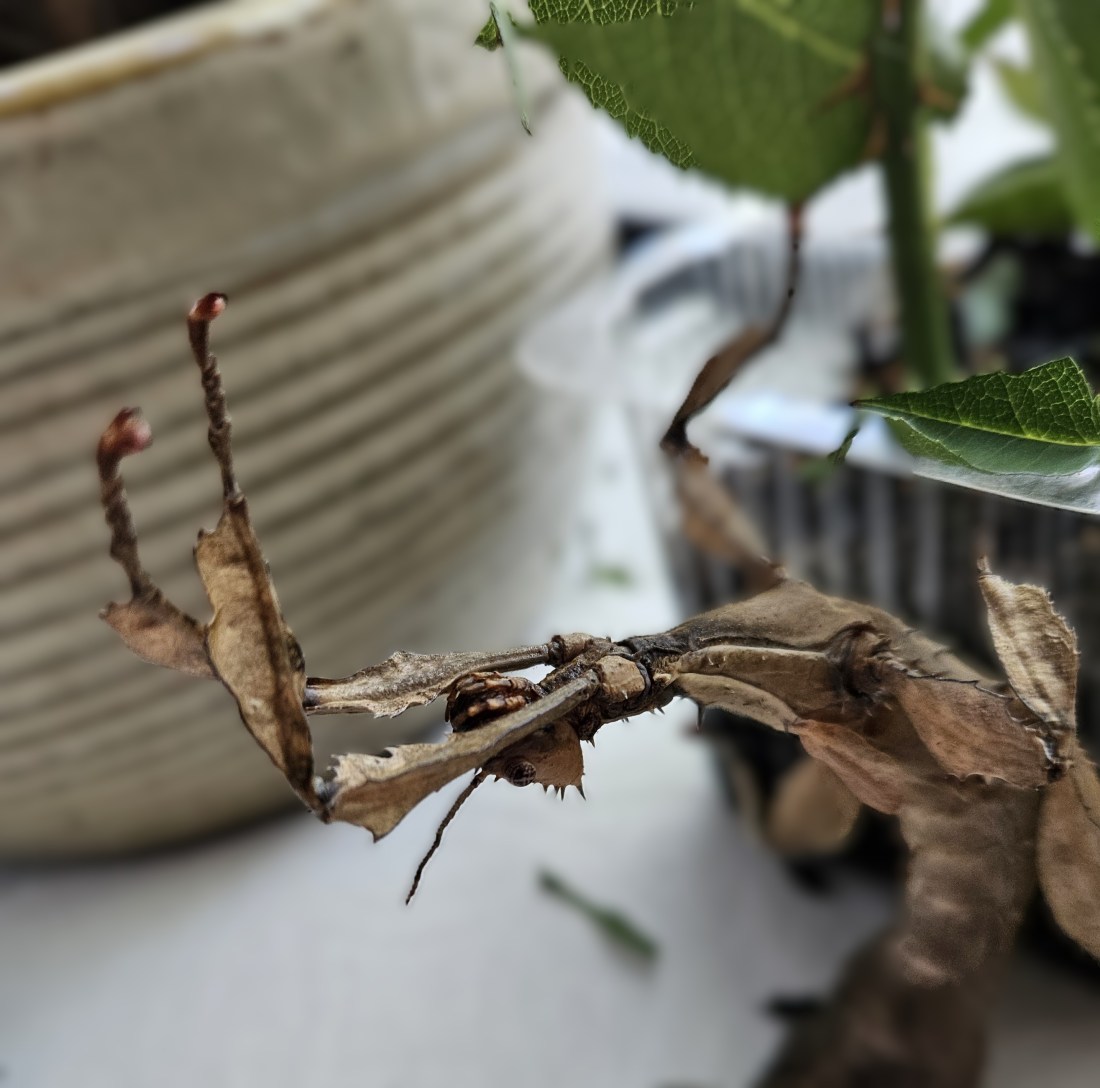
Usually, Sticky Willie, my dear Giant Australian Prickly Stick insect, recoils from my presence, especially if I open her door. She curls, rolls her tail over her back like a scorpion, and rocks frantically, trying to make it known – spikes here – be afraid.

What a poser.

One day, August 6, 2025, to be exact, magic happened: I opened her door. She looked up. Slowly, carefully, one leg at a time, she began creeping toward me. It was as if she were asking, “Who are you?”

Every few steps, she would stop and reach up with one arm as if to explore what was in front of her.

The third time she did this, she was close. Her little face seemed focused on mine. She reached out.

Gently, I touched her tiny claw with the tip of my forefinger.

She patted me.

I stayed there for her, letting her little claw explore my touch.

A sweet moment passed between us, a single moment of joy, shared by two beings of Earth, one homo sapien and one extatosoma tiaratum. 

My heart dances each time I return to that exquisite, wondrous moment.

I can’t help but think how joyful this world would be if we as humans were patient with every living thing, waiting for their energy to come to us rather than us bullying our way into their lives’ plan. What would happen if all of us stopped to learn what trees have to say, what birds are really singing about, what the lady bugs at our feet are doing?

Sticky Willie has her agenda. Her agenda does not alter mine, except with the things she cannot do for herself because I have placed her in an artificial situation. She can’t keep her cage clean, nor can she leave her cage to hunt for her own rose leaves. She cannot squirt herself with water to simulate rain. She may no longer be in her native habitat, but she chose to come here, to trust that I will take care of those things she cannot do for herself. 

I am rewarded with the chance to learn more about my world by watching her. And every once in a while we have a moment. It’s worth slowing down to wait for that one single moment of joy.

Reluctant Gardener – Tale of Two Species

As a gardener, even a reluctant one, there are some unwanted visitors that show up from time to time. Those are usually the species that attract the most attention from us because they seem to disrupt the equilibrium of the garden. But what if that is not the story? What if I don’t need to spend an inordinate amount of time trying to eradicate them?

Galium aparine, known around here as Sticky Willy, or the Hitchhiker plant has many names: Cleavers, Goosegrass, Catch-weed, or Velcro Plant. Leaves, stems, flower petals and seed pods are covered with tiny, hook-like hairs that cling to plants, animals, clothing, and human skin…literally everything.

A self-pollinating annual, I never look forward to early spring as its admittedly beautifully fanned leaf whorls begin to rise through the oxalis, prairie grasses, and three-cornered leeks. I can’t walk my sidewalks without this hitchhiker grabbing my pant legs. And of course when it does, it hangs on for dear life. In doing so, its stem breaks. Such a weakling. However, the roots stay embedded and the little suckers come right back up. 

Until this year, I was successful removing them in a timely manner. I never had a chance to see their display of delicate and beautiful light green and white flowers. I did not witness the seed pods, their means of propagation, so I don’t know how they proliferated throughout my property, but here they are. 

Here is the magic of this plant. It prefers to grow in shade, dappled shade or full sun…truth. It likes clay, sand, or loam. It grows in coastal areas, mountainous terrain or on the plains. It tolerates everything and grows EVERYWHERE. Though botanists think it is indigenous to North America, it is found in many other countries. It probably hitchhiked there. (Perhaps in some unwitting person’s pocket).

It’s useful. Seriously. According to my research it has a purpose. In fact it has many uses. Flowers curdle milk for cheese making. It’s used for stuffing mattresses. It’s edible.

“Wait. It is edible? What?”  

That’s right. People can eat Sticky Willy. The stems and leaves can be cooked with other greens. They are used for tea. The fruit can be dried and used as a coffee substitute. It actually has caffeine. 

(Why am I trying to get rid of this????)

It’s an herbal medicine. An infusion can help reduce swelling, treat infections, or boost energy. There are topical uses as well: ease psoriasis, eczema, and acne. It supports the immune system, and can help support the liver when detoxifying the body. It isn’t reactive with other herbal treatments nor does it affect medications. Sticky Willy is more effective used fresh and not dried, but it grows throughout the spring and summer here. 

(Note: always test a plant on your skin before you try to eat it. Then try a tiny amount, to see how your tongue reacts. Spit out if your body reacts negatively to it.) 

My body did not react negatively to this plant. I might have to create zones for this plant because I think I am going to have to learn to love this plant and look forward to its appearance every year instead of dreading it. 

This leads me to my next tale, also about Sticky Will(ie). On April 12th, 2025 family and friends gathered for my son’s birthday. It’s important to remember that my son seems to be coexisting just fine with the plant called Sticky Will(y). I sat on a bench at his party to admire a flower bed, and there it grew galium aparine, with sparkling fans shining in the string of lights lit for the party.

Go figure. 

The love of his life, his wife, invited a ‘bug lady’ to come to the party to share exotic and interesting insects. My son is a biologist with a love of all things that have multiple legs and sometimes wings. 

The first insect she shared with all the party goers was a monstrous looking thing called extatosoma tiaratum, otherwise known as Giant Prickly Stick Insect. 

I have held stick insects and at the party held another species that looked exactly how you would imagine an insect that imitates a stick should look. Extatosoma tiaratum like its name is GIANT and covered with spiky armor that reminded me of rose thorns. When alarmed, which they all were, they looked like ferocious scorpions of some kind. I did not want to hold this one and didn’t even pet it. It was interesting to “look at.” 

 I was glad when they all went back into their travel carrier.

She loved them though and told us all about it. Native to Australia, they live in trees, usually eucalyptus trees. Herbivorous, they eat the leaves. The insect isn’t harmful, but it does kick when it is angry or scared. 

Then, she gleefully showed us the poop as compared to the eggs that were dropped on the paper towel substrate she was using to transport them. The poop was long and rectangular, the eggs were round. This particular colony was parthenogenetic. 

My listening became more focused. Parthenogenesis, all female colonies – not needing males to breed: I have written about other insects that have this trait. 

She explained that the eggs are dropped to the ground, because the insects don’t come out of the trees willingly. The eggs are coated with a sugary substance that attracts ants. The ants gather them to take them home to feast upon. After eating the sugary shell, they cannot eat through the hard layer underneath so they discard them in their compost piles. (I am interested enough to do some research on ant composting practices in a later blog post.) The babies incubate in the heat of the compost, then hatch, resembling baby ants with black bodies and red heads. 

(Okay, at this point, you have to understand, I was maternally and intellectually interested. The fact that they were born as redheads intrigued me, since my own children are genetically redheads, and my daughter had vivid red hair when she was born.) 

From egg to hatchling takes nine months to 400 days. Wow. That’s a long time. By six molts they look like tiny versions of their mothers. They are quite literally clones of her, since this is a parthenogenetic colony, but there are colonies with both male and female insects. They tend to live longer, and the reproduction cycle may be faster. Each female that is born of a parthenogenetic colony is capable of producing approximately 800 eggs per year, but they only live about eighteen months.  

She continued for at least an hour and a half, perhaps two, sharing many different species with the party crowd which was as intellectually curious as I was. We held and played with many other insects, amphibians, snakes, and even an Amblypygi, the arachnid of Harry Potter fame. I spent a lot of time with a lovely creature that I fell in love with, a small Crested Gecko. 

As she packed up, all of us went to eat food, use the facilities, sit in the living room or around the outside firepit to talk. My daughter and I stayed for about another hour, later than we usually do because this was the best party ever. 

When we got into the car, we fastened our seatbelts for the thirty minute drive to her house. I planned to tank up on coffee for the next leg of my own journey, another forty minutes to my front door. I used the facilities again, made some coffee, and sat down in a chair to review the party. I got up to clean my coffee cup, and pulled a handkerchief from my pocket, which I had done repeatedly during the party to wipe my nose, because it was irritated by the fire pit smoke and my clothes reeked of it.

I felt something prickly in my pocket. Sticky Willy. I didn’t realize I had sat next to some of it, while playing with the animals. Ugh. The tiny green hitchhiker was stuck in my pocket. 

I pulled out the prickliness. It felt like velcro, just like it always did. I felt a pang of disgust because I had not yet come to terms with this plant. (This was pre-research.) 

Instead, I pulled out something brown that clung to my fingers for dear life. I held it up to my daughter. She slowly backed down the hallway away from my outstretched hand, shaking her head. I said, “This isn’t what I think it is, is it?”

She nodded her head, “Yes.” 

A Giant Prickly Stick Insect had hitch hiked home with me. What are the chances that a native tree dweller from Australia, in a yard full of people and TREES would choose my pocket to hide in? 

WHAT ARE THE CHANCES????

My daughter quickly found a jar. We called her brother, and said, “Happy Birthday. You have a new insect,” to which he replied, “No. I am leaving for Ireland tomorrow. You have a new insect.” 

My daughter shook her head, vehemently. “I don’t a don’t have a new insect,” she informed me.

I got home around midnight. I sat in my car, staring at the pint canning jar I had nestled in my cup holder. I sighed, picked it up and trudged into the house. 

My cat greeted me, and I fed her again. I stared at the pint jar on my dining table. “What am I going to do with you?” The tiaratum stayed hidden under the leaves we’d thrown at her from my daughter’s backyard. 

Finally, I threw my hands up into the air and said to the powers of the universe, “Well, I guess I am going to learn how to love an insect.”  

As I write this, she is in a two gallon canning jar, with a makeshift screen lid made for screening I’d bought to repair a door. She is happily munching on oak and rose leaves, while laying eggs. 

Oh goody for me. 

She has huge but peaceful energy, and I am starting to like her. I bought some supplies to make her a better house. I hope she lives the whole eighteen months so I can get to know her better. 

It’s amazing what one can learn and who one can find common ground with when one decides to love, whether that new love is a plant, an animal or another human. 

Works Cited

  1. https://plants.ces.ncsu.edu/plants/galium-aparine/#:~:text=Phonetic%20Spelling%20GAL%2Dee%2Dum,flowering%20and%20seed%20production%20commences
  2. https://www.verywellhealth.com/cleavers-health-benefits-5084341 
  3. https://www.inaturalist.org/taxa/141860-Extatosoma-tiaratum 

The Reluctant Gardener

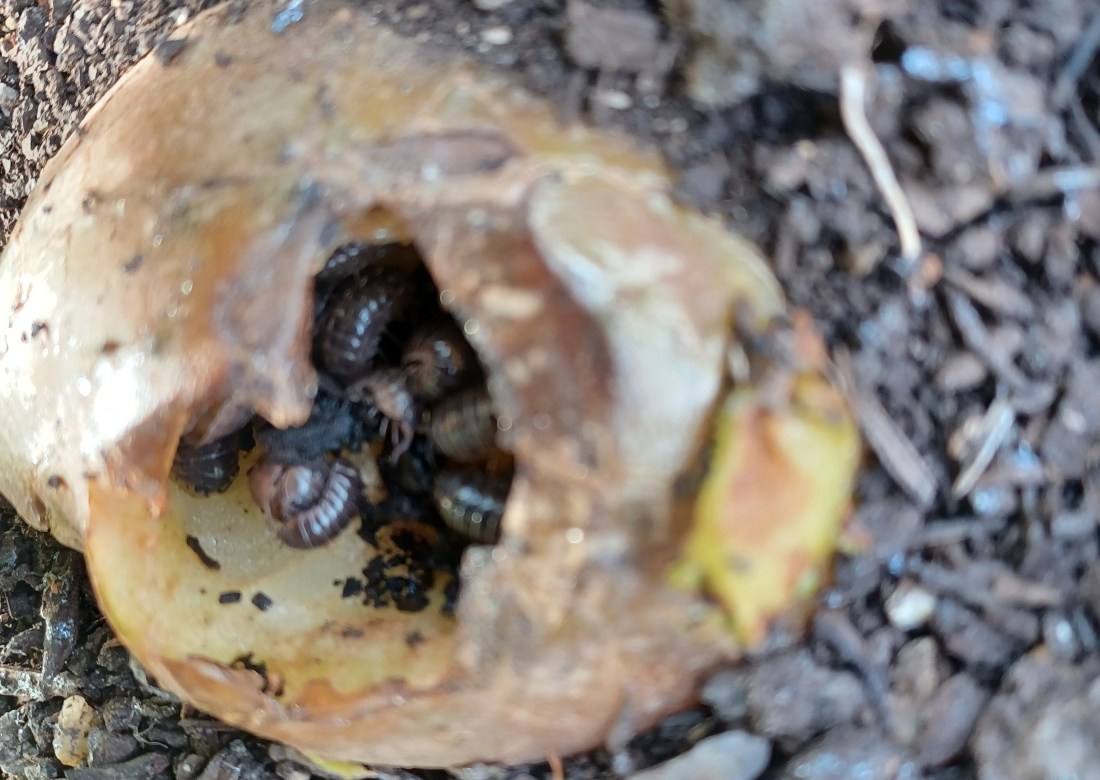
Armadillidiidae (photo by Lisa DeRosa)

Wee boy
Flipped a rock
Found a crawly
Picked it up
Watched it curl
Perfect ball
Rolling on his palm.
What a wonder.
Did you pop it
Into your nose
To keep it safe
To keep it close?

While I discourage this behavior, especially after a trip to the doctor to remove the little beastie, it did prove that Armadillidium vulgare, a terrestrial crustacean, can live quite happily in a dark, moist environment. (Yes, it was still alive when the doctor removed it.)

It was difficult to research A. vulgare. They are not considered agricultural pests. They are so common in our country that people take them for granted and mostly ignore them. They did not originate here though. Possibly as early as two-hundred million years ago,
sometime after the end of the Triassic period, tiny, gill-breathing crustaceans
crawled onto what would now be considered European shores and adapted to stay
land-bound. The species found in California, Armadillidium vulgare, is usually
bluish gray with plates that allow them to conglobate, or curl into a ball,
which they do for protection and water conservation. This species was
introduced to New England from mediterranean regions sometime during the
1800’s. I could not find any documentation about how they arrived in California.
Maybe they came during the Gold Rush.

Here's what we do know about them. They are nocturnal, and like dark moist places. They breathe with a gill system. Apparently, the hind-most set of their seven pairs of legs adapted to become air tubes that feed into a gill system on the underside of their body. They
roll into a ball to conserve moisture, because gills need wet surfaces to stay
healthy. One usually finds them under rocks, or leaf litter on moist ground, but
if you are a pet-keeper, it is a good idea to create some dry, warm places as
well, because they need an outside source of heat to regulate body temperature.
 

Pill bugs, or as they are commonly known in my area, roly-polies, are detritivores, consuming decomposing plants and animals. In terrarium conditions, they are helpful as they will also clean-up their own shed exoskeletons and any mold or fungus that grows in an enclosed, moist habitat.

Though not a pest, they will consume young plants. I learned the hard way that using leaf litter as a mulch only attracts them…By. The. Thousands. (Okay, maybe hundreds.) My point is nothing has a chance to grow with a large population of hungry decomposers who eat seedlings as dessert.

There have been some recent studies that claim that because they also eat fungi they help with global warming. Fungi release CO2 into the atmosphere as they perform decomposition
tasks. Armadillidiidae keep fungi populations in check, mitigating CO2 production.
Every little bit helps.

Another fun fact is that when they are cleaning up, they eat trace amounts of heavy metals, thereby preventing food plants from absorbing them. The more I learn about these little treasures, the more I am tempted to create attractions for them in my garden on purpose
instead of by accident.

Roly-polies are hatched about a week after fertilization into a brood sack on the underside of an adult female. Yes, they are marsupials. I was so thrilled to learn that. I now know that I have mammalian and crustaceous marsupials in my backyard. Yay!

The babies stay in the marsupial pouch for about two weeks. Upon exiting the pouch, these young ones molt every two weeks for about four and a half months, at which point they are considered adults. (I think. No source actually said that.) Females can store deposited sperm
for up to a year, picking the prime time for survival. This may be why some
sites claim the females can reproduce asexually. However, in my opinion, the
male courting dance seems quite elaborate: males wave their antennae at the
females to get their attention. Once they get it, they choose a mate. They then
lick and tap her to convey intention. In my mind, that refutes the notion that
females can reproduce asexually. It just seems that the male roly-poly uses a
lot of energy to get the female to like him. Why would she put up with that if she
could do it without him?

Even though I could not find much scientific research about them, because roly-polies are not agricultural pests, I had a great time researching pet sites on YouTube. Did you know they live three to five years? That’s plenty of time to form relationships with these
tiny creatures.

If you want to attract roly-polies, pile up some fallen leaves, or place a corn cob, half of a cantaloupe, or even a rotting potato outside in the shade. Leave whatever you have chosen in place for a few days, then move the waste along with scores of attracted pill bugs. I
have included links to videos that show how to set up a house for your newly
adopted pets.

Or, you can just let them mind your garden, knowing that this gift from the sea is protecting your land.

Sources Cited
https://entnemdept.ufl.edu/creatures/MISC/Armadillidium_vulgare.htm
https://www.pbs.org/newshour/science/pill-bugs-emerged-sea-conquer-earth
https://www.treehugger.com/roly-poly-pill-bug-facts-important-environment-4864410
https://en.wikipedia.org/wiki/Armadillidiidae
https://en.wikipedia.org/wiki/Armadillidium_vulgare

Videos
https://www.youtube.com/watch?v=Ij7VDu6iWCg
https://www.youtube.com/watch?v=9oUkDOI_QmI
https://www.youtube.com/watch?v=p-dTokDjn14   
(This is about A. vulgare in particular)

Playful Writing

I can’t remember the exact date I joined the writer’s group I belong to, but I am very grateful to belong to this collective. For those of you readers serious about writing, it is infinitely more fun to find support among like minded people who encourage, lovingly critique, and celebrate each others’ writing efforts. Because we meet weekly, I had binders full of not only ideas, some of which have bloomed into full stories, and even novels which I have published, but there were many that seemed complete just as they were. So many of my blog ideas come from these writings. I lost insight of that with the past crowding me. Now that it has been dealt with, I hope to share some of those overlooked pieces.

This bloomed a couple of years ago on 9/19/2022. For those of you who like numbers, 919 seen often can signify a change coming. Hopefully, the change for me is being able to write more often. 

Meditation Writing – Playful

What is it like to be in the center of a creative moment? Is it a swirling tornado careening across a plain, or a capricious dust dervish hopping over the sands of a desert?

Is it a roller coaster with screaming kids or a quiet walk in the forest? Did it toss you off a cliff, pound you under the surf, or did you float in a deep lake, sparkling with pricks of sunlight?

What is it like, the center of a creative moment?

Does time stop?

Does the world…disappear?

Does darkness creep around the perimeter of your head wondering,”What’s going on in there?”

Do you connect with More Than Self, or do you find connection with Self? Does it fill you with bubbling laughter, or crushing pathos? What is it? What is that center, the very center of a creative moment?

Does self bow to not-self as some mysterious impulse takes over to write itself?

What is it like…what IS it like…to be…in the center…of a creative…moment?

The second prompt of that night was “Lost in Passing Seasons.” Sometimes, the first few minutes are spent uselessly, as in this first attempt:

“Pass the seasons, please.”

“What? You don’t like the weather?”

“Huh? What’s that got to do with anything?”

“You just said, ‘Pass the seasons.’”

“Yes. Please.”

The best course of action is to scratch it out, or if you are typing into a computerized program, hit delete. Fortunately for us today, I always write by hand at these meetings, even when they are online. It gave me a chance to reject what I consider…c^@p! 

In and out of the garbage pail worked better that night:

Passing seasons.

Pass the seasoning.

Did you season the sauce?

She’s a seasoned warrior.

‘Tis the season to be jolly,

Have a holly, jolly Christmas

Pass the Christmas cheer

Pass on Christmas.

Happy New Year!

Finally:

A lion and a bear pass seasons differently.

It’s amazing what can be written in ten minutes, even if it never sees any life beyond the notebook you put it into. If you want to be a writer, just write. The more the merrier. Mary had a little lamb. Lamb chops, chopsticks, stick in the mud, or in your eye, or better yet: Stick to it. Just write.